Monthly Archives: March 2013

Video: Organic Gardening Spring Kick Off – Recorded Version

Join hosts Holly and Joey Baird, along with myself and several other guests for this recorded version of a LIVE Google Hangout on Organic Gardening. Subscribe to the Wisconsin Vegetable Garden Podcast YouTube Channel or Circle their Google+ page.

Live Today: Organic Gardening Spring Kick Off Google+ Hangout with Douglas and The Wisconsin Vegetable Garden Podcast

Join hosts Holly and Joey Baird, along with myself and several other guests for this LIVE Google Hangout on Organic Gardening. Subscribe to the Wisconsin Vegetable Garden Podcast YouTube Channel or Circle their Google+ page to be notified of the show. I’ll also post the live feed here on A Gardener’s Notebook on the evening of the show, so you can watch right from here.

Watch LIVE this Saturday, March 30 at 5PM PDT / 6PM MDT / 7PM CDT / 8PM EDT

Other guests include Jen Hammer, Kerrie & Carol from The Seedkeeper Company, Annie Haven, and Bruce Bailey

6 Years Ago: Video: Windy in the San Fernando Valley, Los Angeles, CA

windy-thumb

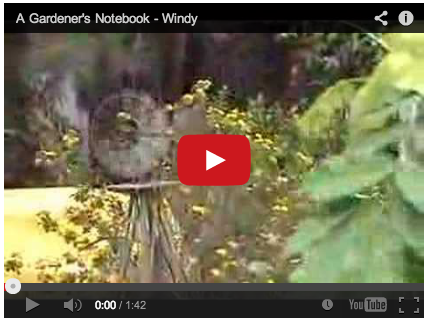
It was quite a windy day in the San Fernando Valley 6 years ago. I remember that Spring when we had a lot of wind damage around the area, although thankfully not in our garden.

This video also points of the state of online video 6 years ago. Today I do everything in HD, but this was shot using an older camcorder and uploaded to YouTube at 360 pixels. How things have changed.

Garden Alphabet: California Poppy (Eschscholzia californica)

California Poppy (Eschscholzia Californica)

Garden Alphabet: California Poppy | A Gardener's Notebook with Douglas E. Welch

Eschscholzia californica is the state flower of California, our native poppy is seen everywhere at this time of year. In past years, we have visited the Antelope Valley California Poppy Reserve just north of us in Lancaster, California. Unfortunately, according to a story in today’s Los Angeles Times (California poppies are a no-show in Lancaster, but festival goes on) there won’t be much of a bloom at the Reserve this year. These poppies were found in a neighbor’s garden during a walk this week. I have tried growing them here, but haven’t had much success for an unknown reason. They are said to be somewhat fussy to cultivate, but I see them in many gardens, so I wonder if that fussiness is exaggerated.

“It is a perennial or annual growing to 5–60 in (13–150 cm) tall, with alternately branching glaucous blue-green foliage. The leaves are ternately divided into round, lobed segments. The flowers are solitary on long stems, silky-textured, with four petals, each petal 2 to 6 cm (0.79 to 2.4 in) long and broad; flower color ranges from yellow to orange, with flowering from February to September. The petals close at night or in cold, windy weather and open again the following morning, although they may remain closed in cloudy weather.[1] The fruit is a slender, dehiscent capsule 3 to 9 cm (1.2 to 3.5 in) long, which splits in two to release the numerous small black or dark brown seeds. It survives mild winters in its native range, dying completely in colder climates.” — Wikipedia.org

 
More information on the California Poppy (Eschscholzia californica):

Previously in Garden Alphabet:

Garden History: Santa Barbara Mission, 2201 Laguna Street, Santa Barbara, California. (LOC)

Just 1.5 hours up the highway from us here in Los Angeles, the Santa Barbara Mission gardens are as welcoming today as they were back in 1917 when this photo was taken. Described as the “Queen of the Missions”, Santa Barbara has been nearly destroyed several times in its long history. Earthquakes on 1812 and 1925 threatened to bring down its stone walls and, in some cases, succeeded.

The mission gardens are a cool respite on a hot Southern Californian day and while there are few friars these days, the building and gardens continue their long tenure on the hill top to the north of the city.

“Mission Santa Barbara, also known as Santa Barbara Mission, is a Spanish mission founded by the Franciscan order near present-day Santa Barbara, California. It was founded by Padre Fermín Lasuén on December 4, 1786, the feast day of Saint Barbara, as the tenth mission for the religious conversion of the indigenous local Chumash—Barbareño tribe of Native American people. The mission is the namesake of the city of Santa Barbara as well as Santa Barbara County.

The Mission grounds occupy a rise between the Pacific Ocean and the Santa Ynez Mountains, and were consecrated by Father Fermín Lasuén, who had taken over the presidency of the California mission chain upon the death of Father Presidente Junípero Serra. Mission Santa Barbara is the only mission to remain under the leadership of the Franciscan Friars since its founding, and today is a parish church of the Archdiocese of Los Angeles.” – Wikipedia

Santa Barbara Mission, 2201 Laguna Street, Santa Barbara, California. (LOC)

Santa Barbara Mission, 2201 Laguna Street, Santa Barbara, California. (LOC)

Johnston, Frances Benjamin,, 1864-1952,, photographer.

[Santa Barbara Mission, 2201 Laguna Street, Santa Barbara, California. Friar in the garden court]

[1917 spring]

1 photograph : glass lantern slide, hand-colored ; 3.25 x 4 in.

Notes:
Site History. Built for Father Antonio Paterna, 18th century, rebuilt from 1815. Landscape: Junipero Serrra; Francisco de Lasuén. Today: Extant.
Slide used with lecture “California Gardens.”
Title, date, and subject information provided by Sam Watters, 2011.
Forms part of: Garden and historic house lecture series in the Frances Benjamin Johnston Collection (Library of Congress).
Published in Gardens for a Beautiful America / Sam Watters. New York: Acanthus Press, 2012. Frontispiece plate for Gardens of the West section.

Rights Info: No known restrictions on publication.

Repository: Library of Congress, Prints and Photographs Division, Washington, D.C. 20540 USA,hdl.loc.gov/loc.pnp/pp.print

Higher resolution image is available (Persistent URL): hdl.loc.gov/loc.pnp/ppmsca.16051

Call Number: LC-J717-X97- 52

Previously in Garden History:

Video: In the garden…March 27, 2013 – No green potatoes and some flowers are blooming

“In the garden…” is a series for A Gardener’s Notebook highlighting what is happening in my garden, my friend’s gardens and California gardens throughout the seasons.

Hilling the potatoes more to prevent greening and a look at some flowers that are blooming in the garden today.

Watch all the past “In the garden…” videos in this YouTube playlist.


Please Like this video and/or subscribe to my channel on YouTube.

Your likes and subscriptions directly reflect how many other viewers are suggested this video.

Garden Decor: Acorn Wind Chime

Acorn Wind Chime

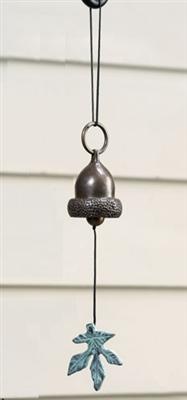
I have always liked wind chimes in my garden and I have several there already. That said, this acorn wind chime caught my attention on Pinterest today. I like its simplicity and I can imagine the single clear tone it would create. I like the colors, as well. I have never been one for bright colors in the garden, beyond the flowers themselves, of course.

acorn-wind-chime

Follow Me on Pinterest

Previously in Garden Decor:

From the archives: Look More Closely – October 17, 1999

Look More Closely

Gardens are a curious thing. Sometimes I am looking at my garden as a whole, trying to develop overall themes and designs. Sometimes I am focused on one plant as I move it from one area to another or try and nurture it back to health. Sometimes, though, I can go for weeks or months without ever really “seeing” my garden. I have several ways of re-connecting with my garden and one involves the combination of gardening with another of my hobbies, art.

Sketch of Oak TreesDrawing is seeing

An ancient artist once said that you never really see anything unless you draw or paint it. The attention required in developing a representation of something requires us to regard it as never before. We alternately jump from the concrete to the abstract as we draw petal and leaf, root and branch. These mental leaps can lead us to a deeper understanding of whatever we are drawing.

I know what you are thinking. “I can’t draw. I can’t paint! He must be crazy!” While I am a little daft in some ways, I have learned that anyone can draw and anyone can paint. More importantly, the level of your skill really doesn’t matter at all. Just as a writer’s journal is something private, your sketches can be for your eyes only. Even more, the act of drawing itself is more important than the results. The goal of sketching in the garden is to see things more clearly not necessarily make a perfect reproduction of them on paper.

Paint out

If you are looking for an interesting garden party idea take a hint from an art coach friend of mine and schedule a “paint out.” You can host a paint out in your own garden, a friend’s garden or some public place. It is very simple to organize. Merely get a bunch of your friends together with pad and pencil and start to draw. You can each draw something different in the garden or you can all draw the same tree or plant. It is amazing how we can each see something different in the same rose, the same daisy, the same tree. Remember, the process is more important than the results. Notice how you approach the drawing. Are you drawing the plant or merely how you think the plant should be drawn? Look closely at whatever you are drawing but forget what it is . Instead of a petal it is a combination of pink and white light. Instead of a leaf, it is a construction of veins and edges.

Sketch of flower vaseSketch, don’t shoot

Sketching can be especially useful when you are visiting gardens. Instead of taking photographs, make a sketch instead. You will be surprised at how much more you remember about the garden later. The act of sketching, like taking notes in class, helps to lock the memory tighter in our mind. It also helps to distill the scene into its more important parts. When sketching, we unconsciously and consciously leave out the lesser parts to concentrate on that which most interests us.

You don’t need to go to the lengths of Monet, who created his own garden as a source for his artwork. Sketching and painting in your garden can open up a whole new world of possibilities for you, both in gardening and art.

Interesting Plant: Rosa banksiae (Lady Banks’ Rose)

Interesting Plant: Rosa banksiae (Lady Banks’ Rose)

Rosa banksiae (Lady Banks' Rose)

Rosa banksiae (Lady Banks' Rose)

Click for larger images

Interesting Plant: Rosa banksiae (Lady Banks’ Rose)

“Rosa banksiae, commonly referred to as the Lady Banks’ Rose, is a species of Rosa native to central and western China, in the provinces of Gansu, Guizhou, Henan, Hubei, Jiangsu, Sichuan, and Yunnan; it grows in mountains at altitudes of 500–2200 m.

It is a scrambling shrubby liana growing vigorously over other shrubs to 6 m tall. Unlike most roses, it is practically thornless, though may bear some prickles up to 5 mm long, particularly on stout, strong shoots. The leaves are evergreen, 4–6 cm long, with three to five (rarely seven) leaflets 2–5 cm long with a serrated margin. The flowers are small, 1.5-2.5 cm diameter, white or pale yellow.
There are two varieties:[2]

Rosa banksiae var. banksiae. Flowers semi-double or double, with numerous petals replacing most or all of the stamens; a cultigen developed in Chinese gardens.

Rosa banksiae var. normalis Regel. Flowers single, with five petals; the natural wild form of the species.
The rose is named after Lady Banks, the wife of the eminent botanist Sir Joseph Banks (after whom the Banks Peninsula is named).”  — 
Wikipedia.org

I came across this amazing specimen of Rosa banksias growing at my son’s high school. I hadn’t noticed it previously, but it covers an entire wall from the ground floor and scrambles up on the patio above. It was in gorgeous bloom this weekend and I had to grab a couple of photos to share. i would love to have one of these in my garden, but I am not sure where I could it plant it. My garden is quite shay and this rose obviously benefits from a full sun exposure, as most roses do.

Follow Me on Pinterest

More information on Primula ‘Victoriana Silver Laced Black’:

Previously in the Interesting Plant series: