Today in the garden…
Monthly Archives: March 2013
Video: Container Garden Update 20: Slow going and some frugal lettuce
The containers are slowing down as the hot days arrive here in Los Angeles. A lettuce root from the store provides both lunch and a new start in a container.
What’s happening in your garden? I’d love to know! Leave your questions and comments here or on any of the web and social media sites linked below!
Can’t see the video above? Watch “Container Vegetable Garden Update 20” on YouTube
Watch the “Container Vegetable Garden” Playlist for all related videos
Please like this video and/or subscribe to my channel on YouTube. Your LIKES directly effect how many others will see this video.
Music: “Whiskey on the Mississippi” Kevin MacLeod (incompetech.com) – Licensed under Creative Commons: By Attribution 3.0
- Follow A Gardener’s Notebook on Pinterest
- Follow A Gardener’s Notebook on Twitter
- Like A Gardener’s Notebook on Facebook
- Circle A Gardener’s Notebook on Google+
- Subscribe to A Gardener’s Notebook podcast via iTunes
Podcast: Play in new window | Download
Subscribe: RSS
Books on Hold: The Drunken Botanist : The plants that create the world’s great drinks
Books on Hold is a blog series dedicated to books I have seen in passing and requested from my local library. See more in the series at the end of this blog post. — Douglas
The drunken botanist : the plants that create the world’s great drinks
From Amazon.com…
“Sake began with a grain of rice. Scotch emerged from barley, tequila from agave, rum from sugarcane, bourbon from corn. Thirsty yet? In The Drunken Botanist, Amy Stewart explores the dizzying array of herbs, flowers, trees, fruits, and fungi that humans have, through ingenuity, inspiration, and sheer desperation, contrived to transform into alcohol over the centuries.
Of all the extraordinary and obscure plants that have been fermented and distilled, a few are dangerous, some are downright bizarre, and one is as ancient as dinosaurs—but each represents a unique cultural contribution to our global drinking traditions and our history.
This fascinating concoction of biology, chemistry, history, etymology, and mixology—with more than fifty drink recipes and growing tips for gardeners—will make you the most popular guest at any cocktail party.”
Previously in Books on Hold:
- Contagious: Why Things Catch On by Jonah Berger
- Salty Snacks: Make Your Own Chips, Crisps, Crackers, Pretzels, Dips, and Other Savory Bites
- Pancake: A Global History
- Breakfast for Dinner: Recipes for Frittata Florentine, Huevos Rancheros, Sunny-Side-Up Burgers, and More!
- Blog, Inc.: Blogging for Passion, Profit, and to Create Community by Joy Deangdeelert Cho
- Nigellissima: Easy Italian-Inspired Recipes by Nigella Lawson
- Just Start: Take Action, Embrace Uncertainty, Create the Future
- Meatless: More Than 200 of the Very Best Vegetarian Recipes (Martha Stewart Living)
- How to Boil An Egg by Rose Carrarini
- Dirt Candy: A Cookbook: Flavor-Forward Food from the Upstart New York City Vegetarian Restaurant by Amanda Cohen
- See more Books on Hold here!
Garden Inventory: Lantana
Garden Inventory is a series where I begin an inventory of all the plants and trees in my garden. Along with some of my own pictures, I will link to various sources of information about each plant and tree so we can learn a little more together.
I would also like to highlight your special plants and tress. Pass along your favorite plants in the comments and I will use them for future Garden Inventory posts. — Douglas
Garden Inventory: Lantana
“Lantana is a genus of about 150 species of perennial flowering plants in the verbena family, Verbenaceae. They are native to tropical regions of the Americas and Africa but exist as an introduced species in numerous areas, especially in the Australian-Pacific region. The genus includes both herbaceous plants and shrubs growing to 0.5–2 m (1.6–6.6 ft) tall. Their common names are shrub verbenas or lantanas. The generic name originated in Late Latin, where it refers to the unrelated Viburnum lantana.[2]
Lantana’s aromatic flower clusters (called umbels) are a mix of red, orange, yellow, or blue and white florets. Other colors exist as new varieties are being selected. The flowers typically change color as they mature, resulting in inflorescences that are two- or three-colored. — Wikipedia.org
Lantana are a quite common landscaping plant here in Southern California and you are liable to see a wide variety simply driving around town. I have two types here — a yellow/gold variety with an upright habit that was here when we bought the property and a sprawling prostrate purple variety which I added to the streetside bed a few years ago. While I am happy with the upright habit lantana, the prostrate ones can quickly take over an area and smother out the other plants. I have cut back my purple lantana dramatically recently and will probably remove them entirely, to be replaced with more manageable and enjoyable lavender.
Some people find the smell of lantana horrible and can’t stand it in their garden. While it is indeed pungent, I don’t find it objectionable. There have also been reports of contact dermatitis (rash) in certain people when they handle or brush against the plant, so use caution if you think you might be sensitive to the plant.
Photos of Lantana with closeups of flowers, leaves, growing habit, and stems.
More information on Lantana:
- Lantana at Wikipedia
- Lantana at the Center for Aquatic and Invasive Plants, University of Florida
- Lantana at About.com
- Lantana at Pinterest.com
Previously on Garden Inventory:
Garden Budget: Plants and Supplies for March 2013
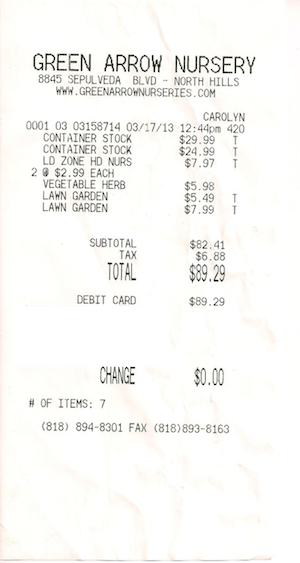
I have decided to start spending a certain budget each month on improving the garden (~$100) and then blogging about it here on A Gardener’s Notebook. March starts the first month in the series and I am beginning by trying to “re-green” the back garden, which has suffered with over planting and too much shade since we first moved in 16 years ago. I didn’t get pictures of everything this time, but I’ll make sure to do better in future installments, including labels and such.

It is a little hard to tell from the receipt (and I think the checker might have missed some items), but here is what I picked up this month.
- False Aralia: 5 gallon
- Schefflera: 5 gallon
- Aucuba: 1 gallon (2)
- Worm Castings (2)
- Watering Can
- Basil (2)
- Nasturtium Seeds
Here are some photos of the plants installed in the garden. Click for larger images.
You can see installing these plants in the video below:
Garden Alphabet: Freesia
Freesia
We have two types of Freesia that arrive in the garden each Spring. They don’t get quite enough sun and so they are quite “floppy”, but they return every year like clockwork
“Freesia is a genus of around 16 species of flowering plants in the family Iridaceae, native to the eastern side of southern Africa, from Kenya down to South Africa,[1] most species being found in Cape Province.[citation needed] Species of the former genus Anomatheca are now included in Freesia.[1] The plants commonly known as “freesias”, with fragrant funnel-shaped flowers, are cultivated hybrids of a number of Freesia species. Some other species are also grown as ornamental plants.” — Wikipedia.org
More information on the Freesia:
Previously in Garden Alphabet:
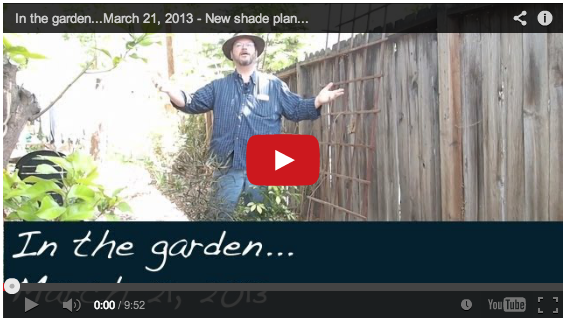
Video: In the garden…March 21, 2013 – Planting new shade plants and discovering a “pond” in the garden
“In the garden…” is a series for A Gardener’s Notebook highlighting what is happening in my garden, my friend’s gardens and California gardens throughout the seasons.
I plant 2 Aucuba, a Schefflera and an aralia to start the “re-greening” of the back garden, but I also find a small “pond” in the area I wanted to plant. Looks like a broken irrigation line has been leaking. Oh oh!
Watch all the past “In the garden…” videos in this YouTube playlist.
Please Like this video and/or subscribe to my channel on YouTube.
Your likes and subscriptions directly reflect how many other viewers are suggested this video.
- Follow A Gardener’s Notebook on Pinterest
- Follow A Gardener’s Notebook on Twitter
- Like A Gardener’s Notebook on Facebook
- Circle A Gardener’s Notebook on Google+
- Subscribe to A Gardener’s Notebook podcast via iTunes
Podcast: Play in new window | Download
Subscribe: RSS
Garden History: Your victory garden counts more than ever!
It isn’t just during times of war that your Victory Garden counts. I wish that they had never gone out of style. Once food rationing finished and food was freely available again, most returned to there previous ways of life. Pity. Gardening brings so much more than just food. It can bring health, heart and happiness to anyone who engages in it. Imagine if the concept of a Victory Garden never went away. We wouldn’t have to be trying to resurrect urban gardening as we are today. It would have never gone away. In today’s Victory Garden, the “victory” isn’t in the war, but rather the victory of reacquiring something that should have never been lost in the first place.
Your victory garden counts more than ever!
File name: 07_01_000035
Title: Your victory garden counts more than ever!
Creator/Contributor: Morley, Hubert (artist); United States. War Food Administration (sponsor)
Created/Published: U. S. Government Printing Office
Date issued: 1945
Physical description: 1 print (poster) : color
Summary: Vegetables in foreground, man plowing, woman kneeling in garden in background.
Genre: War posters
Subjects: Victory gardens; Agriculture; Food supply
Notes: U.S. Government Printing Office : 1945–O-629743
Location: Boston Public Library, Print Department
Previously in Garden History:
- “Villa Sciarra,” George Wurts house, via Calandrelli, Rome, Italy. (LOC)
- Whitworth Gardens, Darley Dale, Derbyshire, England
- John & Lizzie Wilson from Boston in Bradenton, Florida, 1951
- Paris Exposition: gardens, Paris, France, 1900
- Wisteria blooms in Davis Garden (Locust Valley, New York), 1930
- “Killenworth,” George Dupont Pratt house, Glen Cove, New York, ca. 1918
- A Garden Under Glass, Nice, France, c1865-1895
5 Years Ago: Photos: Lake Balboa Cherry Trees 2008
I try to get out to to shoot pictures of the Japanese Cherry Trees at Lake Balboa, but didn’t make it out this year, unfortunately. Still, Timehop is great at reminding me of past events and these photos from 2008 popped up in my feed. It looks like it was a really nice bloom that year. Click the photo to link to the entire series. I have also included a slide show in this post to show you all the photos.
Garden Decor: Potting bench from old door
Potting bench from old door
I am always on the look out for a door like this — complete with the windows. I have one older door in the garden that could probably be re-purposed, but it is solid and very narrow — coming from the original, pre-ADA code part of our 1943 house. Still, maybe I can put it to use by doing something like this. Thinking, thinking, thinking…(SMILE)
Previously in Garden Decor: