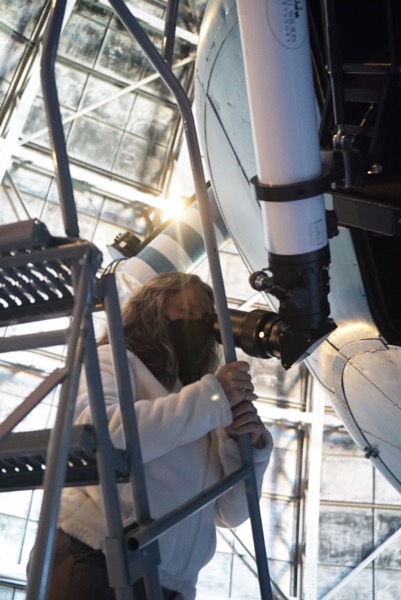
Video: 3 Years Ago: LA Friday Coffee at Griffith Observatory, Griffith Park, Los Angeles
A flashback to March 2010 when LA Friday Coffee visited the Griffith Observatory, Griffith Park, Los Angeles.
Here is a review list of all the videos I produced in January 2013.
You can find all my past videos on my YouTube Channel. If you enjoy a video, please click the Like button or Subscribe to the YouTube Channel. Doing that directly effects how many other people will see the video.
In the garden…Onions Sprouting !
Container Garden Update 11 – Frost in the San Fernando Valley of Los Angeles
In the garden…January 13, 2013 – Potato Planting Project
Container Garden Update 12 – A new pot of lettuce
In the garden…January 24, 2013 – Rain, rain, rain
Set Minimum Text Size in Safari 6 and Chrome 24
In the garden…with Vine for iPhone
Container Garden Update 13 – Seedlings
Installing iOS Updates on your iPhone and iPad
In the garden…January 30, 2013 – Potato!

A Year of Self Preservation with Douglas E. Welch @ Tuesdays with Transitioners
Tuesday, February 19, 2013, 12 Noon to 2 pm
Congregational Church of Northridge
9659 Balboa Blvd, Northridge, CA
Please RSVP on
It is a fact of nature that we often spend many hours of each day focused on someone else. We focus on our boss, our job, our family, our projects — but one person is usually left out of this focus — you! We can easily lose ourselves in the clamor for our attention. This year, though, I call for “A Year of Self Preservation”. A year of returning the focus to ourselves and our own lives, so that we can continue to help others.
It is my firm belief that we can only, truly, help others when we ourselves are in a good position. If we try to do too much, without the support of friends, family or a stable income, we risk placing our own life, work and income in jeopardy. This isn’t selfishness. Self preservation is about establishing a firm foundation where you can stand so you can offer a helping hand to others.
The tenets of A Year of Self Preservation are:
Join Douglas at Tuesdays with Transitioners and see how you can make 2013 the best year possible.
Books on Hold is a blog series dedicated to books I have seen in passing and then requested from my local library. See more in the series at the end of this blog post. — Douglas
The Layered Garden: Design Lessons for Year-Round Beauty from Brandywine Cottage
From Amazon.com…
“Brandywine Cottage is David Culp’s beloved two-acre Pennsylvania garden where he mastered the design technique of layering — interplanting many different species in the same area so that as one plant passes its peak, another takes over. The result is a nonstop parade of color that begins with a tapestry of heirloom daffodils and hellebores in spring and ends with a jewel-like blend of Asian wildflowers at the onset of winter.
The Layered Garden shows you how to recreate Culp’s majestic display. It starts with a basic lesson in layering — how to choose the correct plants by understanding how they grow and change throughout the seasons, how to design a layered garden, and how to maintain it. To illustrate how layering works, Culp takes you on a personal tour through each part of his celebrated garden: the woodland garden, the perennial border, the kitchen garden, the shrubbery, and the walled garden. The book culminates with a chapter dedicated to signature plants for all four seasons.
As practical as it is inspiring, The Layered Garden will provide you with expert information gleaned from decades of hard work and close observation. If you thought that a four-season garden was beyond your reach, this book will show you how to achieve that elusive, tantalizing goal.”
Previously in Books on Hold:

In the course of my days, weeks and months, I do a lot of reading. I read blogs, I read, web sites, I read Twitter and Facebook and Google+, but I also read a LOT of books. Usually these books focus on some aspect of business, innovation, thinking, gardening or food. I am always looking for new ideas, new ways of thinking and new ways to jumpstart my own thinking.
Over the last few years, though, I have become frustrated with may books — especially those involving business and/or innovation. Whether a factor of the book publishing process, editorial advice or writer insecurity, I am seeing a few fundamental flaws in the books I am reading (or trying to read) today.
1. Excessive attempts to prove the writer’s or the book’s worth to the reader
Several books in the last few months have spent the major it of their length in the writer justifying why the book should be written and why they should write it. Frankly, I don’t care. If I pick up a book, I do so because I know the writer’s past work or the topic of the book interests me in some way. I don’t care about your degrees, your past publications, the status of your co-authors or even how to you came to write the book. I am reading to discover what new thoughts you have developed and, more importantly, how they might help me. You have already earned me as a reader, don’t waste my time trying to prove to me what I am already doing — namely, reading your book.
Keep the justifications to a minimum (along with chapter length acknowledgement sections) and tell me your ideas. If you don’t, you might lose me a reader before I ever hear what important things you have to say.
2. Excessive review of supporting materials
I come to a book to hear what you (the author) have to say, not what everyone else in the past 5 decades has had to say. If I feel I need more supporting information for your ideas or arguments, I can go and find additional material on my own. In fact, if I am interested in the topic of your book, I have probably read much of the supporting material you address or at least have passing knowledge of it. Again, I am reading YOUR book to hear YOUR ideas, not a general review of the topic.
If you feel you must, use footnotes to direct me to additional material I might find interesting or important. Trust me — and other readers — enough to give your book the chance it deserves without trying to bury us in overwhelming supporting material. We can’t be forced to read your book, only encouraged to read it through the power of your ideas.
GET ON WITH IT!
If you truly have an idea worth sharing in a book, then GET ON WITH IT! Enough waffling and hemming and hawing and supporting and proving. Tell me what is so important that you have to say it in a book.
If you were telling me your idea face-to-face, you wouldn’t spend hours giving me all the background first. I would simply walk away. That is exactly what I will do with a book that does the same thing. You can interweave the supporting material if you think it important, but when I read your book I want to hear what you have to say about a topic.
Why do so many books fall victims to these errors?
It is my belief that it all has to do with insecurity. The writer is insecure in their ideas and so tries to include every supporting study and report they can find. The editor is insecure in selling the book unless they provide some sort of overwhelming proof that it deserves your attention. The publishing company is insecure that a book can be written or sold in any way other than the traditional methods.
The truth is, all this insecurity wastes the reader’s time and convinces them of the exact opposite message of the one the writer, the editor and publisher are trying to convey. When faced with these errors, readers simply abandon the book. Sure, we might try to flip ahead to see if we can find the “meat” of the book, bit in most cases I will simply look elsewhere.
Authors, trust in yourself, your message, your writing and your book. If you have something important to say, readers will notice and acknowledge it. If you feel you have to justify your book and the thoughts within to a large degree, you may want to think more deeply about your ideas, instead.

I have a lot of interests, as most of you already know. Therefore, I have a lot of different blogs, events, and groups in my portfolio of online engagements. I also try to make myself available wherever people want to converse. This means that each of my interests usually has multiple presences on the Internet.
Here is a list of almost all of the ways you can talk with me and learn about what is happening in my life and work. You don’t need to, nor should you, try to subscribe to all of them. That would only lead to you seeing multiple copies of the same information. Rather, pick and choose whatever ways you would like to consume my “content.” If you are a heavy Facbeook user, you might want to join my pages there. Is Google+ catching your fancy? I have a home over there, too. Maybe email is your thing? No problem, almost all of my content can be emailed directly to your Inbox.
My goal is to make my content available in whatever way makes the most sense to you. It also means you can contact me and converse with me on your favorite online services. This list is also broken down by interest. If you want to see everything I post and share, the first section is where you can find it. This will contain information from all my areas of interest including events, careers, gardening, technology and my organizations.
Maybe, though, you are only interested in my gardening information. You can narrow your reading to my gardening blog or Facebook page. The same applies for careers, technology and my organizations. Select whatever is most interesting, and valuable, to you.
Thank you for supporting me, my blogs and podcasts and my organization over the years! I look forward to talking with you — and sharing more with you — in 2013.
Cognitive Surplus: Creativity and Generosity in a Connected Age by Clay Shirkey
I am in the midst of reading this book and enjoying it a lot Shirley seeks to provide some background as to why people volunteer their time and energy on various Internet-conncected pursuits as varied as online communities, sharing Instagram photos and raising money for charities online. I am finding that I am highlighting quite a few sections to consider later, as I read.
It is important for every careerist to understand how this new hyper-connected world effects not only what we do, but who we are. Understanding the tools and the motivations that drive their use is a great career advantage that should not be ignored.
From Amazon.com…
“The author of the breakout hit Here Comes Everybody reveals how new technology is changing us for the better.
In his bestselling Here Comes Everybody, Internet guru Clay Shirky provided readers with a much-needed primer for the digital age. Now, with Cognitive Surplus, he reveals how new digital technology is unleashing a torrent of creative production that will transform our world. For the first time, people are embracing new media that allow them to pool their efforts at vanishingly low cost. The results of this aggregated effort range from mind-expanding reference tools like Wikipedia, which allows Kenyans to report acts of violence in real time. Cognitive Surplus explores what’s possible when people unite to use their intellect, energy, and time for the greater good.”
More 2012 Gift Guide Items:
Kylee Baumlee over at Our Little Acre (and fellow Saturday6 members) posted this plant press to her own Gardening Gift Guide and it quickly reminded me of the one my son and I would use when he was very young. He loved to collect flowers from the garden and press them to preserve them for later. This press adds the convenience of being microwave safe, meaning you can dry flowers quickly and, according to the description, maintain more of their color and shape, than traditional pressing.
More 2012 Gift Guide Items:
Kylee Baumlee over at Our Little Acre (and fellow Saturday6 members) posted this plant press to her own Gardening Gift Guide and it quickly reminded me of the one my son and I would use when he was very young. He loved to collect flowers from the garden and press them to preserve them for later. This press adds the convenience of being microwave safe, meaning you can dry flowers quickly and, according to the description, maintain more of their color and shape, than traditional pressing.
More 2012 Gift Guide Items:
Twine Internet Sensor (Pre-order)
Your friend will have to wait to get this gift, but it could be a cool introduction into “The Internet of Things”. This is a world where everything talks to everything and everything talks to you. Tires on your car need replacing or maintenance — they send you a message. Garden needs watering — ping goes an alert. The possibilities are endless.
The Twine is the first of what is sure to become many devices that facilitate this communication. Each unit has a built-in temperature sensor and orientation accelerometers, so they can tell when they change orientation or are moved in any way. You then use a web-based interface to create rules to notify you on specific events. Did the mailbox open and close? Send an alert to pick up the mail. Is the temperature approaching freezing? Receive an alert to bring in your sensitive plants. Twine plans additional sensors that can be added to the original Twine that include a magnetic sensor and moisture sensor.
I am sure we will see many more devices like this in the future, but with Twine you can be on the truly leading edge of technology.
Pre-Order from the SuperMechanical web site