Previously in my Instagram Photos…
Monthly Archives: March 2014
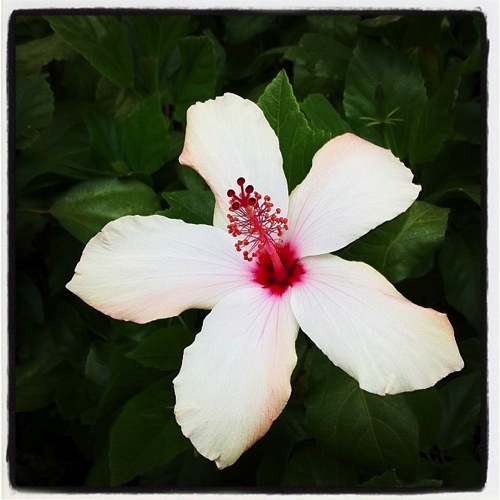
Photo: Pink Hibiscus via #instagram
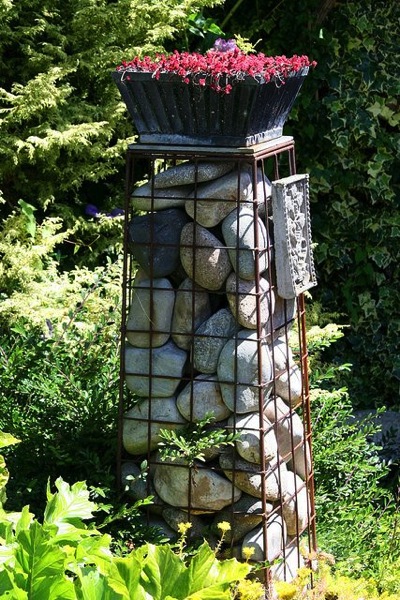
Garden Decor: River Rock Pillar
Rock and stone hardscape in the garden always provides a great counterpoint to the soft and green plantings. This river rock pillar adds a rusted steel cage and a perfect setting for a container on top, too. The innovative use of individual stones instead of concrete gives it huge visual interest. This could act as a focal point in the garden or you could use multiple pillars, linked with rustic fencing to enclose an area of the garden.
Discovered via Pinterest User Dianne Hollister
More rock and stone ideas from Amazon.com:
- Driftwood Succulent Planter
- Crema Piatto Bird Bath
- Brick Garden Shed
- Over-the-top Garden Shed
- 30 Amazing Downspout Ideas
- Garden gate made from re-purposed tools
- Moss Buddha via Tumblr
- Shovel Head Daisy
- A ladder in the garden
- Alice’s Tea Party Sculpture
- DIY Log Birdfeeder
- Amazing river stone mosaic path
- Straw Bale Sofa
- DIY: My Lowe’s Creative Ideas Pallet Project from Our Little Acre
- The Bird sNest Box by All Lovely Stuff
- Decorative Garden Trellis become a Tuteur (garden tower)
- Japanese Garden Water Fountain
- Acorn Wind Chime
- Potting bench from old door
- Tolkein-esque garden door
Interesting Plant: Japanese Maple (Acer palmatum)
Growing up in rural Ohio, I was surrounded by maple trees of all shapes and sizes. There were the huge 100+ year old maples that overarched the main streets and also the large “sugar bush” lots where maple sap (and then maple syrup) remerged each Spring. When I moved to Los Angeles 28 years ago, I was somewhat disappointed that maples were few and far between here. The traditional east coast maple trees do not grow well here at all, requiring a period of deep cold to thrive. After several years, though, I discovered a new maple to love, the Japanese Maple (Acer palmatum). I have come to love these maples even more than those in my native state. They come in an almost infinite array of shapes, sizes, leaf coloration and shape and, thankfully, grow quite well here in Southern California. If I ever have the chance to start a garden from scratch, I would certainly use Japanese Maple as the focal points.
Acer palmatum, called Japanese Maple or Smooth Japanese Maple (Japanese: irohamomiji, イロハモミジ, or momiji, 紅葉) is a species of woody plant native to Japan, North Korea, South Korea, China, easternMongolia, and southeast Russia.[2] Many different cultivars of this maple have been selected and they are grown worldwide for their attractive leaf shapes and colours.
Acer palmatum is a deciduous shrub or small tree reaching heights of 6 to 10 m (20 to 33 ft), rarely 16 metres (52 ft), often growing as an understory plant in shady woodlands. It may have multiple trunks joining close to the ground. In habit, it is often shaped like a hemisphere (especially when younger) or takes on a dome-like form, especially when mature.[3] The leaves are 4–12 cm long and wide, palmately lobed with five, seven, or nine acutely pointed lobes. The flowers are produced in small cymes, the individual flowers with five red or purple sepals and five whitish petals. The fruit is a pair of winged samaras, each samara 2–3 cm long with a 6–8 mm seed. The seeds of Japanese maple and similar species require stratification in order to germinate.[3][4]
Even in nature, Acer palmatum displays considerable genetic variation, with seedlings from the same parent tree typically showing differences in such traits as leaf size, shape, and colour.[3]
Three subspecies are recognised:[3][4]
- Acer palmatum subsp. palmatum. Leaves small, 4–7 cm wide, with five or seven lobes and double-serrate margins; seed wings 10–15 mm. Lower altitudes throughout central and southern Japan (not Hokkaido).
- Acer palmatum subsp. amoenum (Carrière) H.Hara. Leaves larger, 6–12 cm wide, with seven or nine lobes and single-serrate margins; seed wings 20–25 mm. Higher altitudes throughout Japan and South Korea.
- Acer palmatum subsp. matsumurae Koidz. Leaves larger, 6–12 cm wide, with seven (rarely five or nine) lobes and double-serrate margins; seed wings 15–25 mm. Higher altitudes throughout Japan. — Wikipedia.org
Previously in the Interesting Plant series:
- Kousa Dogwood (Cornus kousa)
- Giant Chalk Dudleya (Dudleya brittonii)
- Sunrose (Helianthemum nummularium)
- Australian/New Zealand Tea Tree (Leptospermum scoparium)
- Brugmansia Sanguinea
- Calico Monkeyflower (Mimulus pictus)
- Colocasia Esculenta
- Acer palmatum ‘Sango-kaku’ (Coral Bark Japanese Maple)
- Linderniaceae (formerly Torenia) Kuaui Deep Blue
- Passiflora (Passion flower)
- Firewheel Tree (Stenocarpus sinuatus)
- Anemone
- Allium Cowanii
- Symphyotrichum oblongifolius (Purple Aster)
- Hemerocallis ‘Derrick Cane’ (Daylily)
- Agastache ‘Aztec Rose’
- Rudbeckia hirta Moreno
- Kalanchoe Tomentosa
- Albuca namaquensis
- Hosta ‘Remember Me’
- Dahlia ‘Clair de Lune’
- Lovely silver-tinged fern on campus of Oberlin College, Ohio
- Tricolor Beech (Fagus sylvatica Purpurea Tricolor)
- Climbing Hydrangea (Hydrangea anomala petiolaris)
- Eremurus ‘Lemon Meringue’
- Lupine “Sunrise” (Lupinus hartwegii)
- Chinese Fringe Flower (Loropetalum chinense)
- Streptocarpus ‘Harlequin Blue’
- Nigella damascena (love-in-a-mist, ragged lady)
- Epiphyllum (Orchid Cactus)
- Sempervivum ‘Westerlin’
- Gladiolus ‘Kings Lynn’
- Hosta sieboldiana ‘Dorothy Benedict’
- Begonia “Escargot”
- Asparagus Pea (Psophocarpus tetragonolobus)
- Rosa banksiae (Lady Banks’ Rose)
- Primula ‘Victoriana Silver Laced Black’
- Oxalis versicolor
- Poached Egg Plant (Limnanthes douglasii)
- Parisian Carrots
- Fritillaria imperialis Rubra Maxima
- Clematis “Fascination”
- Swiss Chard “Bright Lights”
- Georgia Rattlesnake Melon
- Dianthus Barbathus “Green Ball” or “Green Trick”
- Coleus “Religious Radish”
- Black Forest Calla Lily
- Black Bamboo
Interesting Plant is a series from A Gardener’s Notebook blog and podcast that highlights the most interesting plants I find in my Internet and real-world travels — Douglas
Video: Lake Balboa Cherry Blossoms 2014 – A Video Montage
As I do each year, I took some time to visit nearby Lake Balboa Park today to see the Japanese Cherry trees that bloom around the lake each year. We are in a drought year, so the bloom is not as vibrant has it has been in the past, but there was still many blossoms to photograph and video. Here are a video montage from this year’s trip.
You can view a collection of photos from this trip in this past post — Photos: Cherry Blossoms at Lake Balboa 2014
Podcast: Play in new window | Download
Subscribe: RSS
Photo: Cherry Blossoms in pseudo-watercolor
Garden History: Every garden deserves a lovely garden gate – Wellington Stanley Morse House 1917
Every garden deserves a lovely garden gate and this one from 1917 California garden certainly fits the bill. Garden gates, in all their forms, give us a sense of enclosure while also inviting us inside for the beauty that might be found there. I find that in all my Internet travels garden gates and fences always attract my attention. I think it might be their regimented shapes enclosing the relatively wilder garden inside and the contrast sit provides that catches my eye.
Johnston, Frances Benjamin,, 1864-1952,, photographer.
[Wellington Stanley Morse house, 450 South San Rafael Avenue, San Rafael Heights, Pasadena, California. Garden gate]
[1917 spring]
1 photograph : glass lantern slide, hand-colored ; 3.25 x 4 in.
Notes:
Site History. House Architecture: Reginald Davis Johnson, built 1919. Landscape: Paul George Thiene, 1919. Associated Name: Cora Dorr (Mrs. Wellington S.) Morse. Today: House extant , garden redesigned.
Title, date, and subject information provided by Sam Watters, 2011.
Forms part of: Garden and historic house lecture series in the Frances Benjamin Johnston Collection (Library of Congress).
Published in Gardens for a Beautiful America / Sam Watters. New York: Acanthus Press, 2012. Plate 120.
Rights Info: No known restrictions on publication.
Repository: Library of Congress, Prints and Photographs Division, Washington, D.C. 20540 USA, hdl.loc.gov/loc.pnp/pp.print
Higher resolution image is available (Persistent URL): hdl.loc.gov/loc.pnp/ppmsca.16932
Call Number: LC-J717-X110- 40
More information on garden gates:
- More garden gate images from Google Image Search
- 12 Stylish Garden Gates via Better Home and Gardens
- Beautiful Garden Gates on Pinterest
Previously in Garden History:
- Our roots are strong and deep – Tree Roots, Saint-Cloud, Eugène Atget
- Painting with plants, Miramar, Newport, Rhode Island, 1930
- Leading you down the garden path, The Farm House, 1930
- The importance of trees (Botanic Garden, Sydney, Australia)
- Sunnie-Holme, Home of Annie Burr Jennings
- “The Dunes,” Frank Bestow Wiborg house, Highway Behind the Pond, East Hampton, New York
- Henry Edwards Huntington house, Oxford Road, San Marino, California. (LOC)
- Pittville Gardens, Cheltenham, England
- “Willowmere,” Rear Admiral Aaron Ward house, 435 Bryant Avenue, Roslyn Harbor, New York (LOC)
- “The Appletrees,” Henry Eugene Coe house, Southampton, New York
- Thornewood, Tacoma, Washington
- Mrs. Francis Lemoine Loring house, 700 South San Rafael Avenue, San Rafael Heights, Pasadena, California. (LOC)
- Tatham Garden
- ‘Santa Barbara Mission, 2201 Laguna Street, Santa Barbara, California. (LOC)
- Your victory garden counts more than ever!
- “Villa Sciarra,” George Wurts house, via Calandrelli, Rome, Italy. (LOC)
- Whitworth Gardens, Darley Dale, Derbyshire, England
- John & Lizzie Wilson from Boston in Bradenton, Florida, 1951
- Paris Exposition: gardens, Paris, France, 1900
- Wisteria blooms in Davis Garden (Locust Valley, New York), 1930
- “Killenworth,” George Dupont Pratt house, Glen Cove, New York, ca. 1918
- A Garden Under Glass, Nice, France, c1865-1895
Garden History draws on “The Commons” a collection of historical photos from institutions from around the world and shared via Flickr, a photo sharing web site. Explore The Commons yourself!
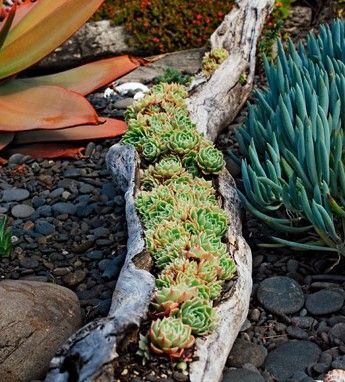
Garden Decor: Driftwood Succulent Planter
While I love great uses of recycled materials for the garden, sometimes the old classics just shine out. This driftwood branch, converted into a succulent planter, is absolutely gorgeous. It is both simple and complex at the same time, if that is possible. I am wondering if I could try something like this with any large branch or limb, although the sculptural nature of the driftwood lends its own beauty and complexity to the design.
Discovered via Pinterest User Tessa AraSmith-Cosby
More driftwood ideas from Amazon.com:
- Crema Piatto Bird Bath
- Brick Garden Shed
- Over-the-top Garden Shed
- 30 Amazing Downspout Ideas
- Garden gate made from re-purposed tools
- Moss Buddha via Tumblr
- Shovel Head Daisy
- A ladder in the garden
- Alice’s Tea Party Sculpture
- DIY Log Birdfeeder
- Amazing river stone mosaic path
- Straw Bale Sofa
- DIY: My Lowe’s Creative Ideas Pallet Project from Our Little Acre
- The Bird sNest Box by All Lovely Stuff
- Decorative Garden Trellis become a Tuteur (garden tower)
- Japanese Garden Water Fountain
- Acorn Wind Chime
- Potting bench from old door
- Tolkein-esque garden door
Interesting Plant: Kousa Dogwood (Cornus kousa)
A lovely specimen of Kousa Dogwood found on the grounds of Oberlin College in Oberlin, Ohio. Oberlin was founded in 1837 and is renowned as the the first US college to admit African-Americans and Women.
Download your own Free Kousa Dogwood Computer and Smartphone Wallpapers
Kousa Dogwood (Cornus kousa)
The Kousa dogwood[1] (Cornus kousa or Benthamidia kousa) is a small deciduous tree 8–12 m (26–39 ft) tall, native to eastern Asia. Like most dogwoods, it has opposite, simple leaves, 4–10 cm long. The tree is extremely showy when in bloom, but what appear to be four-petalled white flowers are actually bracts spread open below the cluster of inconspicuous yellow-green flowers. The blossoms appear in late spring, weeks after the tree leafs out. The Kousa dogwood is sometimes also called “Chinese dogwood”,[2][3] Korean Dogwood,[3] orJapanese dogwood.[1]“
The kousa dogwood can be distinguished from the closely related flowering dogwood (Cornus florida) of eastern North America by its more upright habit, flowering about a month later, and having pointed rather than rounded flower bracts.
The fruit is a globose pink to red compound berry 2–3 cm in diameter, though these berries tend to grow larger towards the end of the season and some berry clusters that do not fall from the tree surpass 4 cm. It is edible, a sweet and delicious addition to the tree’s ornamental value. The fruit is sometimes used for making wine.[4]
It is resistant to the dogwood anthracnose disease, caused by the fungus Discula destructiva, unlike C. florida, which is very susceptible and commonly killed by it; for this reason, C. kousa is being widely planted as an ornamental tree in areas affected by the disease. A number of hybrids between C. kousa and C. florida have also been selected for their disease resistance and good flower appearance.
Fall foliage is a showy red color. — Wikipedia.org
Previously in the Interesting Plant series:
- Giant Chalk Dudleya (Dudleya brittonii)
- Sunrose (Helianthemum nummularium)
- Australian/New Zealand Tea Tree (Leptospermum scoparium)
- Brugmansia Sanguinea
- Calico Monkeyflower (Mimulus pictus)
- Colocasia Esculenta
- Acer palmatum ‘Sango-kaku’ (Coral Bark Japanese Maple)
- Linderniaceae (formerly Torenia) Kuaui Deep Blue
- Passiflora (Passion flower)
- Firewheel Tree (Stenocarpus sinuatus)
- Anemone
- Allium Cowanii
- Symphyotrichum oblongifolius (Purple Aster)
- Hemerocallis ‘Derrick Cane’ (Daylily)
- Agastache ‘Aztec Rose’
- Rudbeckia hirta Moreno
- Kalanchoe Tomentosa
- Albuca namaquensis
- Hosta ‘Remember Me’
- Dahlia ‘Clair de Lune’
- Lovely silver-tinged fern on campus of Oberlin College, Ohio
- Tricolor Beech (Fagus sylvatica Purpurea Tricolor)
- Climbing Hydrangea (Hydrangea anomala petiolaris)
- Eremurus ‘Lemon Meringue’
- Lupine “Sunrise” (Lupinus hartwegii)
- Chinese Fringe Flower (Loropetalum chinense)
- Streptocarpus ‘Harlequin Blue’
- Nigella damascena (love-in-a-mist, ragged lady)
- Epiphyllum (Orchid Cactus)
- Sempervivum ‘Westerlin’
- Gladiolus ‘Kings Lynn’
- Hosta sieboldiana ‘Dorothy Benedict’
- Begonia “Escargot”
- Asparagus Pea (Psophocarpus tetragonolobus)
- Rosa banksiae (Lady Banks’ Rose)
- Primula ‘Victoriana Silver Laced Black’
- Oxalis versicolor
- Poached Egg Plant (Limnanthes douglasii)
- Parisian Carrots
- Fritillaria imperialis Rubra Maxima
- Clematis “Fascination”
- Swiss Chard “Bright Lights”
- Georgia Rattlesnake Melon
- Dianthus Barbathus “Green Ball” or “Green Trick”
- Coleus “Religious Radish”
- Black Forest Calla Lily
- Black Bamboo
Interesting Plant is a series from A Gardener’s Notebook blog and podcast that highlights the most interesting plants I find in my Internet and real-world travels — Douglas
Video: In the garden…March 16, 2014: Potatoes and chives and onions and flowers

Potatoes are going crazy, our 2 weeks of Spring is probably over and chives are flowering
Check out what was happening in the garden a year ago: “Container Garden Update 19 – A failed container, worm castings and some new basil”
Check out my collection of gardening essays, “From A Gardener’s Notebook” now available as a Kindle eBook. (You don’t need a Kindle to read it, though. Read it on your PC, Link: http://j.mp/fagnbook
Watch all past episodes of “In the garden…” in this YouTube Playlist
Music: “The One” by the Woodshedders (http://musicalley.com)
Please Like this video and/or subscribe to my channel on YouTube.
Your likes and subscriptions directly reflect how many other viewers are suggested this video.
- Follow A Gardener’s Notebook on Pinterest
- Follow A Gardener’s Notebook on Twitter
- Like A Gardener’s Notebook on Facebook
- Circle A Gardener’s Notebook on Google+
- Subscribe to A Gardener’s Notebook podcast via iTunes
“In the garden…” is a series for A Gardener’s Notebook highlighting what is happening in my garden, my friend’s gardens and California gardens throughout the seasons.
Podcast: Play in new window | Download
Subscribe: RSS