Garden Alphabet: Butterfly (Lepidoptera)

Garden Alphabet: Butterfly (Lepidoptera)

The garden is made up of more than just plants. The best gardens are filled with insects and wildlife as well as plants and flowers and learning more about these inhabitants can expand your understanding and the joy of keeping a garden. This butterfly photo was taken at Sunnylands in Rancho Mirage California. I have also created 2 photo galleries and videos from the photos of my 2 visits. You’ll find a video and links to more below.

Garden Alphabet: Butterfly | A Gardener's Notebook

Butterfly (Lepidoptera)

butterfly is a mainly day-flying insect of the order Lepidoptera, which includes the butterflies and moths. Like other holometabolous insects, the butterfly’s life cycle consists of four parts: egglarvapupa and adult. Most species are diurnal. Butterflies have large, often brightly coloured wings, and conspicuous, fluttering flight. Butterflies comprise the true butterflies (superfamily Papilionoidea), the skippers(superfamily Hesperioidea) and the moth-butterflies (superfamily Hedyloidea). All the many other families within the Lepidoptera are referred to as moths. The earliest known butterfly fossils date to the midEocene epoch, 40–50 million years ago.[1]

Butterflies exhibit polymorphism, mimicry and aposematism. Some, like the Monarch, will migrate over long distances. Some butterflies have evolved symbiotic and parasitic relationships with social insects such as ants. Some species are pests because in their larval stages they can damage domestic crops or trees; however, some species are agents of pollination of some plants, and caterpillars of a few butterflies (e.g., Harvesters) eat harmful insects. Culturally, butterflies are a popular motif in the visual and literary arts. — Wikipedia

More information on Butterly (Lepidoptera):


Previously in Garden Alphabet:
 

Theodore Payne Wild Flower Hotline 2014 now available each Thursday through May 2014

Theodore payne wildflower hotline

Looking to see wildflowers in Southern California? The Theodore Payne Foundation for Wild Flowers and Native Plants is running their 32nd Annual Wild Flower Hotline directly from their web site. Each Thursday they update the hotline with reports from all over the Southland. The Hotline is available in both PDF and MS Word format.

Wildflower report

Here is a small section of this wrk’s report, posted March 7, 2014.

Again this year, we are at below normal rainfall and time is running out for  significant rain events. Snow in the high elevations and high desert regions may  contribute to a nice bloom, but not until later in the spring. The drought makes   seeking out wildflower beauties more challenging but a lot more fun for Southern  Californians to get out there a cheer every flower sighting!

If you are driving on the 395 to the Sierra ski resorts, take a detour for wildflower  sightings along Nine Mile Canyon. Actually there are 3 or 4 canyons coming out  of the Eastern Sierra just above the Inyo/Kern County border that are fun to  explore. Nine-mile though has easiest access. There is a good smattering of  flowers along the shoulder and protected draws. You’ll see Fremont phacelia  (Phacelia fremontii), desert sunflower (Geraea canescens), forget-me-not  (Cryptantha cicumcissa), desert chicory (Rafinesquia neomexicana), Fremont  pincushion (Chaenactis fremontii), a sweet gilia species (Gilia sp.) and desert  dandelion (Malacothrix glabrata).The Joshua Trees (Yucca brevifolia) are starting  to bloom as well.

Read the entire report

Photo: Gopher in motion

An Auto Awesome animated gif from Google+ created with a series of photos I took on our last camping trip. This guy popped up right in our circle of chairs around the fire ring. I don’t mind these guys in the park, but wouldn’t want them in the garden. They can be quite destructive.

Botta’s Pocket Gopher (Thomomys bottae) info on Wikipedia

Previously in my Instagram Photos…

Interesting Plant: Giant Chalk Dudleya (Dudleya brittonii)

Interesting Plant: Giant Chalk Dudleya (Dudleya brittonii)

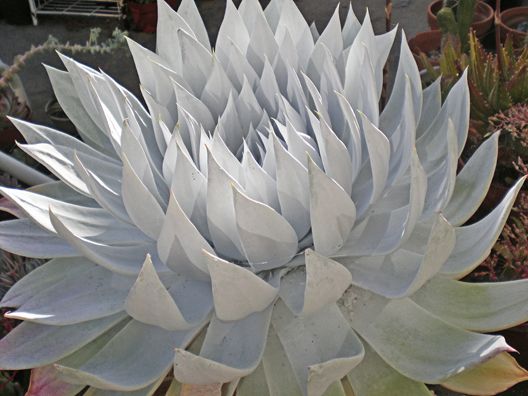
After living in Southern California for so long (nearly 28 years), I have really come to love succulents of all sorts. The dudleya always catch my eye when we are out and about and at our local succulent show, which takes places just about a mile from our house. The chalky, white leaves of this dudleya is such a unique look and I could easily find a place for it in my garden. Maybe you could find a place in yours.

dudleya-brittonii
Dudleya brittonii (DUD-lee-yuh brit-TON-ee-eye), with common names Britton’s dudleya and Giant Chalk Dudleya, is a succulent plant in the Crassulaceae family. It is native to Baja California, Mexico.

The leaves of Dudleya brittonii grow in a basal rosette and are covered with a dusty, chalky, mealy white epicuticular “wax”. The wax in its mealy state on the leaves is attracted to water and coats drops on the leaves and prevents their evaporation. The wax has the highest measured ultraviolet reflectivity of any plant.[1]

Dudleya brittonii is similar in appearance to Dudleya pulverulenta, native to California. — Wikipedia

More information on Giant Chalk Dudleya (Dudleya brittonii):

From Amazon.com:
 

Previously in the Interesting Plant series: 

Interesting Plant is a series from A Gardener’s Notebook blog and podcast that highlights the most interesting plants I find in my Internet and real-world travels — Douglas

Garden Alphabet: Lavender (Lavendula)

Garden Alphabet: Lavender (Lavendula)

A closeup of a lavender harvest from my own garden. Lavender seems to do very well here in our Mediterranean climate, if we can get it enough sun, It deals well with our hot and dry summers and never fails to impress with its smell. I love the purple flowers too, and it fits in well with my casually applied love for combinations of purple and gold.

Garden Alphabet: Lavender | A Gardener's Notebook with Douglas E. Welch

Lavender (Lavendula)

Lavandula (common name Lavender) is a genus of 39 species of flowering plants in the mint family, Lamiaceae. It is native to the Old World and is found from Cape Verde and the Canary Islands, southern Europe across to northern and eastern Africa, the Mediterranean, southwest Asia to southeast India. Many members of the genus are cultivated extensively in temperate climates as ornamental plants for garden and landscape use, for use as culinary herbs, and also commercially for the extraction of essential oils. The most widely cultivated species, Lavandula angustifolia is often referred to as lavender, and there is a colour named for the shade of the flowers of this species. — Wikipedia

More information on Lavender (Lavendula):


Previously in Garden Alphabet:

Link Focus: Garden | Garden Bridge Over The Thames Moves Forward from Londonist

Link focus logo

Garden | Garden Bridge Over The Thames Moves Forward from Londonist

London, as busy a city as it is, already has some wonderful gardens and parks throughout the city. I was so pleased when I was able to walk from Westminster back to Kensington almost continuously in parks and under shady trees. That said, every city can always use more nature and this concept to create a nature-covered pedestrian bridge over the Thames sounds wonderful. The views of the river are amazing nearly anywhere along its length, but bringing scenes from the more natural parts of the river upstream down to the city would benefit both residents and tourists. I have walked across the Millennium Bridge and found its design beautiful and striking but it is a bit stark and exposed. Maybe it could benefit from some greenery, too.

London garden bridge

More info on London Gardens:

London Gardens from Amazon.com:


Previously on Link Focus:
 

Link Focus is a series that comments on some of the links I share on my social media accounts and here on the web site. To get these links as I find them, subscribe to me on Twitter, Facebook, Google+ and elsewhere. Also look for the “My Favorite Things” posts that appear regularly in the blog. These include collections of links for each calendar month.

Get new shared links as I find them via my social media feeds:

Twitter Google plus Pinterest Facebook Linkedin