Tag Archives: books

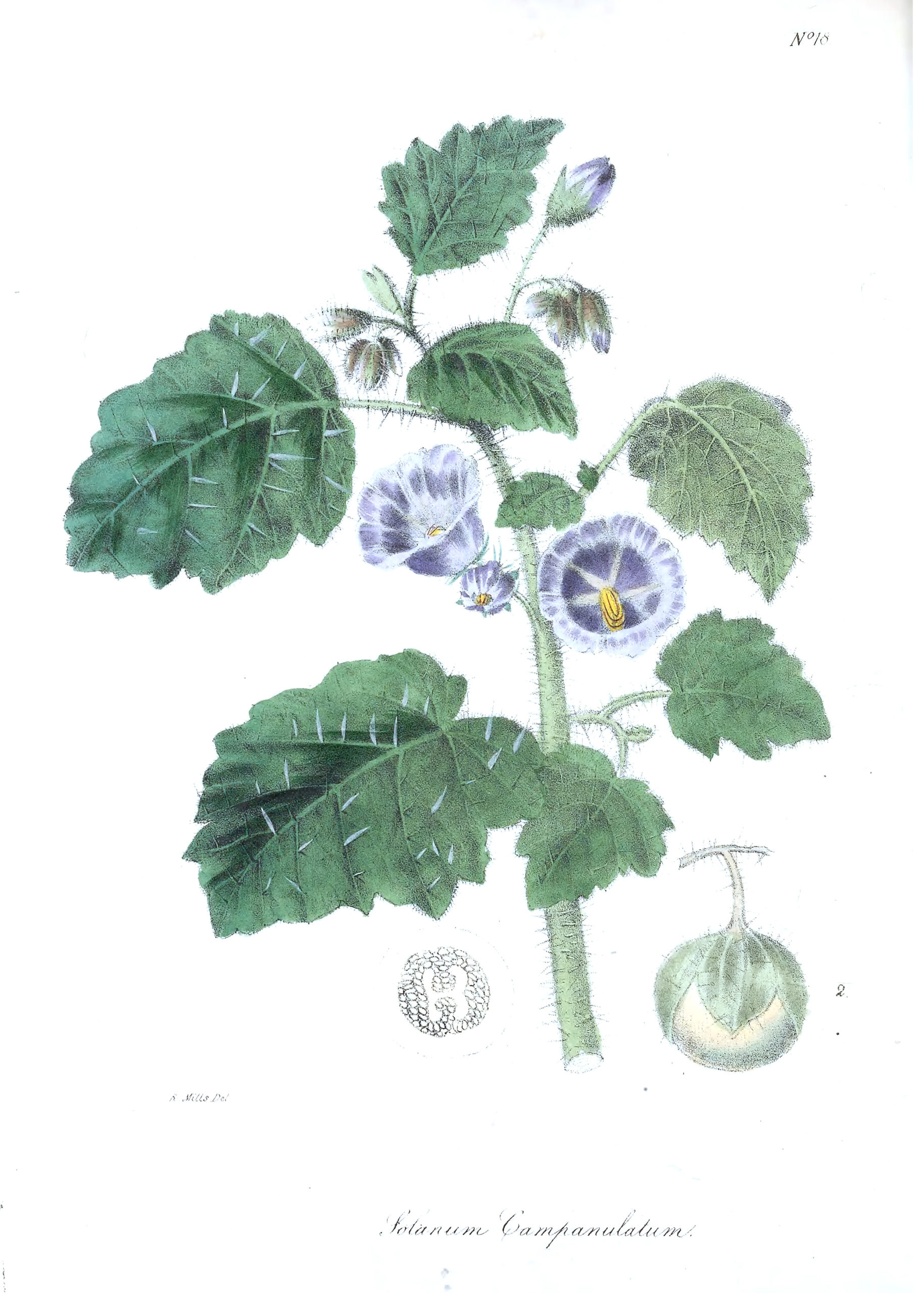
Vintage Botanical Print – 80 in a series – Solanum campanulatum from The floral cabinet and magazine of exotic botany (1837)

Vintage Botanical Print - 80 in a series - Solanum campanulatum from The floral cabinet and magazine of exotic botany (1837)

Click for larger image


This very distinct and showy species of Solanum, with a bell-shaped corolla (an unusual form for a Solanum), will doubtless form an interesting addition to those at present in cultivation. It grows about 2^ feet high (such at least was the height of the plant from which our drawing was taken), and is covered on all sides with sharp setaceous prickles, the greater portion of which are confined to the stem and the calyx. We are doubtful whether this plant be the same which Dr. Brown has described in his Prodromus, and on that account we have not altered the specific name ” campanulatum;”” we should however rather expect it to be different, as he has described the stem of his plant ” caule herbaceo,” and states it to be an annual, whilst ours is certainly suffruticose.

Purchase copies of this prints

Fp 840x830 black off white box20 s f8f8f8 pad 1000x1000 f8f8f8 2 Ssrco classic tee two models fafafa ca443f4786 front square three quarter 1000x1000 Gbra 5x7 900x900


Vintage Botanical Print – 79 in a series – Opuntia vulgaris from Familie Der Cacteen (1893-1905)

The image depicts a botanical illustration of a cactus plant, specifically an Opuntia vulgaris, also known as the common prickly pear. The illustration is detailed and realistic, showcasing the plants green, flat, paddle-shaped pads, which are covered with small red spots and tiny spines. Two bright yellow flowers with multiple petals are prominently displayed, adding a vibrant contrast to the green pads. The cactus is potted in a simple, brown container, and the background is a plain, off-white color, emphasizing the plant. The illustration includes text at the bottom left corner, reading Cactaceae, and at the bottom right, Opuntia vulgaris. Basel. Botan. Garten, 6. Juli 1895, indicating the plants family, species, and the date and location of the illustration.

Provided by @altbot, generated privately and locally using Ovis2-8B

Click for larger image

Purchase copies of these prints


Vintage Botanical Print – 78 in a series – Orange Sherbet from Magasin för Blomster-Älskare och Idkare av Trägårds-Skötsel

The image depicts a botanical illustration of a plant with four flowers. The flowers are vibrant orange with jagged edges and a central cluster of stamens and pistils. The petals have a slightly translucent quality, with visible veins and a gradient of color from a deeper orange at the edges to a lighter shade towards the center. The plant has a green stem with several leaves, some of which are broad and oval-shaped, while others are smaller and more elongated. The leaves have prominent veins and a glossy texture. One flower is partially open, revealing its inner structure, while the others are fully bloomed. The background is a plain, off-white color, which contrasts with the vivid colors of the flowers and leaves. The illustration is detailed and appears to be from a scientific or educational publication, with a signature or initials in the bottom left corner.

Provided by @altbot, generated privately and locally using Ovis2-8B

Click for larger image

Orange Sherbet
Magasin för Blomster-Älskare och Idkare av Trägårds-Skötsel. –
Author: PFEIFFER, August (1777-1842)
Pfeiffer’s “Magazine for Lovers of Flowers” is the first and only flower book in Sweden with hand-coloured plates presenting cultivated decorative flowers and fruit. It is a beautifully hand-coloured flower-book with most of the plates drawn and engraved by Pfeiffer, who also coloured the plates himself.


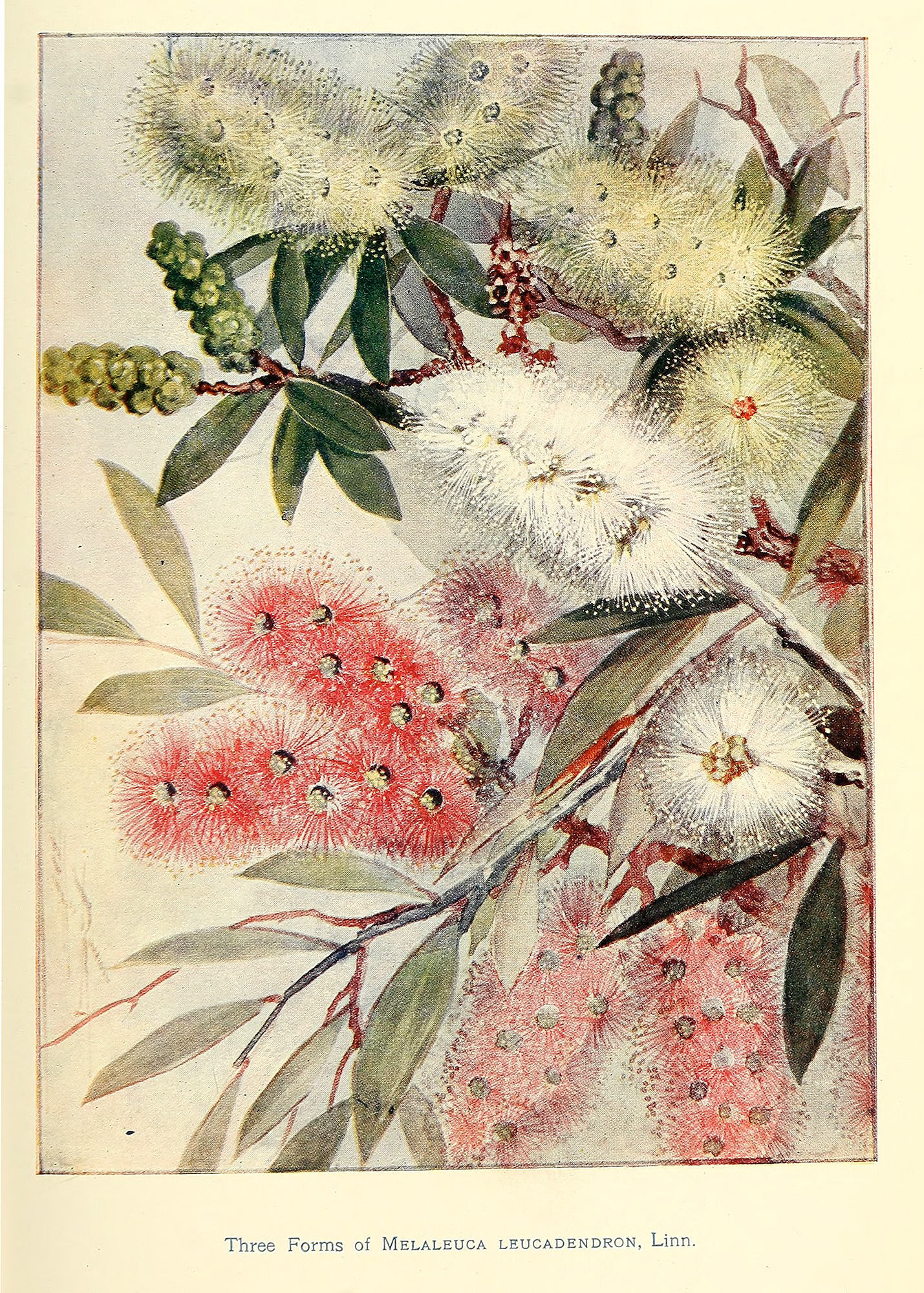
Vintage Botanical Print – 77 in a series- Three Forms of Melaleuca from Comprehensive catalogue of Queensland plants, both indigenous and naturalised (1909)

The image depicts a botanical illustration of the Melaleuca leucadendron plant, showcasing three distinct forms of its flowers. The illustration is detailed and colorful, with a light beige background. The flowers are arranged in clusters, with the top section featuring large, fluffy, yellowish-white blooms, the middle section displaying white flowers, and the bottom section showing vibrant red and pink flowers. Each flower cluster is surrounded by elongated, green leaves with a glossy texture. The branches are reddish-brown, adding contrast to the green leaves and colorful flowers. The illustration is framed by a thin red border, and at the bottom, there is a caption that reads Three Forms of Melaleuca Leucadendron, Linn.

Provided by @altbot, generated privately and locally using Ovis2-8B

Click for larger image


Rocky Mountain Flowers: The Daring Life and Art of Pioneering Plant Ecologist Edith Clements via The Marginalian [Shared]

Rocky Mountain Flowers: The Daring Life and Art of Pioneering Plant Ecologist Edith Clements – The Marginalian

Rocky Mountain Flowers: The Daring Life and Art of Pioneering Plant Ecologist Edith Clements viaThe Marginalian [Shared]

“There is one book that I would rather have produced than all my novels,” Willa Cather rued in her most candid interview about creativity. That book was Rocky Mountain Flowers: An Illustrated Guide For Plant-Lovers and Plant-Users by the pioneering plant ecologist and botanical artist Edith Clements (1874–1971).

Together with her husband, the influential botanist Frederic Clements, she pioneered the science of plant ecology, lending empirical substantiation to her contemporary John Muir’s poetic observation that “when we try to pick out anything by itself, we find it hitched to everything else in the universe.” In her 1960 memoir Adventures in Ecology: Half a Million Miles: From Mud to Macadam , penned shortly before Rachel Carson awakened the modern ecological conscience with Silent Spring and half a century before the climate calamity we are now living, Edith Clements prophesied:

“There seems little doubt that the application of the principles of ecology to human affairs, whether personal, national or world-wide, would go far in solving the problems that beset us.”

Read Rocky Mountain Flowers: The Daring Life and Art of Pioneering Plant Ecologist Edith Clements – The Marginalian

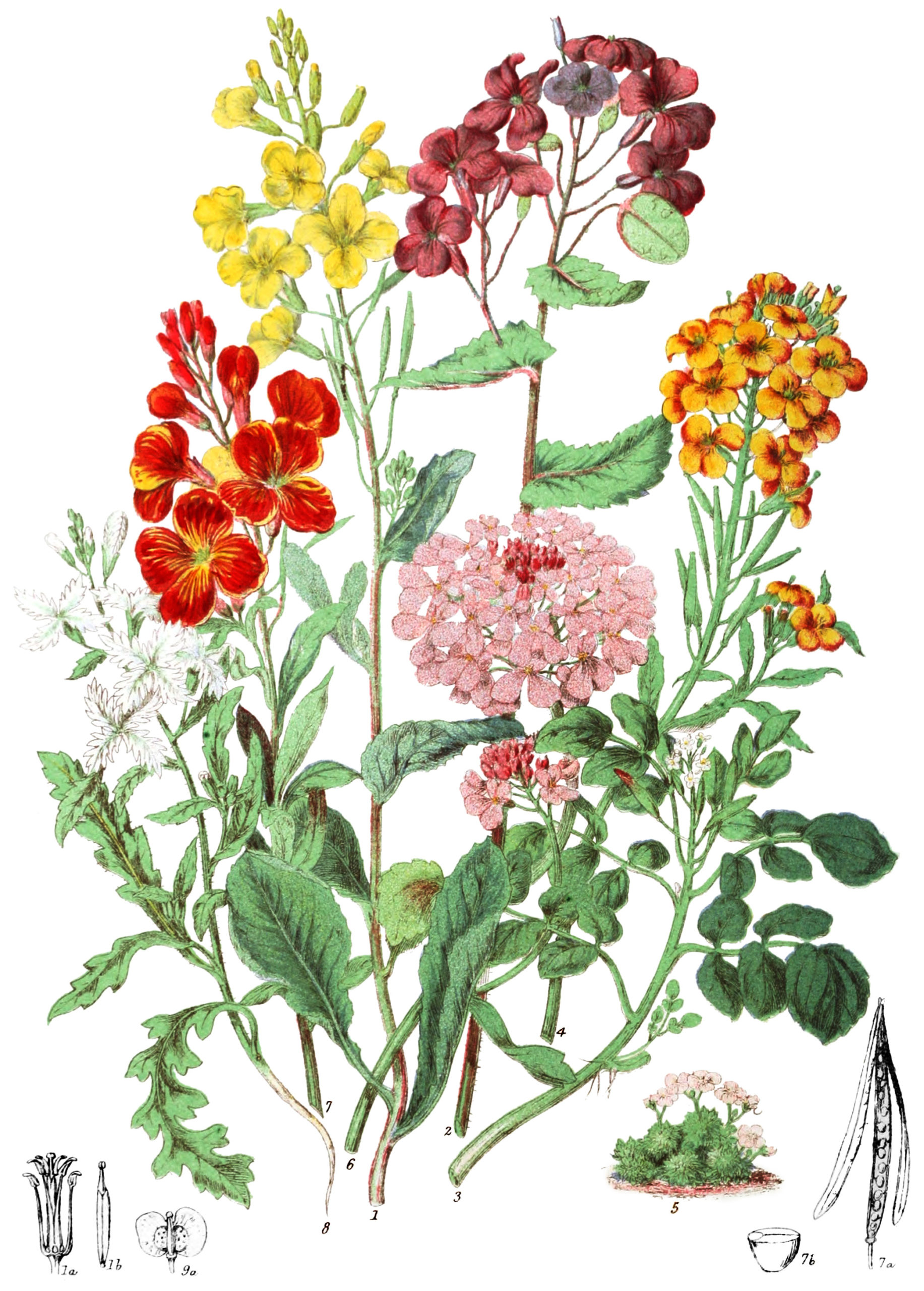
Vintage Botanical Prints – 76 in a series – Cruciaceæ: The Cruciform Tribe from The Natural Order of Plants (1868)

Vintage Botanical Prints - 76 in a series - Cruciaceæ: The Cruciform Tribe from The Natural Order of Plants (1868)

Click for larger image

Herbaceous plants, and a few half shrubs. The leaves are alternate. The flowers are chiefly yellow or white, some are purple, without bracts, generally on branching stalks. The sepals of the calyx are four, falling off before the capsule is enlarged. The petals are four, cruciform, alternate with the sepals, occasionally toothed. The stamens are six, the four longest in pairs, the two short ones single and place between the pairs. On the disk are green honey-glands, between the petals and the stamens and ovary. The ovary is above the calyx and disk, with plates from the edges usually meeting in the centre. The stigmas are two, placed opposite the plate-bearing seeds. The seed-vessel is a silique, a long pod containing many seeds; or a silicule, a short pod with few seeds; opening by two valves separating from the central plate, or remaining close. The seeds are attached by a little cord in a single row to each side of the plate, generally pendulous; they have no albumen.


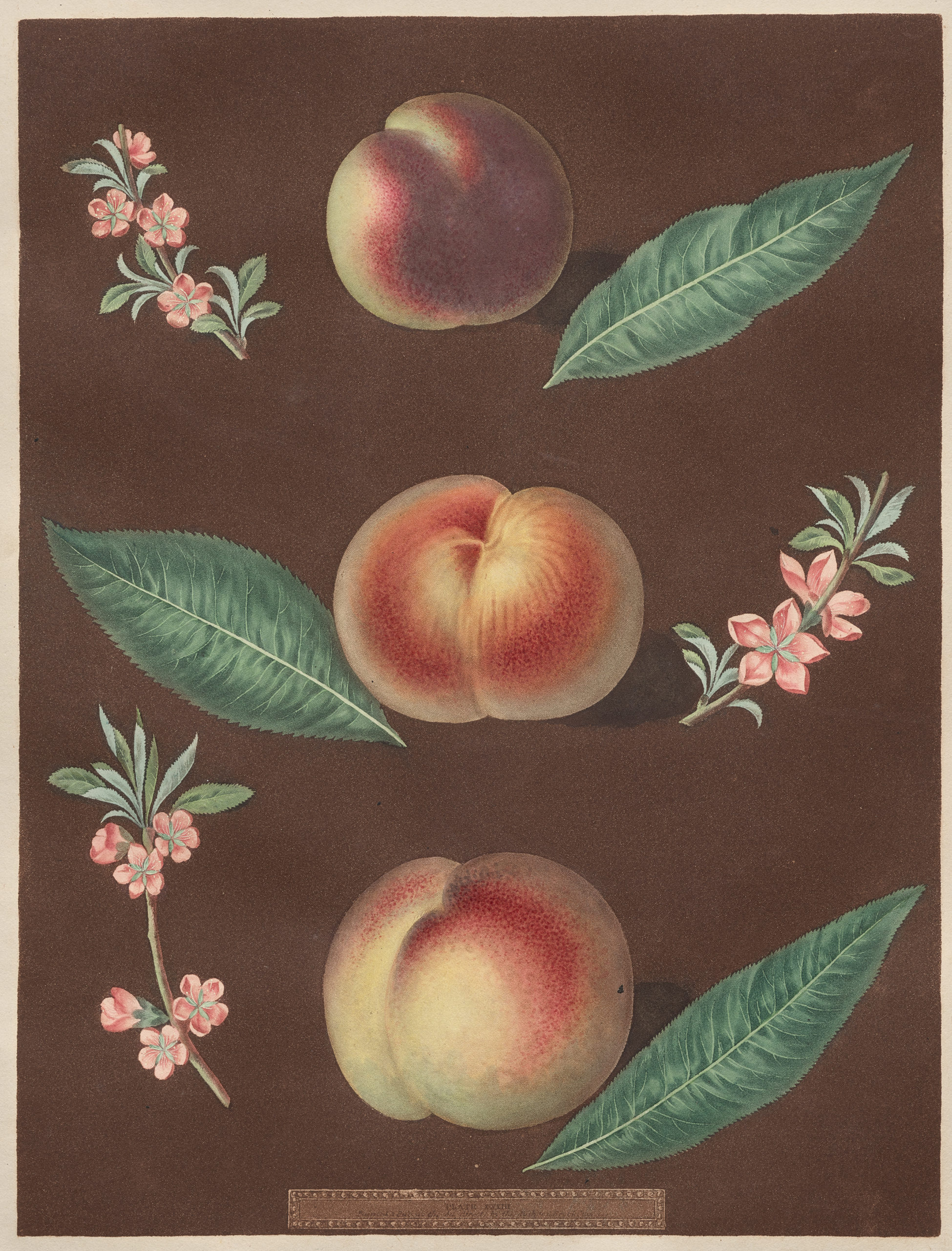
Vintage Botanical Prints – 75 in a series – Pomona Britannica: No. 33 – Peaches, 1812–17. George Brookshaw

The image features a botanical illustration of peaches and their associated elements. The background is a solid dark brown, providing a stark contrast to the subjects. There are three peaches depicted, each with a distinct coloration and shape. The top peach is predominantly purple with a hint of red, the middle one is a vibrant orange with a yellow base, and the bottom peach is a lighter yellow with red blushes.

Each peach is accompanied by a large green leaf, showcasing detailed veins and a serrated edge. Additionally, there are clusters of pink flowers with five petals each, interspersed among the peaches and leaves. The flowers have a delicate appearance, with green stems and leaves.

The illustration is framed by a thin white border, and at the bottom, there is a rectangular label with a decorative border, though the text is not legible. The overall composition is symmetrical, with the peaches and leaves arranged in a balanced manner.

Click for larger image

id: 380084
accession number: 2020.166
share license status: CC0
url: https://clevelandart.org/art/2020.166
updated: 2022-01-13 10:05:48.513000

Pomona Britannica: No. 33 – Peaches, 1812–17. George Brookshaw (British, 1751-1823). Aquatint and stipple engraving printed in color and hand colored; platemark: 44.9 x 35 cm (17 11/16 x 13 3/4 in.); sheet: 57 x 47 cm (22 7/16 x 18 1/2 in.). The Cleveland Museum of Art, Nancy F. and Joseph P. Keithley Collection Gift 2020.166


Get your own copy of this print and more!


Vintage Botanical Prints – 74 in a series – Vintage Malus domestica Print from USDA Pomological Watercolors

The image features a detailed illustration of three apples and their leaves. The apples are depicted with a high level of detail, showcasing their textures and colors. The top apple is predominantly red with a brownish base and numerous small red spots. The middle apple is green with a yellowish tint and speckled with small brown spots. The bottom apple is a blend of orange and red, also with small brown spots. The leaves surrounding the apples are green with some brown spots and blemishes, adding to the naturalistic appearance. The background is a plain, off-white color, which contrasts with the vibrant colors of the apples and leaves. The artists signature, Shull, is visible in the bottom right corner of the image.

Provided by @altbot, generated privately and locally using Ovis2-8B

Click for larger image


Decorate your home and office with this print

Required Reading: Gardens Under Big Skies—Reimagining Outdoor Space, the Dutch Way via Gardenista [Shared]

Required Reading: Gardens Under Big Skies—Reimagining Outdoor Space, the Dutch Way – Gardenista

Required Reading: Gardens Under Big Skies—Reimagining Outdoor Space, the Dutch Way via Gardenista [Shared]

When we think of the Dutch landscape, water and flatness come to mind—a scene so “monotonous” that British writer Noel Kingsbury used to complain to Holland’s garden superstar Piet Oudolf that it was impossible not to get lost. “Learning to read the landscape takes time,” says Oudolf in the foreword to this erudite and fascinating new book, “and not all visitors are prepared to do that.”

Gardens Under Big Skies, published by Filbert Press, lavishly illustrates that the devil is in the detail: Dutch gardening is distinguished by “its clarity of form and its desire to embrace the contemporary,” in the words of co-author and photographer Maayke de Ridder. The low-lying landscape (about a third of which is below sea level) is key to the rigorously forward-thinking garden scene in the Netherlands.

Read Required Reading: Gardens Under Big Skies—Reimagining Outdoor Space, the Dutch Way – Gardenista

The image depicts a botanical illustration of a hollyhock plant, scientifically known as Alcea rosea, with the text Malua rosea a rubro written below it. The illustration features two large, open flowers with deep pink petals and lighter pink veins, attached to a green stem with several smaller buds. The leaves are a light blue-green color, and the stem is a vibrant green. At the bottom of the image, two insects are illustrated: a yellow and black striped beetle labeled 1 on the left and a similar beetle labeled 2 on the right. The background is a plain off-white color, and the image is framed by a thin black border. The overall style is reminiscent of historical botanical illustrations, with detailed and precise depictions of the plant and insects. Provided by @altbot, generated privately and locally using Ovis2-8B

Vintage Botanical Prints – 73 in a series – Vintage Malua Rosea Print from Nederlandsch bloemwerk (1794)

The image depicts a botanical illustration of a hollyhock plant, scientifically known as Alcea rosea, with the text Malua rosea a rubro written below it. The illustration features two large, open flowers with deep pink petals and lighter pink veins, attached to a green stem with several smaller buds. The leaves are a light blue-green color, and the stem is a vibrant green. At the bottom of the image, two insects are illustrated: a yellow and black striped beetle labeled 1 on the left and a similar beetle labeled 2 on the right. The background is a plain off-white color, and the image is framed by a thin black border. The overall style is reminiscent of historical botanical illustrations, with detailed and precise depictions of the plant and insects.

Provided by @altbot, generated privately and locally using Ovis2-8B

Click for larger image


Order your own copy of this vintage print and additional products