Master Gardener: Protecting your home from wildfires and tips for winter gardening via Press Enterprise


Here in Southern California, we joke about our four seasons: fire, flood, earthquake, and drought. In the fall, otherwise known as fire season, we have hot, dry weather punctuated by gusty winds reaching up to 70 miles per hour. These are perfect conditions for catastrophic wildfires to establish and spread.

If you live in wildfire country, now is a great time to evaluate your property for fire safety. Clean gutters of all debris, and remove dead, dry leaf litter from your roof. Prune or move plants away from windows and move flammable material away from wooden structures.

Dazzling Dahlias – 9 in a series – World’s best dahlias : new creations and old friends / Peacock Dahlia Farms. (1918)

Like Dazzling Dahlias on Facebook

Dazzling Dahlias – 9 in a series – World’s best dahlias : new creations and old friends / Peacock Dahlia Farms. (1918)

Dazzling Dahlias - 9 in a series - World's best dahlias : new creations and old friends / Peacock Dahlia Farms. (1918)Dazzling Dahlias - 9 in a series - World's best dahlias : new creations and old friends / Peacock Dahlia Farms. (1918)

Dazzling Dahlias - 9 in a series - World's best dahlias : new creations and old friends / Peacock Dahlia Farms. (1918)Dazzling Dahlias - 9 in a series - World's best dahlias : new creations and old friends / Peacock Dahlia Farms. (1918)

Dahlia, at last, occupies a position second to no other plant in our gardens, and it is exceedingly gratifying to us 4 J as it bears out our prediction made in 1884 that, “Owing to a dearth of flowers during the summer and early autumn months, a proper development of the possibilities of this beautiful flower would give it a place of honor in every garden. Owing to its free growing habits, freedom from serious disease, and ease of safeguarding from the few insects that attack it, it can and will be universally grown.” It is specially gratifying to us that our prediction of 34 years ago is being realized to the fullest extent.

During this time we have devoted our entire time and energy to aid in the development of the Dahlia, and bring about the present most gratifying results. During this time, regardless of vicissitudes, our keynote has been “Quality” which has resulted in our not only having been the original American Dahlia specialists, but the enviable position of the largest Dahlia growers in the world.

As a large proportion of existing varieties have been originated in other countries, the development was along lines suited to local conditions, there; and, are entirely unsuited to American conditions. This is particularly the case with Dahlias for decorative purposes. We grow the best and most reliable varieties in immense quantities, and as we are not dealers but growers we know that our stock is the best that experience and eternal vigilence can produce.

OUR FARMS embracing 172 acres are located at Williamstown Junction, New Jersey, on the Atlantic City Branch of the Reading R. R., only 17 miles from Chestnut Street Ferries, Philadelphia, and we extend a most cordial invitation to our customers and all interested in Dahlias to visit us and inspect our fields while in bloom, during August, September and October. We have 32 trains daily and 16 trains on Sundays during summer. Time tables will be sent on request.


* A portion of each sale from Amazon.com directly supports our blogs** Many of these books may be available from your local library. Check it out!


An interesting link found among my daily reading


Historical Garden Books: Gardening don’ts by Marion Chappell (1913) – 52 in a series


Historical Garden Books: Gardening don’ts by Marion Chappell (1913) – 52 in a series

Historical Garden Books: Gardening don'ts by Marion Chappell (1913) - 52 in a seriesHistorical Garden Books: Gardening don'ts by Marion Chappell (1913) - 52 in a series

Historical Garden Books: Gardening don'ts by Marion Chappell (1913) - 52 in a seriesHistorical Garden Books: Gardening don'ts by Marion Chappell (1913) - 52 in a series

Download in Text, PDF, Single Page JPG, TORRENT from Archive.org


* A portion of each sale from Amazon.com directly supports our blogs
** Many of these books may be available from your local library. Check it out!

Captivating Cactus: 7 in a series – Echinopsis subdenudata / fall bloom via Cactus Guy

Follow Captivating Cactus and Striking Succulents on Facebook

Captivating Cactus: 7 in a series - Echinopsis subdenudata / fall bloom via Cactus Guy

Visit Echinopsis subdenudata / fall bloom via Cactus Guy


* A portion of each sale from Amazon.com directly supports our blogs
** Many of these books may be available from your local library. Check it out!

To Help Birds This Winter, Go Easy on Fall Yard Work via Audubon

To Help Birds This Winter, Go Easy on Fall Yard Work via Audubon

There’s a certain satisfaction in autumn chores. When the weather’s right, cleaning gutters, touching up paint, or splitting some firewood can feel less like manual labor and more like a rite of the season.

But if you want to make your backyard a welcoming winter haven for birds, some fall tasks call for a laissez-faire approach. “Messy is definitely good to provide food and shelter for birds during the cold winter months,” says Tod Winston, Audubon’s Plants for Birds program manager.

So let someone else keep up with the neighbors this weekend. Sleep in, linger a little longer with your morning coffee, and follow these tips for a bird-friendly yard you can be proud of.

Read To Help Birds This Winter, Go Easy on Fall Yard Work via Audubon


* A portion of each sale from Amazon.com directly supports our blogs
** Many of these books may be available from your local library. Check it out!


An interesting link found among my daily reading

MaliArts designs city-chic beehives to save solitary bees via Inhabitat

You don’t need to spend hundreds of dollars on these lovely bee houses and waterers, but providing some respite for our native bees is a great idea. You might find some ideas here about houses you can build yourself or order one of these to add to your garden. – Douglas
 
 
We’re big fans of beautifully designed urban beehives on Inhabitat, and Mexico-based design studio MaliArts’ new shelters for solitary bees are just as buzz-worthy. Dubbed ‘Refugio,’ the project currently consists of three distinct and sculptural beehives aimed at attracting different species of solitary bees. Built with natural materials, each shelter offers a resting place and access to food and water for the insects.


* A portion of each sale from Amazon.com directly supports our blogs
** Many of these books may be available from your local library. Check it out!

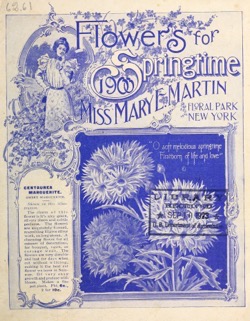
Historical Seed Catalogs: Flowers for springtime by Miss Mary E. Martin (1900) – 41 in a series

Historical Seed Catalogs: Flowers for springtime by Miss Mary E. Martin (1900) – 41 in a series

The image is a vintage advertisement for flowers, specifically for springtime in 1900, created by Miss Mary E. Martin from Floral Park, New York. The advertisement is predominantly in blue and white, with ornate floral designs and text. At the top, the title "Flowers for Springtime 1900" is prominently displayed in large, decorative font. Below the title, Miss Mary E. Martin's name and location are mentioned.

To the left, there is an illustration of a woman in a Victorian-style dress, Historical Seed Catalogs: Flowers for springtime by Miss Mary E. Martin (1900) - 41 in a series

Historical Seed Catalogs: Flowers for springtime by Miss Mary E. Martin (1900) - 41 in a seriesHistorical Seed Catalogs: Flowers for springtime by Miss Mary E. Martin (1900) - 41 in a series

Download in Text, PDF, Single Page JPG, TORRENT from Archive.org

THE EDELWEISS.— THE ALPINE SNOWFLOWER .

As white as snow- But lasts forever.

No other flower in the whole universe— not even the rarest orchid has cost so many lives as this chaste little Alpine beauty. A recent publication states that “scores of lives ” are lost annually by venturesome tourists in their efforts to obtain it. It is well known that travelers circling the globe will stop at the mountains of Switzerland and climb to almost inaccessible heights to be the proud possessors of the precious little treasure

It requires patience, courage, strength, endurance, andaperiloustaskitis. No wonder, therefore, that it|is prized so highly, that the ladies ornate their hats with it as trophies ; no wonder that gathering the plants in their native home by crafty guides, who know their value, is now prohibited for fear of their extermination. Like the wonderful Rose of Jericho from Syria and the Resurrection plant from Mexico, the EDELWEISS is the natural curiosity, for one may say the “flower never dies,” as it remains as white as the snow from which it sprung, and soft and velvety even longer than human life.

There is also some romance connected with it, it being an ancient local custom for the Tyrolian lover to present his affianced as an engagement flower, one that he has gathered himself from among the snow-clad rocks, and the higher the altitude the more cherished it is.

Certainly they are chaste and beautiful, as white as snow and as soft as velvet, growing sometimes 30 on one plant, with grayish white foliage, spreading Rosette. Naturally as hard as a rock, they grow in any way, on sandy moist soil, preferably gritty and well drained, or on raised rockwork, and even as a border plant, in chalky open soil lasting for years. In beauty, it would certainly prove a wonderful attraction, aside from its intrinsic value.

It is well known that owing to the scarcity of EDELWEISS flowers and the great demand for them, imitations made of white cloth, etc. , are palmed off on credulous and unsophisticated travelers. As a ” fad” for the coming Summer, I offer the dried flowers (especially imported for this purpose by me) to be used as a mountain symbol. They can be worn on the “hat, coat or waist.

Three very fine perfect flowers sent for IOc. by mail,

Fresh Edelweiss Seed, Pkt. IOc. Plants of Edelweiss, 15c. each ; 2 for 25c. Yours very truly,

MARY E. MARTIN, Floral Park, New York.

Dazzling Dahlias – 8 in a series – Dahlia. Mary Altha Nims (American, 1817-1907) via Internet Archive

Like Dazzling Dahlias on Facebook

Dahlia. Mary Altha Nims (American, 1817-1907). Watercolor; The Cleveland Museum of Art, Gift of Richard Seymour Bayham 1934.135

* A portion of each sale from Amazon.com directly supports our blogs** Many of these books may be available from your local library. Check it out!


An interesting link found among my daily reading


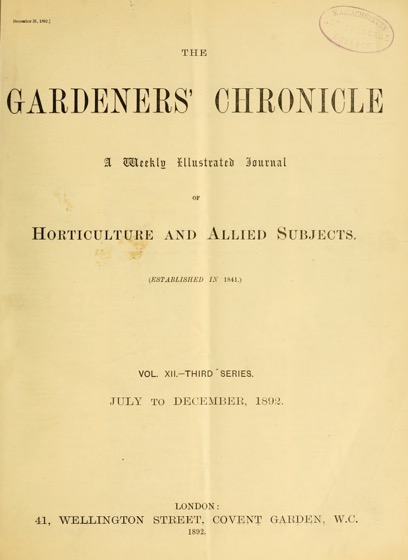
Historical Garden Books: The Gardeners’ chronicle : a weekly illustrated journal of horticulture and allied subjects (1892) – 51 in a series


Historical Garden Books: The Gardeners’ chronicle : a weekly illustrated journal of horticulture and allied subjects (1892) – 51 in a series

Annual, bound, editions of each newsletter throughout the year.

Historical Garden Books: The Gardeners' chronicle : a weekly illustrated journal of horticulture and allied subjects (1892) - 51 in a series

Historical Garden Books: The Gardeners' chronicle : a weekly illustrated journal of horticulture and allied subjects (1892) - 51 in a series

Download in Text, PDF, Single Page JPG, TORRENT from Archive.org


* A portion of each sale from Amazon.com directly supports our blogs
** Many of these books may be available from your local library. Check it out!

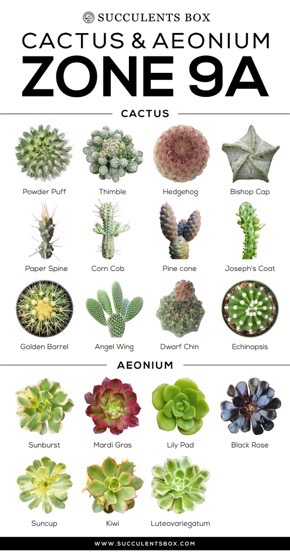
Captivating Cactus: 6 in a series – Choosing Succulents For Zone 9 – California, Florida And Arizona via Succulents Box

Follow Captivating Cactus and Striking Succulents on Facebook

This is an amazing resource of cactus and succulent plants for Zone 9. The infographics lay out each selection with clear photos and names. I know I am going to keep this around for future succulent identification purposes. — Douglas

Captivating Cactus: 6 in a series - Choosing Succulents For Zone 9 - California, Florida And Arizona via Succulents Box

ZONE 9
Zone 9 is commonly known as a year-round planting zone. Summer time in zone 9 last around nine months with extreme high temperatures and dry weather. Summer heat presents a challenge to typical plants and vegetables. However, these kind of temperature hardly pose any threat to water-filled succulents.

Typical states include California, Florida and Arizona. 

WHAT TYPES OF SUCCULENT THRIVE IN ZONE 9?
Zone 9 is paradise to succulent-lovers. The hot and prolonged summer provide a favourable environment for many succulent genus to thrive. Such succulents can be Cactus, Echeveria, String of pearls, Sempervivum, Sedum, Cotyledon, Aloe and many others listed below.

Read Choosing Succulents For Zone 9 – California, Florida And Arizona via Succulents Box


* A portion of each sale from Amazon.com directly supports our blogs
** Many of these books may be available from your local library. Check it out!