Tag Archives: botany

Vintage Botanical Print – 81 in a series – Aquilegia Canadensis from The Floral world and garden guide (1878)

Floralworldgarde1318edhi_0046 blog.

Click for larger image

THIS elegant but hardy perennial is, as its name implies, a native of Canada, where it usually grows about nine inches high ; but in this country, however, it generally attains the same size as the common Columbine, which it greatly resembles in the appearance of its leaves, though it differs in having its flowers of a different form and colour. It may be easily propagated by dividing the roots either in the autumn or the spring ; or it may be raised from seed, which it ripens in great abundance. In the latter case, however, the seeds should be sown as soon as they are ripe, as otherwise they will be a long time before they germinate. The very graceful, nodding, scarlet and orange flowers, which appear in April and. May, are nearly two inches in length, and on each pedicel there are two bracts, so near the flower as to have almost the appearance of a distinct green calyx.

Purchase copies of this print

Fp,840x830,black,off_white,box20,s,f8f8f8 pad,1000x1000,f8f8f8.

Gbra,5x7,900x900 1.

Mug,standard,x1000,right pad,1000x1000,f8f8f8.


Master of Claude de France’s Book of Flower Studies (ca. 1510–1515) via The Public Domain Review [Shared]

Master of Claude de France’s Book of Flower Studies (ca. 1510–1515) via The Public Domain Review

 The image features a detailed illustration of a blue dragonfly perched on a green stem of a flower. The dragonfly has a long, slender body with a blue and green coloration, and its wings are transparent with a delicate pattern. The flower has white petals with a red edge and a yellow center, resembling a daisy. There are three flowers in total, with one fully bloomed, one partially bloomed, and one in bud form. The background is a plain, off-white color, which contrasts with the vibrant colors of the dragonfly and flowers. The illustration is done in a style that suggests it could be from a natural history book or a botanical illustration, with careful attention to the details of the insects and plants.

Despite being full of blooms, this book of floral illustrations marks an autumn in aesthetic history: it was composed during “‘the last flowering’ of northern European manuscript illumination in the medieval tradition”, write curators at the MET. Created in the workshop of the Master of Claude de France, one of the most renowned ateliers in Tours during the early sixteenth century, it takes the form of a model book — and indeed several subsequent commissions linked to Queen Claude drew inspiration from this work. Yet its relative lack of wear and tear has led historians like Jörn Günther to wonder if the manuscript was primarily intended by the Master of Claude de France to be a collection of botanical art in its own right. Having trained with Jean Bourdichon and possibly Jean Poyer, the Master’s true identity remains anonymous in art history, but he and his workshop have been credited with books of hours and books of prayers — generally employing extremely small formats, which fit comfortably into the palm of a hand.

View this entire manuscript

Explore Hundreds of Exquisite Botanical Collages Created by an 18th-Century Septuagenarian Artist via Colossal [Shared]

Explore Hundreds of Exquisite Botanical Collages Created by an 18th-Century Septuagenarian Artist via Colossal

The image depicts a botanical illustration of a flowering plant with a dark background. The plant is identified as Panaverium Marilinum, commonly known as the Sea Daffodil. The illustration features a cluster of white, elongated petals with a delicate, curving structure, resembling a spiders web. The petals are arranged in a spiral pattern, with some extending outward and others curling inward. The stamens, visible at the tips of the petals, are yellow with pinkish-red anthers. The plant has broad, green leaves with a slightly glossy texture, positioned at the base of the flower. The illustration is detailed, with shading and highlights that give depth to the petals and leaves. The name of the plant is written in cursive script at the bottom right corner, with the scientific name above it. The overall composition is centered, with the plant occupying the majority of the space, creating a striking visual impact against the black background.</p></p>

<p><p>Provided by @altbot, generated privately and locally using Ovis2-8B

At age 72, Mary Delany (1700-1788) devoted herself to her art practice, taking up a form of decoupage to create an exquisite collection of botanical collages from dyed and cut paper. She interpreted many of the delicate specimens she encountered in Buckinghamshire while staying with her friend, the Duchess of Portland, through layered pieces on black backdrops. From the wispy clover-like leaves of an oxalis plant to the wildly splayed petals of the daffodil, the realistic works are both stunning for their beauty and faithfulness to the original lifeforms.

Read and View This Entire Article – Explore Hundreds of Exquisite Botanical Collages Created by an 18th-Century Septuagenarian Artist via Colossal 

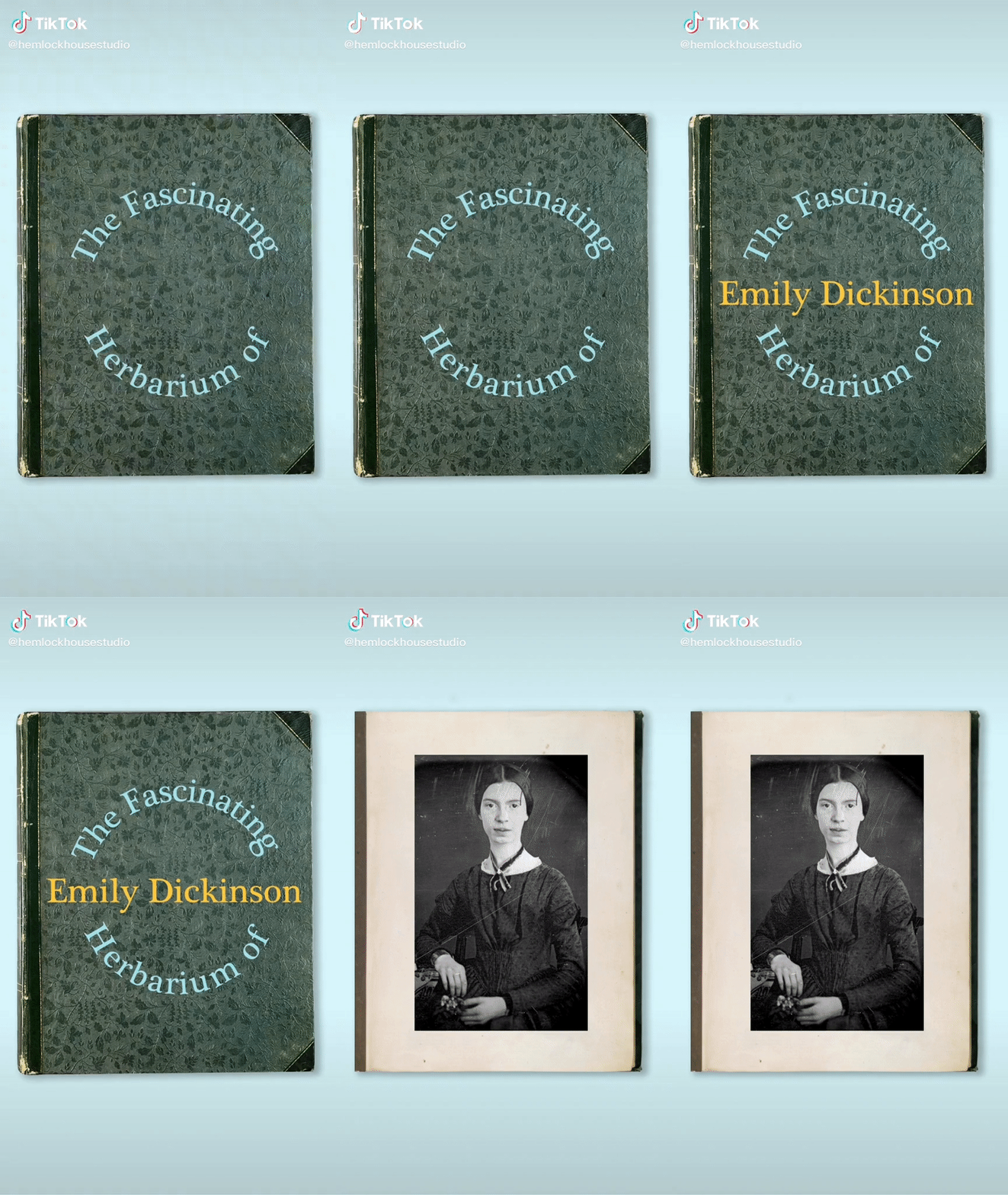
Emily Dickinson’s Herbarium via TikTok [Shared]

@hemlockhousestudio Emily Dickinson’s Herbarium is a collection of over 400 plants pressed and classified by the poet. #socool #botany #pressedflowers #herbarium #garden ♬ original sound – Samantha


Emily Dickinsons Herbarium is a collection of over 400 plan

Today I Learned: Fastigiate or Columnar Trees

I often come across gardening terms I don’t know, so I always make a point to use that as a learning opportunity. I came across “fastigiate” in some magazine article and immediately looked it up. While I understood that there were trees with columnar growth habits I had never heard them described with this more technical term. Like every division of science, botany has its own specific terminology that more closely describes elements than the typical common names or typical English words might. This is one major reason I try to learn the Latin names of plants so that I can refer specifically to one plant and differentiate it from others that might share its common name. – Douglas

Todau I Learned: Fastigate or Columnar Trees

Is there a difference between columnar and fastigiate?

While these two growth forms are often treated as synonyms, they are in reality variations on a theme. Columnar trees usually have a height-to-width ratio of 5-to-1 while fastigiate plants are closer to 10-to-1. Think of columnar plants as having the shape of a stovepipe while fastigiate plants take on the form of a power pole. 

This narrow, upright growth habit is caused by the inability of some seedlings to develop normal, broad-spreading side branches. With these plants, the main branches grow straight up instead of spreading sideways so they can better position themselves to intercept more light. For some reason – probably centered around the response of cells in the apical meristem to the level of a natural growth hormone called auxin – the balance between verticality and photosynthesis is swayed in favor of narrowness.  Nurserymen, ever on the lookout for something different, select these natural variants and maintain the form by grafting.

from the University of Arkansas Divison of Agriculture

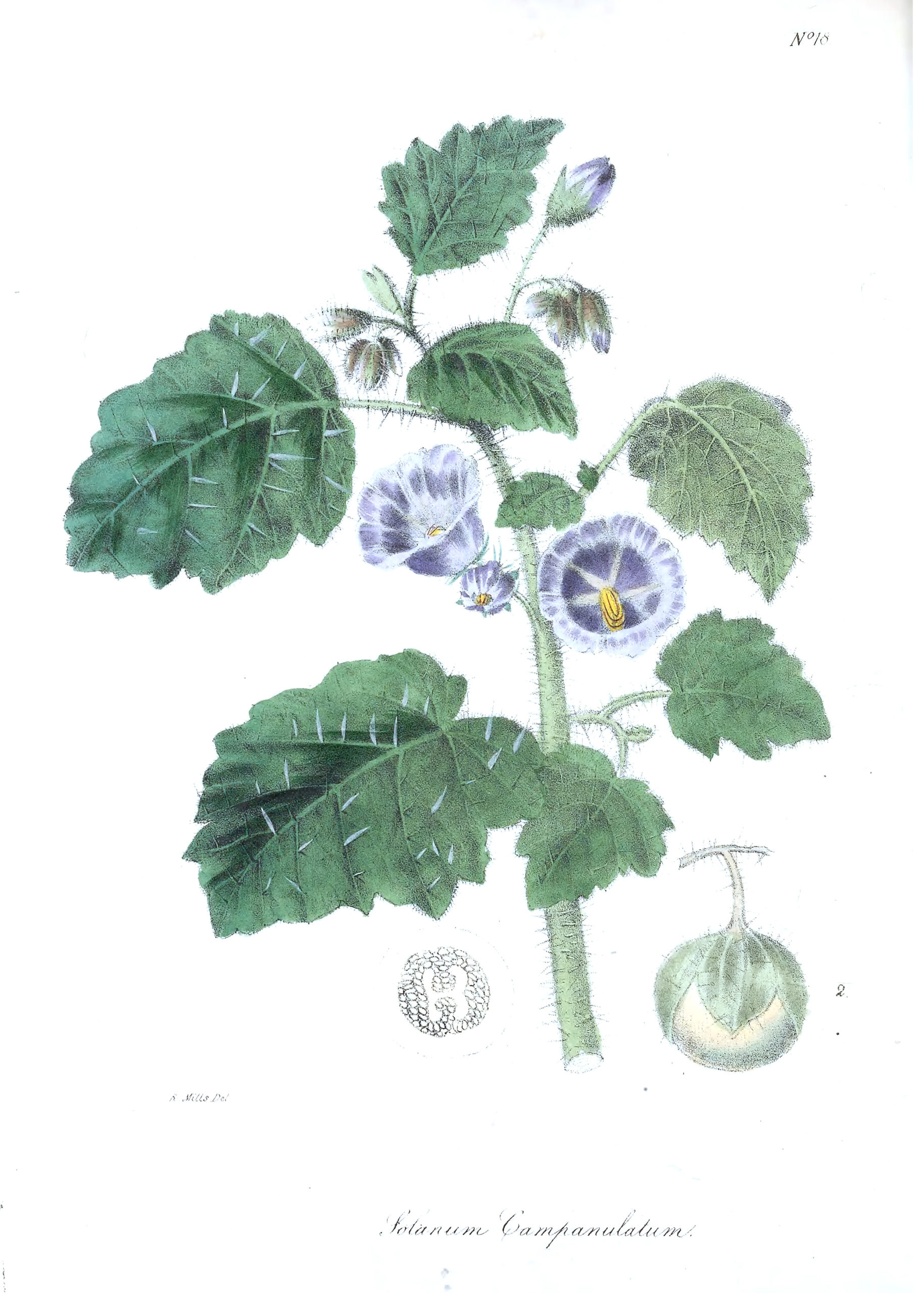
Vintage Botanical Print – 80 in a series – Solanum campanulatum from The floral cabinet and magazine of exotic botany (1837)

Vintage Botanical Print - 80 in a series - Solanum campanulatum from The floral cabinet and magazine of exotic botany (1837)

Click for larger image


This very distinct and showy species of Solanum, with a bell-shaped corolla (an unusual form for a Solanum), will doubtless form an interesting addition to those at present in cultivation. It grows about 2^ feet high (such at least was the height of the plant from which our drawing was taken), and is covered on all sides with sharp setaceous prickles, the greater portion of which are confined to the stem and the calyx. We are doubtful whether this plant be the same which Dr. Brown has described in his Prodromus, and on that account we have not altered the specific name ” campanulatum;”” we should however rather expect it to be different, as he has described the stem of his plant ” caule herbaceo,” and states it to be an annual, whilst ours is certainly suffruticose.

Purchase copies of this prints

Fp 840x830 black off white box20 s f8f8f8 pad 1000x1000 f8f8f8 2 Ssrco classic tee two models fafafa ca443f4786 front square three quarter 1000x1000 Gbra 5x7 900x900


Vintage Botanical Print – 79 in a series – Opuntia vulgaris from Familie Der Cacteen (1893-1905)

The image depicts a botanical illustration of a cactus plant, specifically an Opuntia vulgaris, also known as the common prickly pear. The illustration is detailed and realistic, showcasing the plants green, flat, paddle-shaped pads, which are covered with small red spots and tiny spines. Two bright yellow flowers with multiple petals are prominently displayed, adding a vibrant contrast to the green pads. The cactus is potted in a simple, brown container, and the background is a plain, off-white color, emphasizing the plant. The illustration includes text at the bottom left corner, reading Cactaceae, and at the bottom right, Opuntia vulgaris. Basel. Botan. Garten, 6. Juli 1895, indicating the plants family, species, and the date and location of the illustration.

Provided by @altbot, generated privately and locally using Ovis2-8B

Click for larger image

Purchase copies of these prints


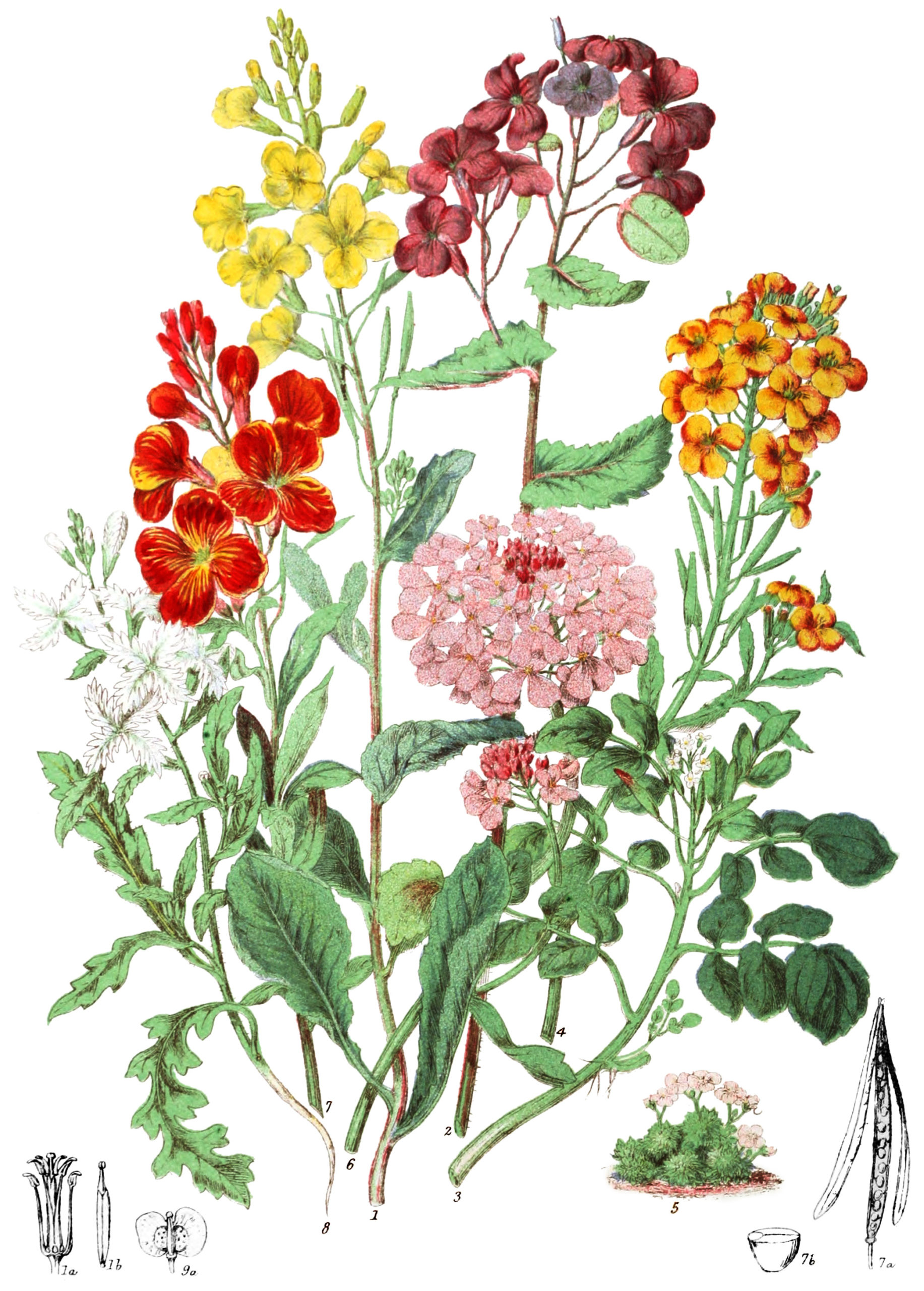
Vintage Botanical Print – 78 in a series – Orange Sherbet from Magasin för Blomster-Älskare och Idkare av Trägårds-Skötsel

The image depicts a botanical illustration of a plant with four flowers. The flowers are vibrant orange with jagged edges and a central cluster of stamens and pistils. The petals have a slightly translucent quality, with visible veins and a gradient of color from a deeper orange at the edges to a lighter shade towards the center. The plant has a green stem with several leaves, some of which are broad and oval-shaped, while others are smaller and more elongated. The leaves have prominent veins and a glossy texture. One flower is partially open, revealing its inner structure, while the others are fully bloomed. The background is a plain, off-white color, which contrasts with the vivid colors of the flowers and leaves. The illustration is detailed and appears to be from a scientific or educational publication, with a signature or initials in the bottom left corner.

Provided by @altbot, generated privately and locally using Ovis2-8B

Click for larger image

Orange Sherbet
Magasin för Blomster-Älskare och Idkare av Trägårds-Skötsel. –
Author: PFEIFFER, August (1777-1842)
Pfeiffer’s “Magazine for Lovers of Flowers” is the first and only flower book in Sweden with hand-coloured plates presenting cultivated decorative flowers and fruit. It is a beautifully hand-coloured flower-book with most of the plates drawn and engraved by Pfeiffer, who also coloured the plates himself.


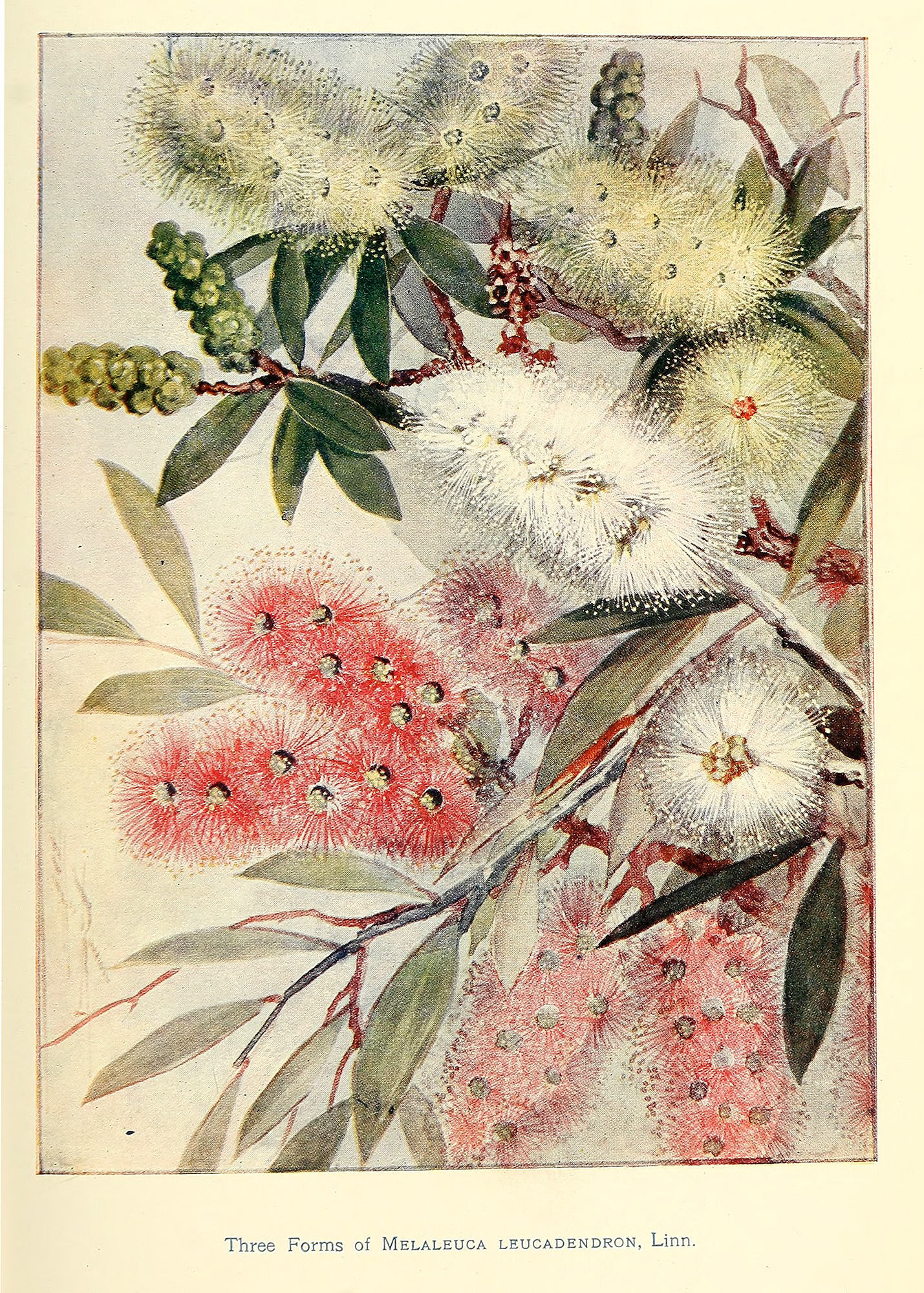
Vintage Botanical Print – 77 in a series- Three Forms of Melaleuca from Comprehensive catalogue of Queensland plants, both indigenous and naturalised (1909)

The image depicts a botanical illustration of the Melaleuca leucadendron plant, showcasing three distinct forms of its flowers. The illustration is detailed and colorful, with a light beige background. The flowers are arranged in clusters, with the top section featuring large, fluffy, yellowish-white blooms, the middle section displaying white flowers, and the bottom section showing vibrant red and pink flowers. Each flower cluster is surrounded by elongated, green leaves with a glossy texture. The branches are reddish-brown, adding contrast to the green leaves and colorful flowers. The illustration is framed by a thin red border, and at the bottom, there is a caption that reads Three Forms of Melaleuca Leucadendron, Linn.

Provided by @altbot, generated privately and locally using Ovis2-8B

Click for larger image


Rocky Mountain Flowers: The Daring Life and Art of Pioneering Plant Ecologist Edith Clements via The Marginalian [Shared]

Rocky Mountain Flowers: The Daring Life and Art of Pioneering Plant Ecologist Edith Clements – The Marginalian

Rocky Mountain Flowers: The Daring Life and Art of Pioneering Plant Ecologist Edith Clements viaThe Marginalian [Shared]

“There is one book that I would rather have produced than all my novels,” Willa Cather rued in her most candid interview about creativity. That book was Rocky Mountain Flowers: An Illustrated Guide For Plant-Lovers and Plant-Users by the pioneering plant ecologist and botanical artist Edith Clements (1874–1971).

Together with her husband, the influential botanist Frederic Clements, she pioneered the science of plant ecology, lending empirical substantiation to her contemporary John Muir’s poetic observation that “when we try to pick out anything by itself, we find it hitched to everything else in the universe.” In her 1960 memoir Adventures in Ecology: Half a Million Miles: From Mud to Macadam , penned shortly before Rachel Carson awakened the modern ecological conscience with Silent Spring and half a century before the climate calamity we are now living, Edith Clements prophesied:

“There seems little doubt that the application of the principles of ecology to human affairs, whether personal, national or world-wide, would go far in solving the problems that beset us.”

Read Rocky Mountain Flowers: The Daring Life and Art of Pioneering Plant Ecologist Edith Clements – The Marginalian