Refresh your home with something new and cute this summer. I am going to share some very creative and inexpensive DIY wall decor ideas. I will tell you today that how you could dress up your walls with inexpensive handmade crafts and decorations. All the wall decorations and crafts are made with inexpensive things and the steps for making these wall decor crafts are also very simple. I have added different ideas for decorating walls of different parts of home.
Monthly Archives: October 2017
In The Garden…New strawberry pots
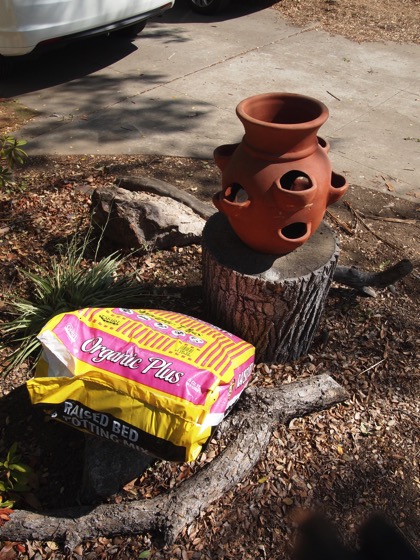
A week or so ago we picked up 2 new strawberry pots form the nursery. While the strawberries in our containers have been doing well, those in the ground were languishing. We figured it was best to get the remaining plants into containers and retrofit the bed to make it a little better for whatever might be planted there later.

I would have liked to place a watering pipe down the center of these pots but didn’t have anything on hand. This helps to distribute the water better throughout the pot, but as sometimes happens, you don’t always have the proper supplies on hand when you need them..

For this pot, I transplanted all the existing in-ground strawberry plants first and then filled in the remainder of the growing ports with runners from our existing container garden. These runners only had a few roots, so I am not sure if they will take or not, but it was a way of making the best use of both the runners and the pot space.

Keeping all of our containers watered is a bit fo challenge here in Southern California. Even today we are experiencing an Autumn Santa Ana Wind which has raised the temperature to almost 100 degrees. These temperatures and the strong winds can quickly dry out any container, so we have had to water every day or risk losing both these new plantings and older ones.

As of today, there are a few healthy looking strawberry plants in the pots along with a few that probably won’t make it. These are most likely the poorly rooted runners mentioned above. I’ll cultivate any new runners from the existing containers, root them in separate pots and then move them here to fill in any holes.
20% Off Everything Today Including these Sunflower Days Totes, Mugs, Smartphone Cases and More!
Including these Sunflower Days Totes, Mugs, Smartphone Cases and More!
Directly from my Instagram Photos
Available exclusively from
DouglasEWelch.com/shop
DouglasEWelch.com/shop/68 (Direct Link)
Tote Bag Features
- Selected design printed on both sides
- 1 inch wide super strong cotton shoulder strap (14 inch length)
- Soft yet hard wearing 100% spun Polyester Poplin fabric
- Dry or Spot Clean Only
View my entire portfolio of over 150 Designs
Befriend Bees via Sunset: Garden
Before a flower can set seed or form fruit, it needs to be pollinated. Though some plants are pollinated by bats, birds, butterflies, moths, and wasps, most of the work is done by bees.
Bees are in serious trouble, though. Their numbers are in sharp decline, mainly because of shrinking habitat. Fortunately, bees have some dedicated advocates like the Xerces Society. And home gardeners can help too. Here’s what you can do to promote a bee-friendly environment in your garden.
Rudbeckia in Fall Colors via Instagram
An amazing rudbeckia flower shines out in the Autumn sun.
Join the conversation on A Gardener’s Notebook on Facebook
* A portion of each sale from Amazon.com directly supports our blogs
** Books on rudbeckia may be available from your local library. Check it out!
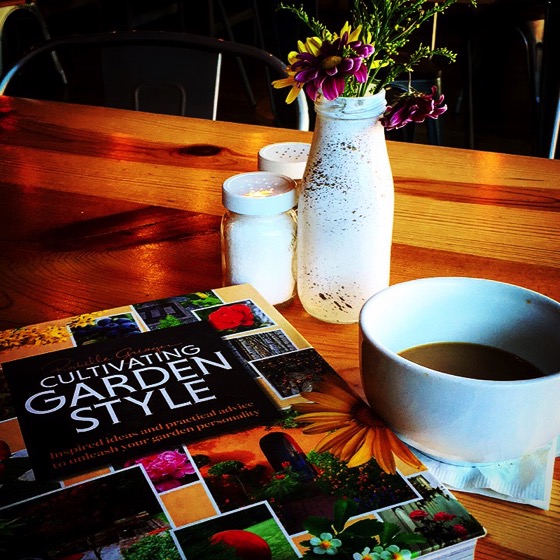
Garden Decor: Today’s Coffee Break Reading at Farm Table via Instagram
Today’s Coffee Break Reading at Farm Table
I walked to the library to pick up this book and grab a coffee this afternoon. Farm Table provides a nice place to grab an Americano and snack on the way back (They have some nice full meals, too)
Join the conversation on A Gardener’s Notebook on Facebook
* A portion of each sale from Amazon.com directly supports our blogs
** 4 books | 0 ebooks available at LA Public Library
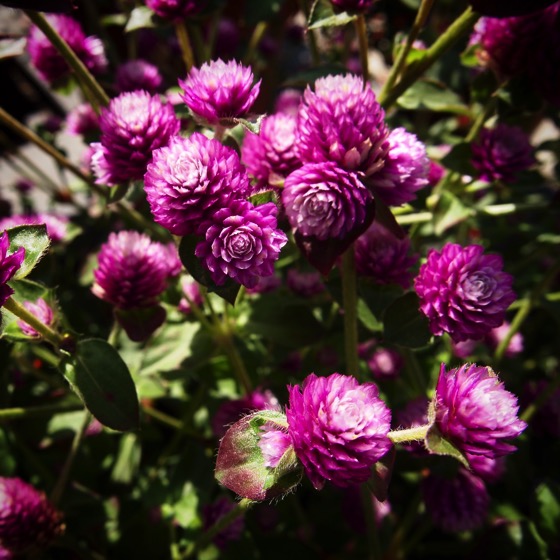
Gomphrena ‘Pinball Purple’ via Instagram
Spotted at the nursery this weekend. Might find a place in my front garden.
Join the conversation on A Gardener’s Notebook on Facebook
From Missouri Botanic Garden…
Annual. Easily grown in average, well-drained soils in full sun. Although mature plants exhibit good drought resistance, plants grow best with regular moisture throughout the growing season. Extremely good heat tolerance. Sow seed directly in the garden after last frost date. Use ample amounts of seed since germination rate can be quite low. For earlier bloom, start seeds indoors 6-8 weeks before last frost. Most nurseries carry plants in cell/six packs. Set seedlings or purchased plants out after last frost date. Pinch young plants to promote bushiness.
* A portion of each sale from Amazon.com directly supports our blogs
** Many of these books may be available from your local library. Check it out!
Fall flower at the nursery via Instagram

Fall flower at the nursery
I didn’t catch the name of this plant, but the Flower certainly caught my eye as I walked around the nursery this weekend.
Join me on Douglas E. Welch Photography on Facebook
* A portion of each sale from Amazon.com directly supports our blogs
** Many of these books may be available from your local library. Check it out!
In the garden…New Obelisk for the Clytostoma

Finally — I know I use that word a lot — I was finally able to locate and install a new, steel frame, obelisk so the clytostoma vine wasn’t flopping over itself with nothing to climb on. It used to cover a trellis that ran along my office windows, but that came down in disrepair years ago. I left one post for it to scramble on, but even that eventually collapsed from rot. So it just stood there, self-supporting on its thick lower vines and flopping over more and more.

At the nursery yesterday, though, we happened upon an obelisk that met all our needs. It was tall, at least 7 feet to give the vine some space to sprawl. It also had to be cheaper than the typical $100-$200 dollars I was seeing online and locally. For whatever reason, this steel frame, simple but elegant was only $50. Sold!

I trimmed out some of the more sprawling vines, removed the remains of a stake that had probably been with the plant since it was put in the ground, and then set the obelisk over. With a little judicious pushing and pulling my wife and I got the plant situated. That said, the trunk vines are old, thick and a bit forceful. I will probably have to stake at least one side into the ground to counteract that natural pull towards the sun.

I think it looks quite nice and it also provides some space for hanging some other decorative items. Now that it has some support it should flower much more and it can be trimmed back to the frame each year to keep it neat.

If you can’t find the obelisk you want locally, Amazon has quite a few. It might, at least, give you some ideas of what you are after for your garden.
* A portion of each sale from Amazon.com directly supports our blogs
Interesting Plant: Cupressus cashmeriana
I really like the weeping habit of this cypress. At around 40’ tall it is a bit too large for my garden but I could easily see it being a focal point of a larger garden. — Douglas

What are your thoughts on this Interesting Plant? Drop a note in the comments!
Cupressus cashmeriana (Bhutan cypress, Kashmir cypress, weeping cypress;[1] Dzongkha language: Tsenden) is a species of cypress native to the eastern Himalaya in Bhutan and adjacent areas of Arunachal Pradesh in northeastern India. It is also introduced in China and Nepal.[1] It grows at moderately high altitudes of 1,250–2,800 metres (4,100–9,190 ft).[2]
Cupressus cashmeriana is a medium-sized to large coniferous tree growing 20–45 metres (66–148 ft) tall, rarely much more, with a trunk up to 3 metres (9.8 ft) diameter. The foliage grows in strongly pendulous sprays of blue-green, very slender, flattened shoots. The leaves are scale-like, 1–2 mm long, up to 5 mm long on strong lead shoots; young trees up to about 5 years old have juvenile foliage with soft needle-like leaves 3–8 mm long.[2]
The seed cones are ovoid, 10–21 mm long and 10–19 mm broad, with 8–12 scales, dark green, maturing dark brown about 24 months after pollination. The cones open at maturity to shed the seed. The pollen cones are 3–5 mm long, and release pollen in early spring.
A tree of 95 metres (312 ft) tall has recently been reported,[3] but the measurements await verification. – Wikipedia
More information on Cupressus cashmeriana :
- Cupressus cashmeriana on Wikipedia
- Cupressus cashmeriana at Missouri Botanical Garden
- Cupressus cashmeriana at San Marcos Growers
View all past “Interesting Plant” posts
Interesting Plant is a series from A Gardener’s Notebook blog and podcast that highlights the most interesting plants I find in my Internet and real-world travels — Douglas