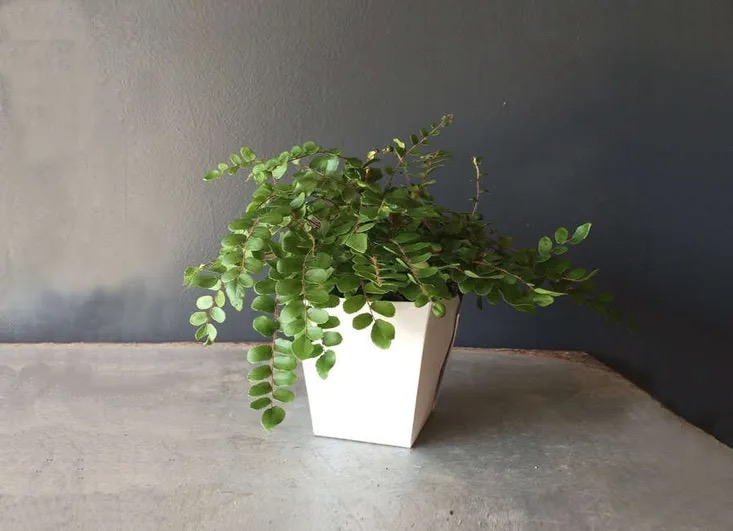
Lately, I’ve been in the market for a houseplant to add some life to my small apartment bathroom. My two requirements: It must be able to survive in the windowless and humid atmosphere of a Manhattan bathroom, and it can’t be too spiky (lest I accidentally bump into it after a shower). I’ve finally found the perfect solution: the button fern. These petite houseplants have soft, velvety leaves and thrive in humidity. Here’s what you need to know before adopting your own button fern.
Mimosa pudica[2] (from Latin: pudica “shy, bashful or shrinking”; also called sensitive plant, sleepy plant, action plant,[3]Dormilones, touch-me-not, shameplant, zombie plant, shy lady or shy plant) is a creeping annual or perennialflowering plant of the pea/legume family Fabaceae and Magnoliopsida taxon, often grown for its curiosity value: the compound leaves fold inward and droop when touched or shaken, defending themselves from harm, and re-open a few minutes later.[4] In the UK it has gained the Royal Horticultural Society‘s Award of Garden Merit.[3][5]
The species is native to South and Central America, but is now a pantropical weed, and can be found in Southern United States, South Asia, East Asia and South Africa as well. It is not shade tolerant, and is primarily found on soils with low nutrient concentrations[6]Mimosa pudica is well known for its rapid plant movement. Like a number of other plant species, it undergoes changes in leaf orientation termed “sleep” or nyctinastic movement. The foliage closes during darkness and reopens in light.[7] This was first studied by the French scientist Jean-Jacques d’Ortous de Mairan. Due to Mimosa’s unique response to touch, it became an ideal plant for many experiments regarding plant habituation and memory..— Wikipedia
What are your thoughts on this Interesting Plant? Drop a note in the comments!
Interesting Plant is a series from A Gardener’s Notebook blog and podcast that highlights the most interesting plants I find in my Internet and real-world travels — Douglas
Fritillaria meleagris is a Eurasianspecies of flowering plant in the lily family.[2][3][4] Its common names include snake’s head fritillary, snake’s head (the original English name), chess flower, frog-cup, guinea-hen flower, guinea flower, leper lily (because its shape resembled the bell once carried by lepers), Lazarus bell, chequered lily, chequered daffodil, drooping tulip or, in northern Europe, simply fritillary.[5] The plant is native to the flood river plains of Europe where it grows in abundance.[6]
The name Fritillaria comes from the Latin fritillus meaning dice-box, possibly referring to the chequered pattern on the flowers[7] although this derivation has been disputed.[8] The name meleagris means “spotted like a guineafowl“.[9] The common name “snake’s head” probably refers to the somewhat snakelike appearance of the nodding flower heads, especially when in bud, on their long stems. Vita Sackville-West called it “a sinister little flower, in the mournful colour of decay”.[8] — Wikipedia
What are your thoughts on this Interesting Plant? Drop a note in the comments!
Interesting Plant is a series from A Gardener’s Notebook blog and podcast that highlights the most interesting plants I find in my Internet and real-world travels — Douglas
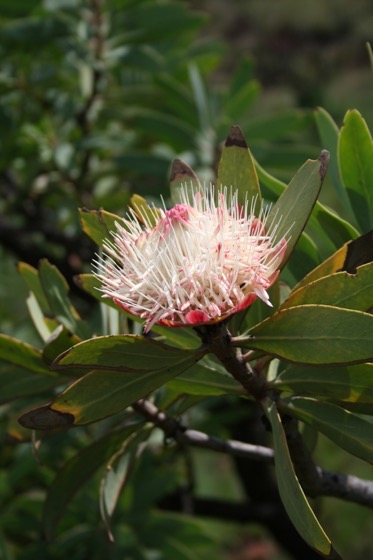
Protea /ˈproʊtiːə/[1] is both the botanical name and the English common name of a genus of South African flowering plants, sometimes also called sugarbushes (Afrikaans: suikerbos). In local tradition, the protea flower represents change and hope.
The genus Protea was named in 1735 by Carl Linnaeus after the Greek god Proteus, who could change his form at will, because they have such a wide variety of forms. Linnaeus’s genus was formed by merging a number of genera previously published by Herman Boerhaave, although precisely which of Boerhaave’s genera were included in Linnaeus’s Protea varied with each of Linnaeus’s publications.— Wikipedia
Interesting Plant is a series from A Gardener’s Notebook blog and podcast that highlights the most interesting plants I find in my Internet and real-world travels — Douglas
The ‘Goldfinger’ will add a long-lasting splash of colour to your garden as the flowers are a vivid buttery yellow colour and appear from May to October. This hardy plant is great for costal locations and its dense and bushy habit makes it the perfect choice for a border. The foliage is pinnate in shape and has a lovely dark grey green colour to it. Plant this shrub alongside other potentillas like the ‘Red Lady’ to enjoy contrasting flowering colours. — Mail Order Trees
Some species are called tormentils, though this is often used specifically for common tormentil (P. erecta). Others are referred to as barren strawberries, which may also refer to P. sterilis in particular, or to the closely related but not congenericWaldsteinia fragarioides. — Wikipedia
What are your thoughts on this Interesting Plant? Drop a note in the comments!
Interesting Plant is a series from A Gardener’s Notebook blog and podcast that highlights the most interesting plants I find in my Internet and real-world travels — Douglas
Clerodendrum trichotomum, the harlequin glorybower, glorytree or peanut butter tree, is a species of flowering plant in the familyLamiaceae. It is native to China, Korea, Taiwan, Japan, India, and the Philippines[1].[2]
It is a large deciduousshrub, growing 3–6 metres (10–20 ft) high. The leaves are ovate, up to 12 cm (5 in) long, soft and downy or hairy, producing a peanut odor when crushed. The fragrant flowers are borne on branching peduncles. They have white petals, held within a green calyx which turns red as the fruits ripen. The fruits (drupes) are white, changing to bright blue and eventually dark blue on maturity.[3] They contain the novel blue pigment trichotomine.[4]
It is cultivated for its fragrant flowers, autumn colour, and ornamental berries. It ishardybut requires a sheltered position. ThevarietyC. trichotomumvar.fargesii(Farges’ harlequin glorybower) and thecultivarC. trichotomumvar.fargesii‘Carnival’[5]have gained theRoyal Horticultural Society‘sAward of Garden Merit.[6](confirmed 2017).[7]– Wikipedia
What are your thoughts on this Interesting Plant? Drop a note in the comments!
Interesting Plant is a series from A Gardener’s Notebook blog and podcast that highlights the most interesting plants I find in my Internet and real-world travels — Douglas
Interesting Plant: Paeonia lactiflora ‘Honey Gold’ via Jimmy Turner on Twitter
Paeonia lactiflora ‘Honey Gold’ @redbuttegarden This blowsy bloomer has large flowers of white cream and just a tiny pinch of pink. Smell amazing too! pic.twitter.com/ArHlRiCLrj
Interesting Plant is a series from A Gardener’s Notebook blog and podcast that highlights the most interesting plants I find in my Internet and real-world travels — Douglas
This irresistible new cosmos reminds us of the Sugarplum Fairy. The pale blush petals on this large bloomer are fused together forming a teacup shaped flower. Blooms are as big as the palm of your hand and the edges look like they have been cut with pinking shears. This romantic variety is a mix of single, semi double, streaked and solid flowers. Perfect for wedding work. A must grow!- Floret Flowers
What are your thoughts on this Interesting Plant? Drop a note in the comments!
Interesting Plant is a series from A Gardener’s Notebook blog and podcast that highlights the most interesting plants I find in my Internet and real-world travels — Douglas
Tacca chantrieri is an unusual plant in that it has black flowers. These flowers are somewhat bat-shaped, are up to 12 inches across, and have long ‘whiskers’ that can grow up to 28 inches. There are ten species in the genus Tacca.[1] One of these, T. integrifolia, is commonly called the “white bat plant.” T. integrifolia is similar to T. chantrieri, but has white bracts which are veined purple. T. integrifolia is larger than T. chantrieri, reaching up to four feet in height (almost twice the size of T. chantrieri at a height of 24″-36″).[2] — Wikipedia
What are your thoughts on this Interesting Plant? Drop a note in the comments!
Interesting Plant is a series from A Gardener’s Notebook blog and podcast that highlights the most interesting plants I find in my Internet and real-world travels — Douglas
Dichelostemma ida-maia is a species of flowering plant known as firecracker flower. It is native to northern California and southern Oregon, where it grows in mountain forests, woodlands, and coastal meadows. It is also widely cultivated as an ornamental plant for its showy crimson and cream flowers.
Dichelostemma ida-maia is a perennial which erects a tall, naked stem topped with an umbel of six to 20 flowers. Each flower is a cylindrical red tube two to three centimeters long. The tip of each flower lobe curls back to reveal a shiny white underside. The curls rim the mouth of the tubular flower in a corona, surrounding the small anthers and a stalked ovary. The flower hangs when it is in anthesis and holds itself erect as the fruit develops. One umbel may have some hanging flowers and some erect fruiting flowers at the same time. — Wikipedia
What are your thoughts on this Interesting Plant? Drop a note in the comments!
Interesting Plant is a series from A Gardener’s Notebook blog and podcast that highlights the most interesting plants I find in my Internet and real-world travels — Douglas