Garden Alphabet: Marigold (Calendula officinalis)

Garden Alphabet: Marigold (Calendula officinalis)

Behold the modest Marigold. I see them everywhere and I am sure you do, too. Still, they do bring a certain kind of exuberance to the garden and are easy-as-pie to grow. These examples come from a neighbors circular, brick, planter, where they plant a regular succession of annuals in their from yard.

These marigolds are a good reminder that even those “common” plants and flowers can bring a significant splash of color to the garden, even if others might think them a bit cliche. 

Marigold

Marigold

Calendula officinalis (pot marigoldruddlescommon marigoldgarden marigoldEnglish marigold, or Scottish marigold)[1] is a plant in the genus Calendula of the family Asteraceae. It is probably native to southern Europe, though its long history of cultivation makes its precise origin unknown, and it may possibly be of garden origin. It is also widely naturalised further north in Europe (north to southern England) and elsewhere in warm temperate regions of the world.[2][3][1]

t is a short-lived aromatic herbaceous perennial, growing to 80 cm (31 in) tall, with sparsely branched lax or erect stems. The leaves are oblong-lanceolate, 5–17 cm (2–7 in) long, hairy on both sides, and with margins entire or occasionally waved or weakly toothed. Theinflorescences are yellow, comprising a thick capitulum or flowerhead 4–7 cm diameter surrounded by two rows of hairy bracts; in the wild plant they have a single ring of ray florets surrounding the central disc florets. The disc florets are tubular and hermaphrodite, and generally of a more intense orange-yellow colour than the female, tridentate, peripheral ray florets. The flowers may appear all year long where conditions are suitable. The fruit is a thorny curved achene.[2][1] — Wikipedia.org

More information on Tomato:
Plants and Seeds:


Previously in Garden Alphabet:

Video: In the garden…August 28, 2013: On the iPhone and in the garden with beans and carrots

Agn artwork

Recording with the iPhone today, as part of a demo for the Dog Days of Podcasting 30 Day Challenge. I wanted to show how you can use it as your video recorder if you don’t have anything else.

We check in on the beans, carrots and green onions we planted in the newly raised bed on the north side of the front garden, pull some grass and more!

Part of the “Dog Days of Podcasting” 30 Day Challenge – http://dogdaysofpodcasting.com

Itg 20130828 thumb

Watch all past episodes of “In the garden…” in this YouTube Playlist


Please Like this video and/or subscribe to my channel on YouTube.

Your likes and subscriptions directly reflect how many other viewers are suggested this video.


“In the garden…” is a series for A Gardener’s Notebook highlighting what is happening in my garden, my friend’s gardens and California gardens throughout the seasons.

Interesting Plant: Rudbeckia hirta Moreno

Interesting Plant: Rudbeckia hirta Moreno

Rudbeckia moreno

Discovered via Pinterest User, Rachel Ottenberg

Lovely dark and striking colors, along with double-petaled blooms in this Rudbeckia.

Wonderful, free flowering dwarf Gloriosa Daisy with deep chocolate colored petals that radiate to bronze to orange to yellow at their tips. Rudbeckia Moreno has a very compact (12″) branching habit producing an abundance of flowers. Pronounced center cone adds to the beauty of this flower. In fall and winter, finches and chickadees adore the ripened seed heads. Combines well with Perovskia (Russian Sage).Bluestone Perennials

More information on Rudbeckia hirta Moreno:

 From Amazon.com:
 

Previously in the Interesting Plant series: 

Interesting Plant is a series from A Gardener’s Notebook blog and podcast that highlights the most interesting plants I find in my Internet and real-world travels — Douglas

Video: Container Garden Update 39: Soakers are soaking and radishes are growing

As part of the Dog Days of Podcasting (http:/dogdaysofpodcasting.com) I am showing off a wide variety of podcasting styles and methods.

A quick check on the radishes, carrots and the potting bench. The soaker hoses seem to be working well and everything is growing well, even with all the heat we are having. It does make it difficult to keep things growing on the potting bench, but as the temperatures drop I plan on working there more.

See what was happening in the container garden last year at this time: Container Garden Update 5


Agn container thumbnail 39

Subscribe on YouTube:


Garden Inventory: Carrotwood (Cupaniopsis anacardioides)

Garden Inventory is a series where I begin an inventory of all the plants and trees in my garden. Along with some of my own pictures, I will link to various sources of information about each plant and tree so we can learn a little more together. As part of the Dog Days of Podcasting, and in order to expand the videos available on my YouTube Channel, this installation of Garden Inventory includes a companion video.

Garden Inventory: Carrotwood (Cupaniopsis anacardioides)

When we purchased our house back in 1996, it was over planted with trees, including probably 10 of these Carrotwood. Over the years, I have edited out 5 or 6 of them to help open up the back garden to more sunlight and reduce competition among the trees. Throughout that process, I have usually kept the carrotwood as they are low to no maintenance and seem to do well whether we are having a wet or dry year. These are quite common trees here in the San Fernando Valley. I often see them as landscape and street trees, especially in new developments. I would imagine this is because they grow fairly quickly.

Carrotwood has a fairly dense growth, but less than the Ficus benjamina, which I also have the in garden. The leaves are similarly heavy and waxy, but there are fewer on each stem, so the overall effect is less heavy.

In most years, Carrotwood will flower and fruit, although this year there seemed to be less. I would guess it depends on the weather and also the pollinators available. I had noticed that trees only a few streets over were heavily fruited, as mine have been in previous years. It seems that there isn’t much wildlife that eats the seeds here, although I have witnessed mockingbirds carrying seeds away in the past.

Carrotwood can be single or multi-trunked, although most in my garden are single. As you might be able to see in the video, the branches in my trees are fairly unkempt and tangled, which I think is mainly due to poor maintenance when they were younger.

Overall, the information on this tree seems to be “DON’T PLANT IT!” Pity I have so many on the property. Hmmm….

Agn ginvent thumb


Video of Carrrotwood (Cupaniopsis anacardioides) with closeups of  leaves,  growing habit, and flowers.

Cupaniopsis anacardioides, with common names tuckeroocarrotwoodbeach tamarind and green-leaved tamarind, is a species offlowering tree in the soapberry family, Sapindaceae, that is native to eastern and northern Australia. The usual habitat is littoral rainforeston sand or near estuaries. The range of natural distribution is from Seven Mile Beach, New South Wales (34.8° S) to Queensland, northern Australia and New Guinea.

C. anacardioides is an invasive species in some parts of the United States, primarily Florida and Hawaii.[1]

It is small tree with attractive foliage, growing up to ten metres tall with a stem diameter of 50 cm. The bark is smooth grey or brown with raised horizontal lines. The bases of the trees are usually flanged.

Leaves are pinnate and alternate with six to ten leaflets. These are not toothed, and are egg shaped to elliptic oblong, 7 to 10 cm long. The tips are often notched or blunt. Leaf veins are evident on both sides. The veins are mostly raised underneath.

Greenish white flowers form on panicles from May to July. The fruit is an orange to yellow capsule with three lobes. There is a glossy dark brown seed inside each lobe. The seeds are covered in a bright orange aril. Fruit ripens from October to December, attracting many birds including Australasian FigbirdOlive-backed Oriole and Pied Currawong.

Germination from fresh seed occurs without difficulty, particularly if the seed is removed from the aril and soaked for a few days. – Wikipedia.org


More information on Carrrotwood (Cupaniopsis anacardioides):

Previously on Garden Inventory:

Garden Alphabet: Tomato

Garden Alphabet: Tomato

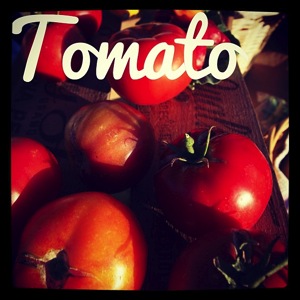
During a recent neighborhood block party, these tomatoes were on-display for produce swapping. I understand they were scooped up quite quickly. No surprise there. (LAUGH)

Garden alphabet tomato

Tomato

The tomato is the edible, often red fruit of the plant Solanum lycopersicum, commonly known as a tomato plant. Both the species and its use as a food originated in Mexico, and spread around the world following the Spanish colonization of the Americas. Its many varieties are now widely grown, sometimes in greenhouses in cooler climates.

 The tomato is consumed in diverse ways, including raw, as an ingredient in many dishes, sauces, salads, and drinks. While it is botanically a fruit, it is considered a vegetable for culinary purposes (as well as by the United States Supreme Court, see Nix v. Hedden), which has caused some confusion. The fruit is rich in lycopene, which may have beneficial health effects.

 The tomato belongs to the nightshade family. The plants typically grow to 1–3 meters (3–10 ft) in height and have a weak stem that often sprawls over the ground and vines over other plants. It is a perennial in its native habitat, although often grown outdoors in temperate climates as an annual. An average common tomato weighs 102–105 grams.[2][3] — Wikipedia.org

More information on Tomato:
 
Plants and Seeds:


Previously in Garden Alphabet:

Interesting Plant: Kalanchoe Tomentosa

Interesting Plant: Kalanchoe Tomentosa

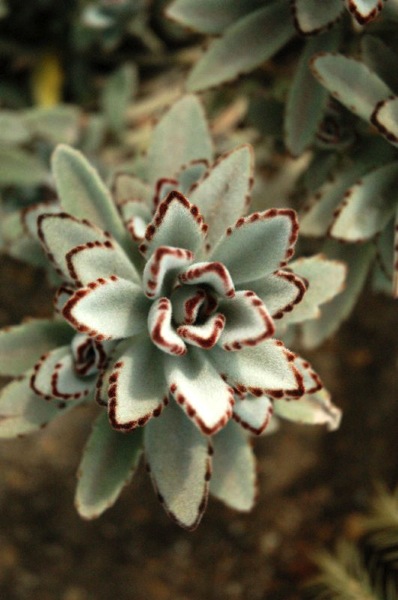
Kalanchoe tormentosa

Discovered via Pinterest User, Zach Revense

Lovely markings on the edge of these kalanchoe leaves. So much variety in succulents and nearly always something interest to see — and maybe even grow in your garden.

“Thick, soft, furry leaves give Panda Plant its common name. Other names for this succulent plant are Pussy Ears and Chocolate Soldier.

Branching from the central stem, the plump, rounded leaves taper to a point. They’re silvery green marked with reddish-brown edges. The “fur” is actually soft, fine hair that covers these succulent plants.

In its native habitat, Panda Plant produces fuzzy, bell-shaped flowers in spring and summer. However, it rarely flowers indoors.

Decorative year-round, it makes a beautiful addition to indoor succulent gardens. Like other succulent types, it stores water so it rarely needs watering.

And like other types of succulents, Panda Plant is tolerant of dry air. It makes a good house plant for heated homes. Just give it plenty of light and it’ll thrive for many years. — Guide to Houseplants


More information on Kalanchoe Tomentosa:

 From Amazon.com:
 

Previously in the Interesting Plant series: 

Interesting Plant is a series from A Gardener’s Notebook blog and podcast that highlights the most interesting plants I find in my Internet and real-world travels — Douglas

Video: In the garden…August 21, 2013: Grass where I don’t want it, flowers where I do and checking in

Agn artwork

Our new, upgraded watering system is helping out a lot with more blooms and healthy plants, but grass springs up from the beds once it gets a little moisture. Weeding will have to get more regular after this. I check in on some other recent and new additions to the back garden, too.

Part of the “Dog Days of Podcasting” 30 Day Challenge – http://dogdaysofpodcasting.com

Itg 20130821 thumb

Watch all past episodes of “In the garden…” in this YouTube Playlist


Please Like this video and/or subscribe to my channel on YouTube.

Your likes and subscriptions directly reflect how many other viewers are suggested this video.


“In the garden…” is a series for A Gardener’s Notebook highlighting what is happening in my garden, my friend’s gardens and California gardens throughout the seasons.

Video: Container Garden Update Live – Recorded Version – Episode 39

As part of the Dog Days of Podcasting (http:/dogdaysofpodcasting.com) I am showing off a wide variety of podcasting styles and methods.

Today, I will be streaming my weekly series, Container Garden Update, LIVE using Google+ Hangouts on Air.

Join us at 7pm EDT/4pm PDT, using the links below, to watch and interact live.

Agn container live thumbnail

Watch live and ask questions via Twitter, Google+ and more. I will embed the video on A Gardener’s Notebook blog page, (http://welchwrite.com/agn/) too, so you can watch directly from there.

Come join in the fun!

Video: In the garden…August 17, 2013: Planting carrots, cauliflower, green onions and beans

Agn artwork

Now that the side bed has been turned into a raised bed, it’s time to plant. Today I put in short rows of green onions, Parisian Carrots. Cauliflower and beans.

Part of the “Dog Days of Podcasting” 30 Day Challenge – http://dogdaysofpodcasting.com

Itg 20130817

Watch all past episodes of “In the garden…” in this YouTube Playlist


Please Like this video and/or subscribe to my channel on YouTube.

Your likes and subscriptions directly reflect how many other viewers are suggested this video.

“In the garden…” is a series for A Gardener’s Notebook highlighting what is happening in my garden, my friend’s gardens and California gardens throughout the seasons.