String of Dolphins (Senecio Peregrinus)

@douglaswelch String of Dolphins (Senecio Peregrinus) #succulent #plants #garden #gardening #nature #senecio ♬ Aesthetic – Tollan Kim


String of Dolphins (Senecio Peregrinus)

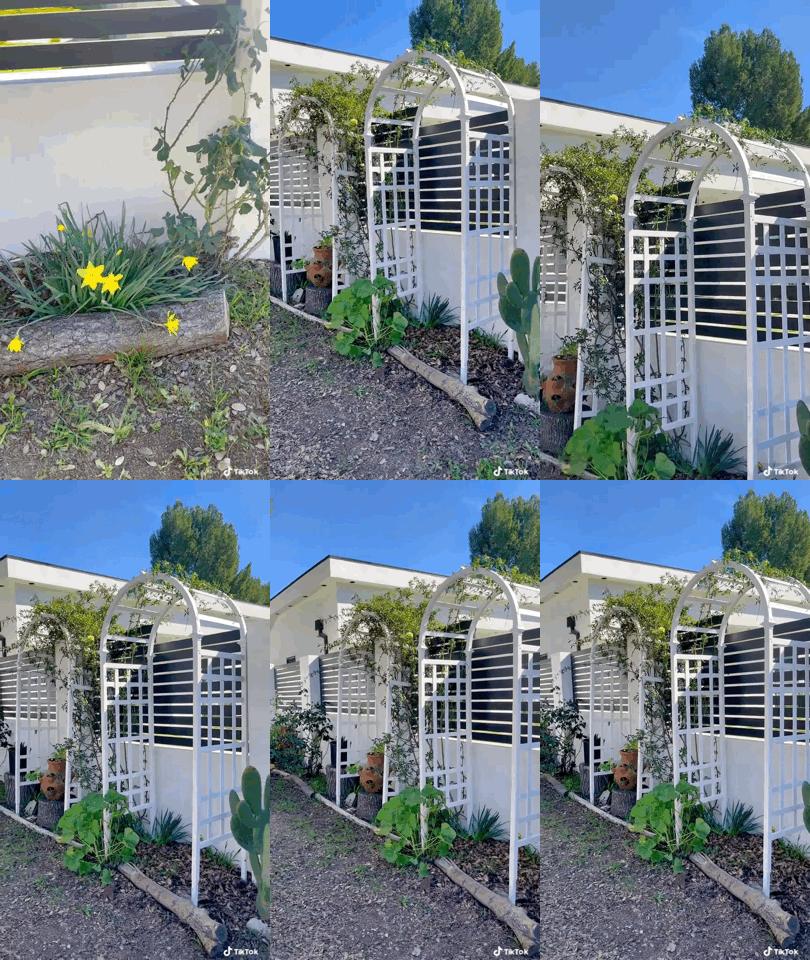
A second arbor for the Lady Bank’s Rose via TikTok [Video]

@douglaswelch A second arbor for the Lady Bank’s Rose #arbor #decor #garden #gardening #nature #outdoors #rose #plants #landscape ♬ original sound – Douglas E. Welch

A second arbor for the Lady Bank’s Rose via TikTok [Video]

In the garden…bulbs are rising via TikTok [Video]

@douglaswelch

In the garden…bulbs are rising ##garden ##bulbs ##plants ##california ##losangeles

♬ Here Comes the Sun – Acoustic Guitar Revival

In the garden...bulbs are rising via TikTok [Video]

Follow me on TikTok

Flowering Now: Gerbera Daisy in the Garden via Instagram

What is your favorite flower? Leave a comment and share!

It is always a welcome surprise to see these Gerbera Daisies popping up in the garden. They were originally decorations from a close friends memorial service and each time they appear they remind me of him. A great way to keep someone in your memories year after year. 

Flowering Now: Gerbera Daisy in the Garden via Instagram


Don’t miss a single post!

Sign up for the Gardener’s Notebook Mailing List


* A portion of each sale from Amazon.com directly supports our blogs
** Many of these books may be available from your local library. Check it out!
† Available from the LA Public Library

Flowering Now: Clivia Blooms in the Garden via Instagram

What is your favorite flower? Leave a comment and share!

I bought these clivia on discount last Fall and now they are blooming in the garden. I am sure the large amount of rain we received has helped but it great to have some color in this shady part of the garden. 

Flowering Now: Clivia Blooms in the Garden via Instagram


Don’t miss a single post!

Sign up for the Gardener’s Notebook Mailing List


* A portion of each sale from Amazon.com directly supports our blogs
** Many of these books may be available from your local library. Check it out!
† Available from the LA Public Library

Garden Inventory: Common Fig (Ficus carica)

Garden Inventory is a series where I begin an inventory of all the plants and trees in my garden. Along with some of my own pictures, I will link to various sources of information about each plant and tree so we can learn a little more together. As part of the Dog Days of Podcasting, and in order to expand the videos available on my YouTube Channel, this installation of Garden Inventory includes a companion video.


Garden Inventory: Common Fig (Ficus carica)

These trees pop up like weeds around here’d, due to the number of birds that eat the seeds and then drop them everywhere. Unlike other problematic volunteers here in Los Angeles, there is, at least, the possibility that they might produce edible fruit. We have several good fruiting trees in the neighborhood and usually have a least one growing in this location in the garden, directly below a power pole where birds like to perch.

I have removed several figs from this location, but since my wife like them, I am thinking of keeping this one and just keeping it pruned more closely, so it doesn’t threaten to take over the entire garden.

Common Fig (Ficus carica)Common Fig (Ficus carica)

Common Fig (Ficus carica)Common Fig (Ficus carica) 

Photo  of Common Fig (Ficus carica) with closeups of  leaves and growing habit.

The common fig (Ficus carica) is a species of flowering plant in the genus Ficus, from the family Moraceae, known as the common fig (or just the fig), انجیر (Urdu),அத்தி (Tamil), anjeer (Hindi), dumur (Bengali), תאנה (Hebrew) and تين (Arabic). It is the source of the fruit also called the fig, and as such is an important crop in those areas where it is grown commercially. Native to the Middle East and western Asia, it has been sought out and cultivated since ancient times, and is now widely grown throughout the temperate world, both for its fruit and as an ornamental plant.[1][2] 

The common fig tree has been cultivated since ancient times and grows wild in dry and sunny areas, with deep and fresh soil; also in rocky areas, from sea level to 1,700 meters. It prefers light and medium soils, requires well-drained soil, and can grow in nutritionally poor soil. Like all fig trees, Ficus carica requires wasp pollination of a particular species of wasp (Blastophaga psenes) to produce seeds. The plant can tolerate seasonal drought, and the Middle Eastern and Mediterranean climate is especially suitable for the plant. Situated in a favorable habitat, old specimens when mature can reach a considerable size and form a large dense shade tree. Its aggressive root system precludes its use in many urban areas of cities, but in nature helps the plant to take root in the most inhospitable areas. Common fig tree is mostly a phreatophyte that lives in areas with standing or running water, grows well in the valleys of the rivers and ravines saving no water, having strong need of water that is extracted from the ground. The deep-rooted plant searches groundwater, in aquifers, ravines, or cracks in the rocks. The fig tree, with the water, cools the environment in hot places, creating a fresh and pleasant habitat for many animals that take shelter in its shade in the times of intense heat. — Wikipedia.org

More information on Common Fig (Ficus carica):

Previously on Garden Inventory:

Garden Inventory: Carrotwood (Cupaniopsis anacardioides)

Garden Inventory is a series where I begin an inventory of all the plants and trees in my garden. Along with some of my own pictures, I will link to various sources of information about each plant and tree so we can learn a little more together. As part of the Dog Days of Podcasting, and in order to expand the videos available on my YouTube Channel, this installation of Garden Inventory includes a companion video.

Garden Inventory: Carrotwood (Cupaniopsis anacardioides)

When we purchased our house back in 1996, it was over planted with trees, including probably 10 of these Carrotwood. Over the years, I have edited out 5 or 6 of them to help open up the back garden to more sunlight and reduce competition among the trees. Throughout that process, I have usually kept the carrotwood as they are low to no maintenance and seem to do well whether we are having a wet or dry year. These are quite common trees here in the San Fernando Valley. I often see them as landscape and street trees, especially in new developments. I would imagine this is because they grow fairly quickly.

Carrotwood has a fairly dense growth, but less than the Ficus benjamina, which I also have the in garden. The leaves are similarly heavy and waxy, but there are fewer on each stem, so the overall effect is less heavy.

In most years, Carrotwood will flower and fruit, although this year there seemed to be less. I would guess it depends on the weather and also the pollinators available. I had noticed that trees only a few streets over were heavily fruited, as mine have been in previous years. It seems that there isn’t much wildlife that eats the seeds here, although I have witnessed mockingbirds carrying seeds away in the past.

Carrotwood can be single or multi-trunked, although most in my garden are single. As you might be able to see in the video, the branches in my trees are fairly unkempt and tangled, which I think is mainly due to poor maintenance when they were younger.

Overall, the information on this tree seems to be “DON’T PLANT IT!” Pity I have so many on the property. Hmmm….

Agn ginvent thumb


Video of Carrrotwood (Cupaniopsis anacardioides) with closeups of  leaves,  growing habit, and flowers.

Cupaniopsis anacardioides, with common names tuckeroocarrotwoodbeach tamarind and green-leaved tamarind, is a species offlowering tree in the soapberry family, Sapindaceae, that is native to eastern and northern Australia. The usual habitat is littoral rainforeston sand or near estuaries. The range of natural distribution is from Seven Mile Beach, New South Wales (34.8° S) to Queensland, northern Australia and New Guinea.

C. anacardioides is an invasive species in some parts of the United States, primarily Florida and Hawaii.[1]

It is small tree with attractive foliage, growing up to ten metres tall with a stem diameter of 50 cm. The bark is smooth grey or brown with raised horizontal lines. The bases of the trees are usually flanged.

Leaves are pinnate and alternate with six to ten leaflets. These are not toothed, and are egg shaped to elliptic oblong, 7 to 10 cm long. The tips are often notched or blunt. Leaf veins are evident on both sides. The veins are mostly raised underneath.

Greenish white flowers form on panicles from May to July. The fruit is an orange to yellow capsule with three lobes. There is a glossy dark brown seed inside each lobe. The seeds are covered in a bright orange aril. Fruit ripens from October to December, attracting many birds including Australasian FigbirdOlive-backed Oriole and Pied Currawong.

Germination from fresh seed occurs without difficulty, particularly if the seed is removed from the aril and soaked for a few days. – Wikipedia.org


More information on Carrrotwood (Cupaniopsis anacardioides):

Previously on Garden Inventory:

Garden Inventory: Asiatic Dayflower (Commelina communis)

 Garden Inventory: Asiatic Dayflower (Commelina communis)

Commelina communis, commonly known as the Asiatic dayflower, is an herbaceous annual plant in the dayflower family. It gets its name because the blooms last for only one day.[1] It is native throughout much of East Asia and northern parts of Southeast Asia. In China, the plant is known as yazhicao (simplified Chinesetraditional Chinese鴨跖草pinyinyāzhīcǎo),[2] roughly translating to “duckfoot herb”, while in Japan it is known as tsuyukusa ( tsuyukusa?),[3] meaning “dew herb”. It has also been introduced to parts of central and southeastern Europe and much of eastern North America, where it has spread to become a noxious weed. It is common in disturbed sites and in moist soil. The flowers emerge from summer through fall and are distinctive with two relatively large blue petals and one very reduced white petal..- Wikipedia.org

Reading up on the Asiatic Dayflower, it seems it can be quite a bully in the garden, depending on your geographic area and even the microclimate of your garden. Here in my garden, I had a patch under a pine tree that we have since removed. This is now the onion bed you may have seen in my recent video “Onion Harvest”. It never received much what and just sort of coasted in this one area, never spreading (or doing much of anything, for that matter.)

A more knowledgeable friend identified the plant for me and so I thought I might pull out some of the plants and use them to fill some empty pots I had lying about. In our heavily wooded lot, a bit of green is a nice change from all the brown of tree trunks and dropped leaves. Once in the pots, the dayflower took off nicely and I now have 2 containers  one near the front door, and one on our back patio.

Asiatic dayflower isn’t a showy plant at all. It’s stems can get a bir gangly an its small blue flowers only last 1 day, at best. Still, I find it a nice accent around the more trafficked areas of the house and something to offer a bit of green.

 Garden Inventory: Asiatic Dayflower (Commelina communis) - 3

Garden Inventory: Asiatic Dayflower (Commelina communis) - 6Garden Inventory: Asiatic Dayflower (Commelina communis) - 5Garden Inventory: Asiatic Dayflower (Commelina communis) - 4

Garden Inventory: Asiatic Dayflower (Commelina communis) - 2Garden Inventory: Asiatic Dayflower (Commelina communis) - 1

Photos of Asiatic Dayflower (Commelina communis) with closeups of  leaves,  growing habit, and flowers.

More information on Asiatic Dayflower (Commelina communis):

Books:


Previously on Garden Inventory:

Garden Inventory is a series where I begin an inventory of all the plants and trees in my garden. Along with some of my own pictures, I will link to various sources of information about each plant and tree so we can learn a little more together.

I would also like to highlight your special plants and tress. Pass along your favorite plants in the comments and I will use them for future Garden Inventory posts. — Douglas

Garden Inventory: Podocarpus

Garden Inventory: Podocarpus

Podocarpus (pron.: /ˌpoʊdəˈkɑrpəs/;[1] from the Greek, podos, meaning “foot”, and karpos, meaning “fruit”) is a genus of conifers, the most numerous and widely distributed of the podocarp family Podocarpaceae. The 105 species of Podocarpus are evergreen shrubs or trees from 1-25 m (rarely to 40 m) in height. The leaves are 0.5-15 cm long, lanceolate to oblong, falcate (sickle-shaped) in some species, with a distinct midrib, and are arranged spirally, though in some species twisted to appear in two horizontal ranks. The cones have two to five fused scales, of which only one, rarely two, are fertile, each fertile scale with one apical seed. At maturity, the scales become berry-like, swollen, brightly coloured red to purple and fleshy, and are eaten by birds which then disperse the seeds in their droppings. The male (pollen) cones are 5-20 mm long, often clustered several together. Many species, though not all, are dioecious. — Wikipedia.org

Several of these trees are planted along our northern wall. I often see podocarpus used here in the San Fernando Valley of Los Angeles as privacy trees, although my particular trees aren’t very useful for this. I would guess that due to pruning all their foliage is atop a large, bare, trunk. It could also be a property of the particular variety of podocarpus, which I have not been able to discern.

These are not my favorite trees on the property and had I been willing to spend the money, I probably would have removed them long ago. They were planted to close to both the house and wall, they are, frankly, ugly in their shape — probably due to years of bad pruning — and they drop a tremendous amount of leaves that cover our roof and seem to get everywhere. I can see a future plan of removing these and placing some more decorative shrubs in the area.

Podocarpus seems to be a huge genus with lots of variety in growth habit, leaves and bark. They are listed as conifers, which surprises me, and some varieties look much more like a yew or fir than my specimens. I would probably be happier with a variety with those properties. 

Garden Inventory: Podocarpus - 4

Garden Inventory: Podocarpus - 9Garden Inventory: Podocarpus - 8Garden Inventory: Podocarpus - 7Garden Inventory: Podocarpus - 6

Garden Inventory: Podocarpus - 5Garden Inventory: Podocarpus - 3Garden Inventory: Podocarpus - 2Garden Inventory: Podocarpus - 1

Photos of Podocarpus with closeups of  leaves,  bark, and growing habit.

More information on Podocarpus:

Previously on Garden Inventory:

Garden Inventory is a series where I begin an inventory of all the plants and trees in my garden. Along with some of my own pictures, I will link to various sources of information about each plant and tree so we can learn a little more together.

I would also like to highlight your special plants and tress. Pass along your favorite plants in the comments and I will use them for future Garden Inventory posts. — Douglas

Garden Inventory: Chinese Elm (Ulmus parvifolia)

 Garden Inventory: Chinese Elm (Ulmus parvifolia)

Ulmus parvifolia, commonly known as the Chinese Elm[1] or Lacebark Elm, is a species native to China, Japan, North Korea and Vietnam.[2] It has been described as “one of the most splendid elms, having the poise of a graceful Nothofagus”.[3] 

A small to medium deciduous, semi-deciduous (rarely semi-evergreen) tree growing to 10–18 m (30–60 ft) tall with a slender trunk and crown. The leathery, lustrous green single-toothed leaves are small, 2–5 cm long by 1–3 cm broad, and often retained as late as December or even January in Europe and North America. The apetalous wind-pollinated perfect flowers are produced in early autumn, small and inconspicuous. The fruit is a samara, elliptic to ovate-elliptic, 10–13 mm long by 6–8 mm broad.[2] The samara is mostly glabrous, the seed at the centre or toward the apex, borne on a stalk 1–3 mm in length; it matures rapidly and disperses by late autumn. The trunk has a handsome, flaking bark of mottled greys with tans and reds, giving rise to its other common name, the Lacebark Elm, although scarring from major branch loss can lead to large canker-like wounds — Wikipedia.org

This tree dominates our front garden and, if left un-pruned long enough, can obscure the entire front of the house with it s large, heavily leaved and somewhat weeping limbs. We let it go far too long and just recently had it pruned back. Each time we have it pruned, I am reminded of how much I like it. The particular specimen was badly abused when we moved in 16 years ago, being nothing much more than a large trunk and nothing else. Luckily, after many years of proper pruning I think it looks like an elm once again. It has a nice habit and is truly a showpiece in the garden.

Chinese elm are a common “street tree” here in the San Fernando Valley, but I think it might be possible that are a few American Elms scattered about. I have noticed trees with similar stems and leaves, but with a completely different bark and it had been confusing my identification. Now I am going to go back to those tress and see if, perhaps, they are the American Elm.

Other than regular pruning, our elm requires almost no other care, which makes it a great tree for my garden. 

Garden Inventory: Chinese Elm (Ulmus parvifolia) - 05

Garden Inventory: Chinese Elm (Ulmus parvifolia) - 11Garden Inventory: Chinese Elm (Ulmus parvifolia) - 10Garden Inventory: Chinese Elm (Ulmus parvifolia) - 09Garden Inventory: Chinese Elm (Ulmus parvifolia) - 08Garden Inventory: Chinese Elm (Ulmus parvifolia) - 07

Garden Inventory: Chinese Elm (Ulmus parvifolia) - 06Garden Inventory: Chinese Elm (Ulmus parvifolia) - 04Garden Inventory: Chinese Elm (Ulmus parvifolia) - 03Garden Inventory: Chinese Elm (Ulmus parvifolia) - 02Garden Inventory: Chinese Elm (Ulmus parvifolia) - 01

Photos of Chinese Elm (Ulmus parvifolia) with closeups of  leaves,  bark, and growing habit.

More information on Chinese Elm (Ulmus parvifolia):

Previously on Garden Inventory:

Garden Inventory is a series where I begin an inventory of all the plants and trees in my garden. Along with some of my own pictures, I will link to various sources of information about each plant and tree so we can learn a little more together.

I would also like to highlight your special plants and tress. Pass along your favorite plants in the comments and I will use them for future Garden Inventory posts. — Douglas