Yearly Archives: 2013

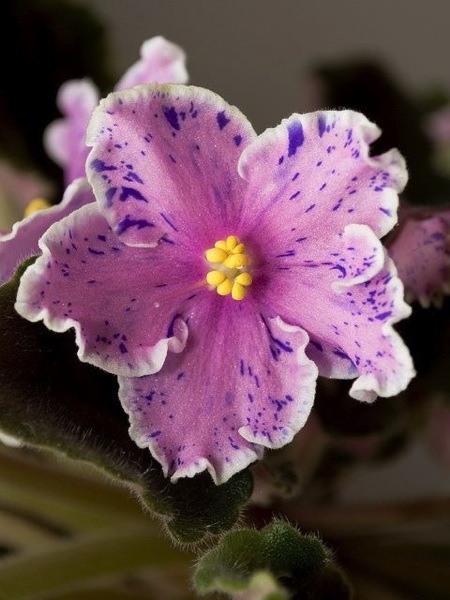
Interesting Plant: Saintpaulia ‘Rebel’s Splatter Kake’

Interesting Plant: Saintpaulia ‘Rebel’s Splatter Kake’

I never knew the Latin name for African Violets, even though my grandmother grew them religiously when I was growing up in Ohio. She had a 3-tier indoor planter covered with them. This particular Saintpaulia caught my eye in my travels though Pinterest and gave me and easy excuse and another entry for this Interesting Plant series. 

Saintpaulia

Discovered via Pinterest user Ammar Aue

Saintpaulias, commonly known as African violets, are a genus of 6–20 species of herbaceous perennial flowering plants in the family Gesneriaceae, native toTanzania and adjacent southeastern Kenya in eastern tropical Africa. Typically the African violet is a common household indoor plant but can also be an outdoor plant. Several of the species and subspecies are endangered, and many more are threatened, due to their native cloud forest habitats being cleared for agriculture.

Saintpaulias grow from 6–15 cm tall and can be anywhere from 6–30 cm wide. The leaves are rounded to oval, 2.5–8.5 cm long with a 2–10 cm petiole, finely hairy, and have a fleshy texture. The flowers are 2–3 cm in diameter, with a five-lobed velvety corolla (“petals”), and grow in clusters of 3–10 or more on slender stalks called peduncles. Wild species can have violet, purple, pale blue, or white flowers. — Wikipedia.org 

More information on Stenocarpus sinuatus:

From Amazon.com:
 

Previously in the Interesting Plant series: 

Interesting Plant is a series from A Gardener’s Notebook blog and podcast that highlights the most interesting plants I find in my Internet and real-world travels — Douglas

Photo: Sweet potato harvest and Snowflakes rising

Yesterday we harvested the bowl full of sweet potatoes you see here. While I was outside taking these photos I noticed that our Snowflakes (Leucojum) were rising out of the beds, too.

You can scroll down to see the video of our harvest or click over to the blog post, “Video: In the garden…December 28, 2013: Planting onion sets and harvesting some sweet potatoes.”

Sweet Potato Harvest

Sweet Potato Harvest

Snowflakes rising

Video: In the garden…December 28, 2013: Planting onion sets and harvesting some sweet potatoes

Agn artwork

Onion sets go into the ground while sweet potatoes come out.

It 20130228 thumb


Check out what was happening in the garden a year ago: “In the garden… – Planting Onion Sets – December 30, 2012

Check out my collection of gardening essays, “From A Gardener’s Notebook” now available as a Kindle eBook. (You don’t need a Kindle to read it, though. Read it on your PC, Link: http://j.mp/fagnbook


Watch all past episodes of “In the garden…” in this YouTube Playlist


Music: ‘Hustle” by Kevin MacLeod (http://incompetech.com) Licensed under Creative Commons: By Attribution 3.0

Please Like this video and/or subscribe to my channel on YouTube.

Your likes and subscriptions directly reflect how many other viewers are suggested this video.


“In the garden…” is a series for A Gardener’s Notebook highlighting what is happening in my garden, my friend’s gardens and California gardens throughout the seasons. 

Garden Alphabet: Echinacea

Garden Alphabet: Echinacea

I haven’t had much success growing Echinacea here in my garden, but I plan to keep trying. I love the large flowers and their lovely purple color.

Garden Alphabet: Echinacea | A Gardener's Notebook with Douglas E. Welch 

Echinacea

Echinacea /ˌɛkɨˈnʃ(i)ə/[1] is a genus, or group of herbaceous flowering plants in the daisy family, Asteraceae. The nine species it contains are commonly calledconeflowers. They are endemic to eastern and central North America, where they are found growing in moist to dry prairies and open wooded areas. They have large, showy heads of composite flowers, blooming from early to late summer. The generic name is derived from the Greek word ἐχῖνος (echino), meaning “sea urchin,” due to the spiny central disk. Some species are used in herbal medicines and some are cultivated in gardens for their showy flowers. — Wikipedia.org

More information on Tomato:
Books:


Plants and Seeds:


Previously in Garden Alphabet:

Garden Vocabulary: Annual

Garden Vocabulary LogoIn most gardens, annual plants are used to dress up flower beds and containers during the height of the growing season. Those gardeners in temperate zones tend to rely on annuals as they are designed to grow, flower and die within on growing season and therefore don’t require any special care or protection in order to overwinter. For myself, I don’t like the extra work required by annuals and prefer to plant perennial plants and shrubs whenever I can. Of course, here in Southern California, I would like to plant more native plants, many of which are annuals. These are often self-seeding, though, and that makes them almost a perennial if the conditions are right.

What can you share about this Garden Vocabulary entry? Help educate us all in the comments!

Garden Vocabulary: Annual

In gardening, an annual plant is a plant surviving just for one growing season. Many food plants are, or are grown as, annuals, including virtually all domesticated grains. Some perennials and biennials are grown in gardens as annuals for convenience, particularly if they are not considered cold hardy for the local climate. Carrot,celery and parsley are true biennials that are usually grown as annual crops for their edible roots, petioles and leaves, respectively. Tomatosweet potato and bell pepper are tender perennials usually grown as annuals.

Ornamental perennials commonly grown as annuals are impatienswax begoniasnapdragonPelargonium,coleus and petunia.” — Wikipedia

Sunflower is just one example of an annual plant
 
 
More information on Sepal:
Book on annual plants from Amazon.com:
 
  
Previously on Garden Vocabulary:

This Garden Vocabulary series seeks to introduce and explain to you — and in many cases, myself — words and terms associated with gardening. Please let me know if  there are any terms you would like me to explore. You can leave your ideas in the comments section and we can learn together!

Interesting Plant: Passiflora (Passion flower)

Interesting Plant: Passiflora (Passion flower)

Every time I pass a passiflora vine in the neighborhood I stop and stare. I am quite taken with the lovely, and to me, quite alien looking flowers. Their striking shapes and colors are unlike anything I see on a regular basis. I have grown 2 small vines here from seeds I gathered in the neighborhood, but their is a certain butterfly, the Gulf Fritillary, that adores the foliage of these vines and would strip my small ones down to the point where they couldn’t keep growing. I plan on trying again, perhaps with a little protection in order to get them established. Then the butterflies are more than welcome to lay their eggs there. I have successfully gathered and grown seeds from my neighbor’s plants, as long as I get to them before the birds — which seem to like the seeds, too.

Here are a couple of passiflora photos I have taken in the past.

Passiflora Flower

Passiflora Flower

Passiflora, known also as the passion flowers or passion vines, is a genus of about 500 species of flowering plants, the namesakes of the family Passifloraceae. They are mostly vines, with some being shrubs, and a few species being herbaceous. For information about the fruit of the passiflora plant, see passionfruit. The monotypic genusHollrungia seems to be inseparable from Passiflora, but further study is needed.

The family Passifloraceae has a pantropical distribution. Passiflora itself is absent from Africa, where many other members of the family Passifloraceae occur (e.g. the more plesiomorphic Adenia).

Nine species of Passiflora are native to the USA, found from Ohio to the north, west to California and south to theFlorida Keys. Most other species are found in South America, Eastern Asia, and Southern AsiaNew Guinea, four or more species in Australia and a single endemic species in New Zealand. New species continue to be identified: for example, P. pardifolia and P. xishuangbannaensis have only been known to the scientific community since 2006 and 2005, respectively.

Some species of Passiflora have been naturalised beyond their native ranges. For example, Blue Passion Flower (P. caerulea) now grows wild in Spain.[1] The purple passionfruit (P. edulis) and its yellow relative flavicarpa have been introduced in many tropical regions as commercial crops.

 — Wikipedia.org 

More information on Stenocarpus sinuatus:

From Amazon.com:


Previously in the Interesting Plant series: 

Interesting Plant is a series from A Gardener’s Notebook blog and podcast that highlights the most interesting plants I find in my Internet and real-world travels — Douglas

Elsewhere: Cooper’s Hawk in the birdbath – my video and photos from Animalbytes.net

Update: January 3, 2014: I captured some new Cooper’s Hawk footage yesterday. You can see it in this video, Interesting interaction between Cooper’s Hawk and Fox Squirrel (Accipter cooperii and Sciurus niger)

A month or so ago, our friend, Keri over at Animalbytes.net, shared some great pictures of a Cooper’s Hawk having a fine bath in her bird feeder. I have had Cooper’s Hawks do the same thing in my garden. You can see my Cooper’s Hawk video below along with a sample and link to Keri’s post.

From Animalbytes.net…

Even birds of prey need a drink or a bath now and then. Both the red-tailed hawks and the Cooper’s hawks seem to prefer the still, raised bird bath over the bubbling fountain 20 feet away. The juncos and the hermit thrush prefer a shallow dish placed under a rose bush. Water is vital for creating habitat.

Placing water in an open space enables birds to see any lurking dangers and frequently allows them to feel comfortable enough to happily splash and play in the water.

Read the entire article – Cooper’s Hawk comes in for a bath

Video: In the garden…December 21, 2013: Harvesting carrots and lettuce from the containers

Agn artwork

Time to pull the carrots from their pot along with some of the self-seeded lettuce. They made for a tasty dinner this evening. Even threw in a few nasturtium leaves and flowers for good measure.

Itg 20131221 thumb

Check out what was happening in the garden a year ago: “What Douglas Dug…Show 008 – Garden markers, blue pumpkins, bed frame gates and more! 

Check out my collection of gardening essays, “From A Gardener’s Notebook” now available as a Kindle eBook. (You don’t need a Kindle to read it, though. Read it on your PC, Link: http://j.mp/fagnbook


Watch all past episodes of “In the garden…” in this YouTube Playlist


Music: ‘Hustle” by Kevin MacLeod (http://incompetech.com) Licensed under Creative Commons: By Attribution 3.0

Please Like this video and/or subscribe to my channel on YouTube.

Your likes and subscriptions directly reflect how many other viewers are suggested this video.


“In the garden…” is a series for A Gardener’s Notebook highlighting what is happening in my garden, my friend’s gardens and California gardens throughout the seasons. 

<iframe width=”560″ height=”315″ src=”//www.youtube.com/embed/bBZ8MFSXZj0″ frameborder=”0″ allowfullscreen></iframe>

Garden Alphabet: Camellia

Garden Alphabet: Camellia

They only camellia bloomed for only the second time in 17 years, so I made sure to grab some photos. Most modern camellia are big, blousy things, with multiple-petals and huge flowers, while this one is simple and, I think, striking in its simplicity.

Garden Alphabet: Camellia | A Gardner's Notebook

Camellia

Camellia is a genus of flowering plants in the family Theaceae. They are found in eastern and southern Asia, from the Himalayas east to Japan and Indonesia. There are 100–250 described species, with some controversy over the exact number. The genus was named by Linnaeus after the Jesuit botanist Georg Joseph Kamel, who worked in the Philippines, though he never described a camellia. This genus is famous throughout East Asia; camellias are known as cháhuā (茶花) in Chinese, “tea flower”, an apt designation, as tsubaki (椿) in Japanese, as dongbaek-kkot (동백꽃) in Korean and as hoa trà or hoa chè in Vietnamese.


Of economic importance in the Indian subcontinent and Asia, leaves of C. sinensis are processed to create the popular beverage, tea. The ornamental Camellia japonicaCamellia oleifera and Camellia sasanqua and their hybrids are represented in cultivation by a large number of cultivars.— Wikipedia.org

More information on Tomato:
Books:
 

Plants and Seeds:


Previously in Garden Alphabet:

Gift Guide 2013: Yes, You Can! And Freeze and Dry It, Too: The Modern Step-By-Step Guide to Preserving Food

Yes, You Can! And Freeze and Dry It, Too: The Modern Step-By-Step Guide to Preserving Food

I heard about this book from the writer, who is a regular attendee of the weekly #gardenchat Twitter chat. His handle is @cityslipper. The book is chock-full of great ideas on how to preserve the bounty of your garden for those cold, dark, Winter days.

From Amazon.com…

“Preserving food is hot! The local food movement gains even more popularity as consumers return to vegetable gardening to grow their own food. They increasingly have become interested in the techniques for “putting up” their bounty. Driven by the recession; the need for healthier, chemical-free food,and taste, people everywhere are preserving the abundance of fruits, vegetables, and herbs harvested from their garden (or someone else’s). You don’t even have to grow your own to preserve freshness; non-gardeners too are learning to preserve with locally grown produce bought from local markets. Targeted at anyone who wants to capture the flavor of freshness, whether it’s from making tomato sauce, drying herbs, or preserving jams and jellies.”

More 2013 Gift Guide Items: