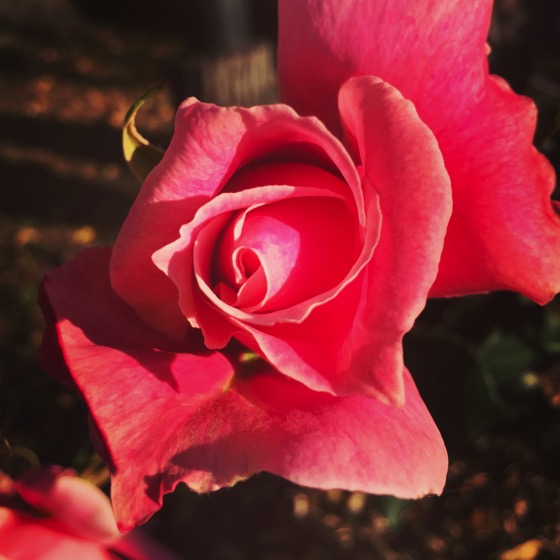
Our rain has kicked off a heavy bloom on our Bewitched Roses. This is the first mass bloom in a long time due to the extended drought.
Monthly Archives: January 2017
First Daffodil 2017 — A Minute in the Garden 53 from A Gardener’s Notebook
A Minute in the Garden: A series from A Gardener’s Notebook
Here is Los Angeles Spring arrives early. The paperwhites have been up for a while, but here is the first daffodil in the garden.
Music: “Life of Riley” by Kevin MacLeod (http://incompetech.com) under Creative Commons License
See all the videos in “A minute in the garden” series in this YouTube playlist
* A portion of each sale from Amazon.com directly supports our blogs
** Many of these books may be available from your local library. Check it out!
Help Support A Gardener’ Notebook!
- Buy Garden and flower photography products available from http://DouglasEWelch.com/buy
- Use our Amazon Affiliate Code by starting your shopping at http://welchwrite.com/bookstore
- Consider a donation via PayPal to support more garden posts, podcasts and videos!
- Follow A Gardener’s Notebook on Twitter
- Like A Gardener’s Notebook on Facebook
- Circle A Gardener’s Notebook on Google+
Podcast: Play in new window | Download
Subscribe: RSS
Interesting Plant: Cream Bush (Holodiscus discolor)
Starting a series within a series, I will be highlighting shade plants that grow well underneath trees, especially California Live Oak. I have a deep shade area beneath many trees here in my own garden and i am constantly looking for plants that can help green this area. — Douglas
Cream Bush (Holodiscus discolor)
Another striking white plant that works in partial shade, according to the folks at Las Pilitas Nursery. white, of course, brings some evening and night interest to your garden, too.
By Walter Siegmund (talk) – Own work, CC BY-SA 3.0, Link
What are your thoughts on this Interesting Plant? Drop a note in the comments!
The plant is common in the Pacific Northwest, and throughout California in diverse habitats including California mixed evergreen forest, California oak woodlands, chaparral, Coast redwood forest, Douglas-fir forest, Yellow pine forest, Red fir forest, and Lodgepole pine forest. It is native to regions of California including the High Sierra Nevada, Northern and Southern California Coast Ranges, Klamath Mountains, Santa Cruz Mountains, Western Transverse Ranges, and the San Gabriel Mountains.
It is found in both openings and the common understory shrub in a variety of forest overstories from 300–1,300 metres (980–4,270 ft) in elevation. It is found in a variety of habitats, from moist coastal forests to drier, cooler mountains of inland California. The plant is found in areas prone to wildfire, and it is often the first green shoot to spring up in an area recovering from a burn. It is commonly found in chaparral communities, a fire ecology ecosystem which evolved with burning periodically. It also may grow in areas cleared by logging.
In the California black oak woodland plant community, common understory associate species include Western poison-oak (Toxicodendron diversilobum), toyon (Heteromeles arbutifolia), and coastal wood fern (Dryopteris arguta).[6] — Wikipedia
More information on Cream Bush (Holodiscus discolor):
- Cream Bush (Holodiscus discolor) in Wikipedia
- Sierra Iris (Iris hartwegii) at Las Pilitas Nursery
- Cream Bush (Holodiscus discolor) at the Lady Bird Johnson Wildflower Center
- Sierra Iris (Iris hartwegii)
- Siskiyou Alum Root (Heuchera merriamii)
- Island Alum Root (Heuchera maxima)
- Wood Strawberry/California strawberry (Fragaria californica)
- Sticky Monkey Flower (Mimulus aurantiacus/Diplacus aurantiacus)
- Red Stem Dogwood (Cornus stolonifera/Cornus sericea)
- Blackfruit Dogwood (Cornus sessilis)
- California Spikenard and Elk Clover (Aralia californica)
- Bush Anemone (Carpenteria californica)
- California Pipevine/California Dutchman’s Pipe (Aristolochia californica)
- Wild Ginger (Asarum caudatum)
- Begonia Rex (Painted-leaf begonia)
- Leonotis leonurus
- Matilija Poppy (Romneya)
- Melocactus matanzanus (Turk’s Cap Cactus)
- Coleus “Redhead”
- Tiarella ‘Pink Skyrocket’
- Bacopa monnieri (Water hyssop)
- Lycoris squamigera (Naked Lady Lily)
- Kong Coleus (Plectranthus/Solenostemon scutellarioides “Kong Series”)
- Crassula plegmatoides
- Agave victoriae-reginae
- Mountain Cornflower (Centaurea montana)
- Euphorbia ‘Black Bird’
- Firecracker vine (Ipomoea lobata)
- Eryngium yuccifolium
- Dahlia ‘Karma Choc’
- Echeveria Agavoides
- Jerusalem Sage (Phlomis fruticosa)
- Hummingbird Sage (Salvia spathacea)
- Seaside Daisy, Beach Aster (Erigeron glaucus)
- Toyon (Heteromeles arbutifolia)
- California Lilac (Ceanothus)
- Bigberry Manzanita (Arctostaphylos glauca)
- Douglas Iris (Iris douglasiana)
- Malva Rosa (Lavatera assurgentiflora)
- Baby Blue-Eyes (Nemophila)
- Coral Bells or Alum Root (Heuchera)
- Deer Grass (Muhlenbergia rigens)
- Echeveria ‘Lola’
- View all past “Interesting Plant” posts
Interesting Plant is a series from A Gardener’s Notebook blog and podcast that highlights the most interesting plants I find in my Internet and real-world travels — Douglas
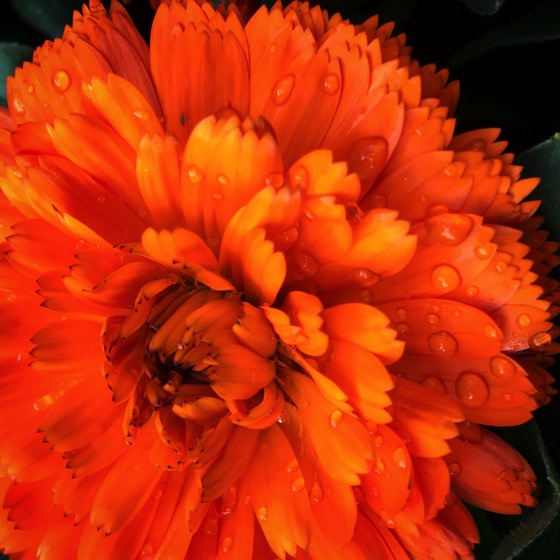
Marigold with Raindrops
After the rain these double marigolds collect raindrops that shone in the sun.
Follow A Gardener’s Notebook on Facebook
Buy this photo on these products and much more!
New Plant: Navaho Blackberry (Rubus)
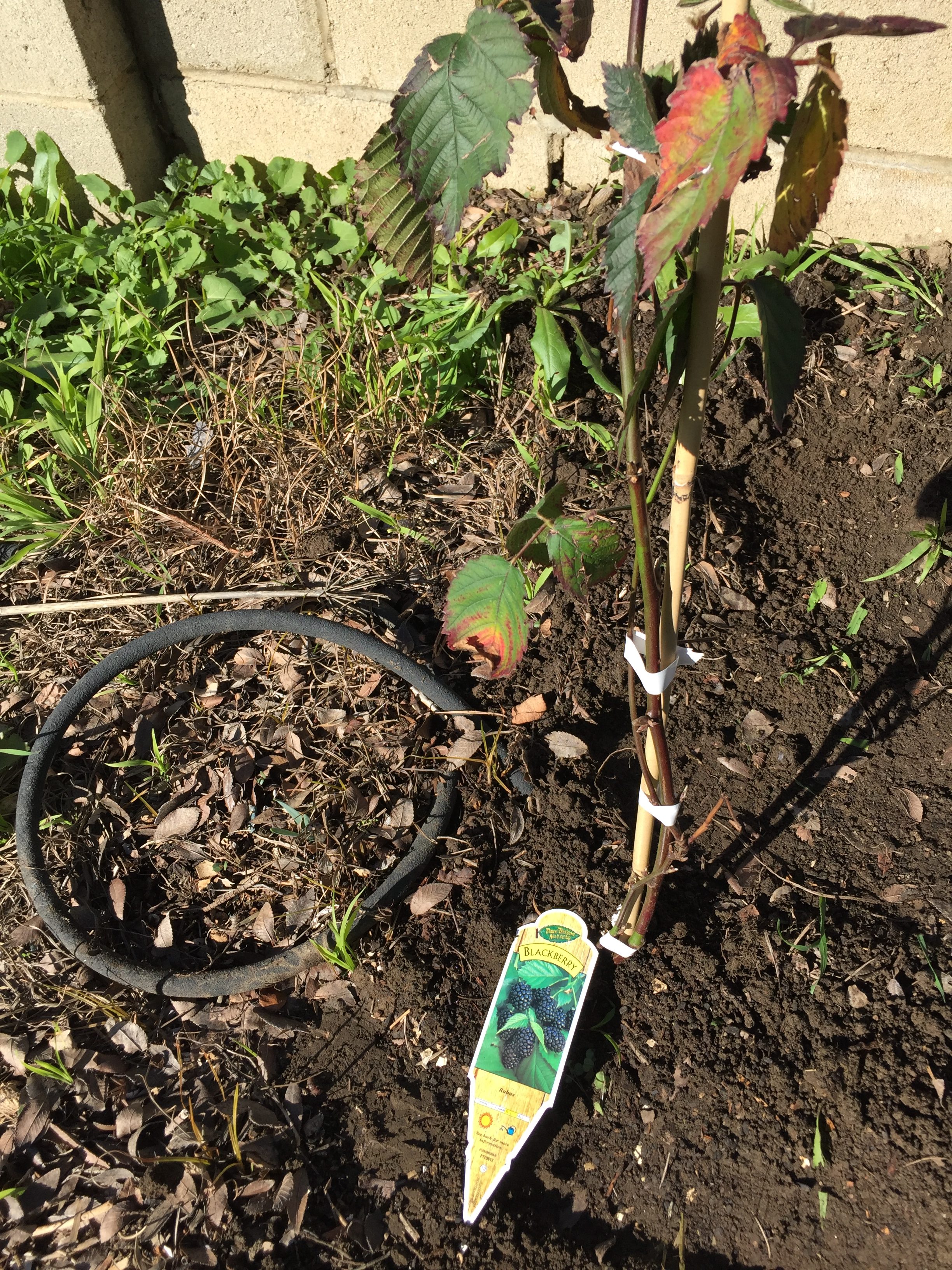
In an effort to add more edible plants to the garden, I picked up this Navaho Blackberry at my local nursery during a recent visit to take photos.
Since I have been unable to do other work today as we are having new carpet laid in our combination office/family room, I decided to take a moment to get this into the ground. I placed it in one of sunniest spots in the front garden, in a bed where I have previously grown sweet potatoes. I still have more than enough space for growing potatoes and I am hoping this blackberry naturalizes well and grows into a sizeable clump. We love blackberries here and, much like the kale plant in the same bed, being able to pick fruit from our own garden would be marvelous.
From DaveWilson.com…
Navaho Blackberry
Upright, thornless. 1988 University of Arkansas introduction. Superb flavor in a small berry. Fruit is firm with significantly smaller seeds than other thornless varieties. Upright canes require no support. Popular with home gardeners and commercial producers alike. USDA Zone 6-10.
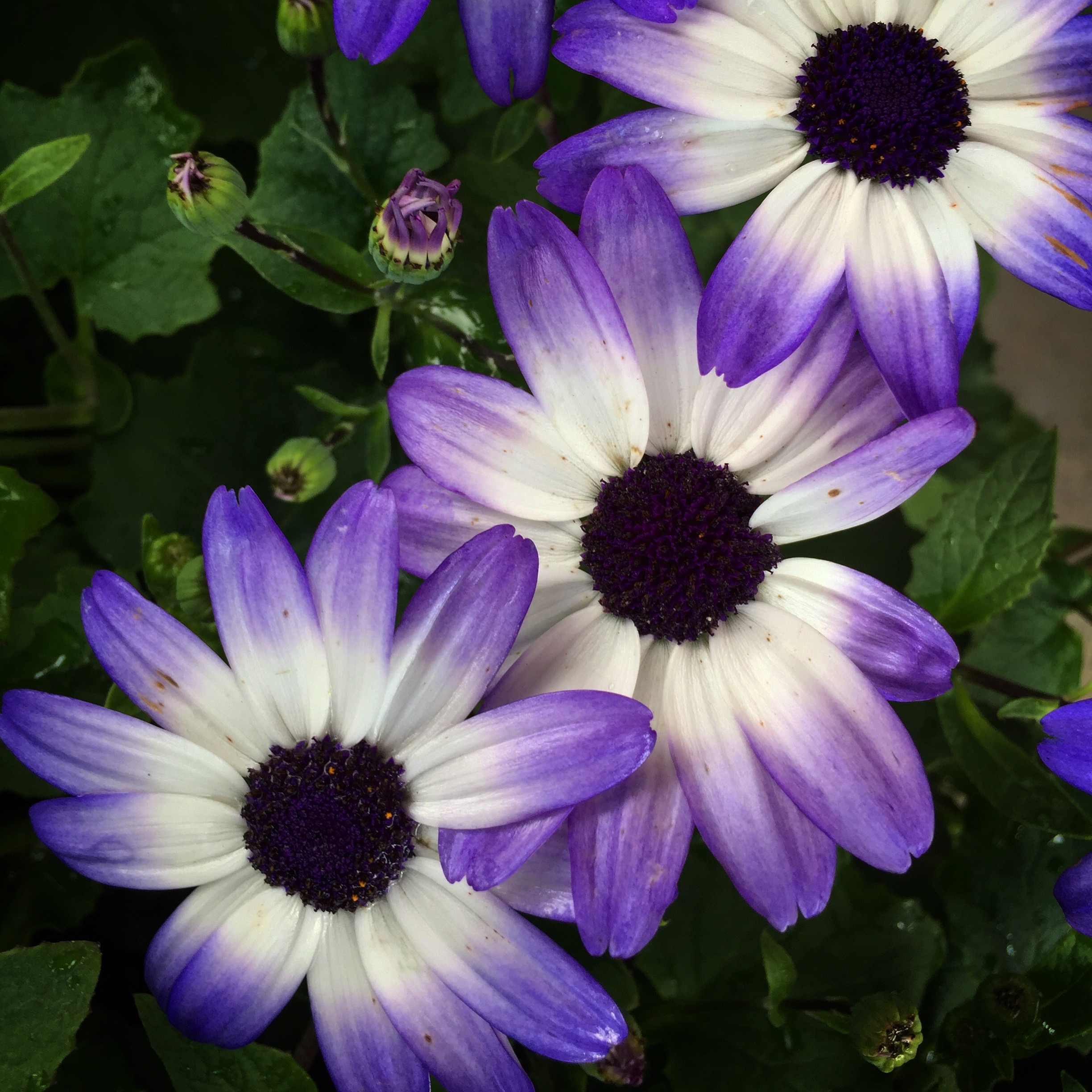
Purple and White
Purple is one of my favorite colors, so how could I not like these flowers. I have a purple and gold theme in the front garden that I would like to build on too.
Follow A Gardener’s Notebook on Facebook
Get this photo on a variety of home, technology and clothing products
Noted: My connected coop brings all the chickens to the IoT
An interesting link found among my daily reading
Dianthus ‘Diabunda Red Picotee’
The trouble with making regular visits to the nursery is that I am constantly seeing new plants and varieties I would love to add to the garden. This exuberant dianthus was just one plant that caught my eye on my last trip.
Unknown variegated shrub with lovely black stems
I spotted this in the neighborhood and need to figure out what it is. I’d love to have it in my garden.
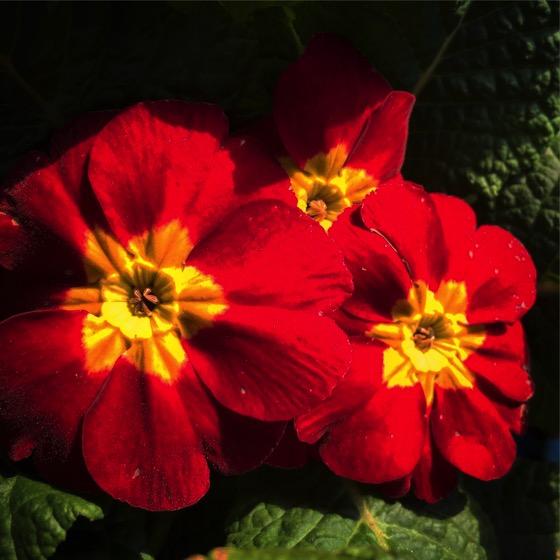
Red Primula (Primrose)
A brilliant red primrose at the nursery. Such dramatic colors in such a smalll and some would say, common, plant.
Follow A Gardener’s Notebook on Facebook
Learn more about primula with these books
* A portion of each sale from Amazon.com directly supports our blogs
** Many of these books may be available from your local library. Check it out!