Purchase this photo and others on a variety of products from my portfolio
Monthly Archives: April 2015
Video: Poppy and Bee in Slow Motion from A Gardener’s Notebook
A Minute in the Garden: A series from A Gardener’s Notebook
- Follow A Gardener’s Notebook on Twitter
- Like A Gardener’s Notebook on Facebook
- Circle A Gardener’s Notebook on Google+
Podcast: Play in new window | Download
Subscribe: RSS
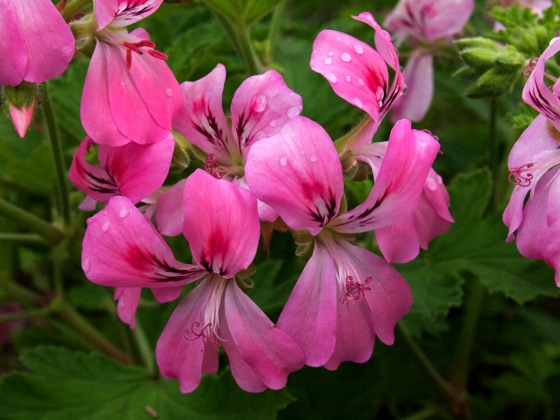
Photo: Pink Geranium (Pelargonium) at The Gardens at Lake Merritt, Oakland, California
Video: Fortnight Lily (Dietes) – A Minute in the Garden 7 from A Gardener’s Notebook
A Minute in the Garden: A series from A Gardener’s Notebook
See all the videos in “A minute in the garden” series in this YouTube playlist
A ubiquitous landscape plant here in Southern California, much abused and ill-pruned, but they do produce these interesting and beautiful flowers on occasion. Unfortunately, it also self-seeds wildly, so best to prune off any seed heads before they mature.
Dietes is a genus of rhizomatous plants of the family Iridaceae, first described as a genus in 1866. Common names include wood iris, Fortnight lily, African iris, Japanese iris and Butterfly iris, each of which may be used differently in different regions for one or more of the six species within the genus.
Most species are native to southern and central Africa, with one (Dietes robinsoniana) native to Lord Howe Island off the coast of Australia. A few species have become naturalized in other parts of the world.[1]
These plants were formerly placed in the genus Moraea, but were reclassified because they are rhizomatous. Like Moraea, they differ from Iris in having flowers with six free tepals that are not joined into a tube at their bases.
Some references mention the species Dietes vegeta or D. vegeta variegata, springing from some confusion with Moraea vegata (which grows from a corm, not a rhizome). The name D. vegetais commonly misapplied to both D. grandiflora or D. iridioides.
The genus name is derived from the Greek words di-, meaning “two”, and etes, meaning “affinities”.[2] — Wikipedia.org
More information on Fortnight Lily (Dietes):
- Fortnight Lily (Dietes) at Wikipedia
- Fortnight Lily (Dietes) Discussion at Dave’s Garden
- Fortnight Lily (Dietes): How to Prune from SFGate.com
- Follow A Gardener’s Notebook on Twitter
- Like A Gardener’s Notebook on Facebook
- Circle A Gardener’s Notebook on Google+
Podcast: Play in new window | Download
Subscribe: RSS
Photo: Scenes from an Oakland Garden
While Rosanne attended an academic conference here in Oakland, I took the time to do some walking and photography. This Instagram collage hold just 3 photos out of 100+ I took at the The Gardens at Lake Merritt here in Oakland. It was only a short walk from our hotel and made for a great morning. I’ll be sharing more of my photos in the coming weeks.
Video: Amaryllis – A Minute in the Garden 6 from A Gardener’s Notebook
A Minute in the Garden: A series from A Gardener’s Notebook
See all the videos in “A minute in the garden” series in this YouTube playlist
- Follow A Gardener’s Notebook on Twitter
- Like A Gardener’s Notebook on Facebook
- Circle A Gardener’s Notebook on Google+
Podcast: Play in new window | Download
Subscribe: RSS
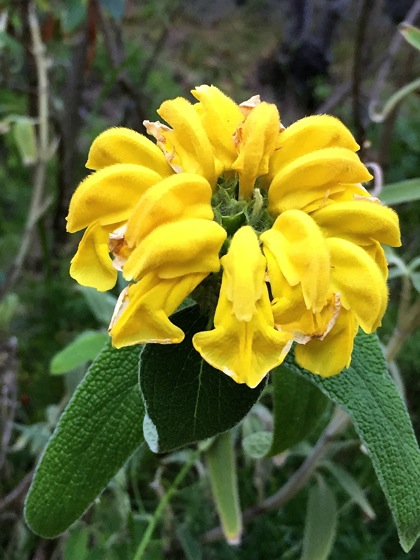
Interesting Plant: Jerusalem Sage (Phlomis fruticosa)
Jerusalem Sage (Phlomis fruticosa)
Today’s Interesting Plant comes from a friends garden. I was visiting Keri from the Animalbytes blog and came across this wonderful phlomis in her garden. It is quite a striking plant, while also being water wise and a great attractor for insects and hummingbirds.

Photo: Douglas E. Welch, A Gardener’s Notebook
Phlomis fruticosa (Jerusalem sage[1]) is a species of flowering plant of the Lamiaceae family, native to Albania, Cyprus, Greece, Italy, Turkey, and regions of the former Yugoslavia.
It is a small evergreen shrub, up to 1 m (3 ft) tall by 1.5 m (5 ft) wide. The sage-like, aromatic leaves are oval, 2-4 inches long, wrinkled, grey-green with white undersides, and covered with fine hairs. Light yellow, tubular flowers, 3 cm in length, grow in whorls of 20 in short spikes in summer.[2]
The specific epithet fruticosa means “shrubby”.[3]
It is popular as an ornamental plant, and has gained the Royal Horticultural Society‘s Award of Garden Merit.[4]
As a garden escape, it has naturalised in parts of South West England.[5] — Wikipedia
- Jerusalem Sage (Phlomis fruticosa) at Wikipedia
- Jerusalem Sage (Phlomis fruticosa) at Daves Garden
- Jerusalem Sage (Phlomis fruticosa) at San Marcos Growers
Previously in the Interesting Plant series:
- Hummingbird Sage (Salvia spathacea)
- Seaside Daisy, Beach Aster (Erigeron glaucus)
- Toyon (Heteromeles arbutifolia)
- California Lilac (Ceanothus)
- Bigberry Manzanita (Arctostaphylos glauca)
- Douglas Iris (Iris douglasiana)
- Malva Rosa (Lavatera assurgentiflora)
- Baby Blue-Eyes (Nemophila)
- Coral Bells or Alum Root (Heuchera)
- Deer Grass (Muhlenbergia rigens)
- Echeveria ‘Lola’
- View all past “Interesting Plant” posts
Interesting Plant is a series from A Gardener’s Notebook blog and podcast that highlights the most interesting plants I find in my Internet and real-world travels — Douglas
Video: In the garden…April 18, 2015: Planting potatoes from pantry leftovers
In the garden…April 18, 2015: Planting potatoes from pantry leftovers
Time to get some sprouted potatoes into the garden
Music: “Hustle” by Kevin MacLeod (http://incompetech.com) under Creative Commons License
- Follow A Gardener’s Notebook on Twitter
- Like A Gardener’s Notebook on Facebook
- Circle A Gardener’s Notebook on Google+
Podcast: Play in new window | Download
Subscribe: RSS
Photo: Garden planning for tomorrow via #instagram

Sitting on the couch this evening watching Gardener’s World and Beechgrove Garden.
Video: Gerbera Daisy A Minute in the Garden 5 from A Gardener’s Notebook
A Minute in the Garden: A series from A Gardener’s Notebook
See all the videos in “A minute in the garden” series in this YouTube playlist
- Follow A Gardener’s Notebook on Twitter
- Like A Gardener’s Notebook on Facebook
- Circle A Gardener’s Notebook on Google+
Podcast: Play in new window | Download
Subscribe: RSS