The Garden As Refuge In A Pandemic Year, With Adrian Higgins Of The Washington Post via A Way To Garden [Shared]

The Garden As Refuge In A Pandemic Year, With Adrian Higgins Of The Washington Post – A Way To Garden

The Garden As Refuge In A Pandemic Year, With Adrian Higgins Of The Washington Post - A Way To Garde

THE WORLD IS SHIFTING focus again now, toward opening up this time, several months after much shutting down. But as we do, I for one hope we won’t go too fast–or turn too quickly away from awareness of the solace that the garden has provided and that it offers for us at all times, bad or good.

Adrian Higgins has been taking note of that in various ways in his columns for “The Washington Post” throughout the strangest and most chaotic of springs, exploring the garden as an anchor, a support. In his longtime role as gardening columnist there, Adrian always inspires readers to connect.

I was so pleased to speak with Adrian, whose thoughtful work has inspired me for years. He delves beyond just horticulture and great plants—though always serving up plenty of both—regularly exploring stewardship of the environment, and even matters of the spirit. That’s his mask on the fence post at his community garden plot above (photograph by Adrian Higgins).

Read along as you listen to the June 22, 2020 edition of my public-radio show and podcast using the player below. You can subscribe to all future editions on Apple Podcasts (iTunes) or Spotify or Stitcher (and browse my archive of podcasts here).

Read The Garden As Refuge In A Pandemic Year, With Adrian Higgins Of The Washington Post – A Way To Garden

Propagating Deciduous Shrubs From Softwood Cuttings, With Ken Druse via A Way to Garden [Audio] [Shared]

I am in the middle of my own “propagation escalation” and this podcast contains some great information on how to propagate from your own garden. — Douglas


Propagating Deciduous Shrubs From Softwood Cuttings, With Ken Druse via A Way to Garden

Propagating Deciduous Shrubs From Softwood Cuttings, With Ken Druse via A Way to Garden

Propagating Deciduous Shrubs From Softwood Cuttings, With Ken Druse via A Way to Garden

TODAY WE’RE going to do some multiplication, as in: make more shrubs, thanks to a lesson in propagating favorites like Hydrangea or elderberry or Physocarpus and more, courtesy of our friend and regular guest, Ken Druse. Ready to learn the basics of shrub propagation and have plants to share or to repeat in your own garden?

You all know my old friend, Ken Druse, author of 20 garden books. So rather than repeat the rest of his bio, I’ll share some news: Ken’s being honored the evening of June 17th, 2021 by Rutgers Gardens, the botanical garden of Rutgers University in New Jersey.

Read/Listen to Propagating Deciduous Shrubs From Softwood Cuttings, With Ken Druse via A Way to Garden 

Noted: Tune In: 8 Best Garden Podcasts to Listen to Now – Gardenista

Get your gardening fix via podcast. Here are 8 great shows to check out! – Douglas
 

White Rose in Black and White [Photo]

White Rose in Black and White #blackandwhite #blackandwhitephotography #garden #rose #roses #bnw_drama #bnw_captures #bnw_society #bnw_life #ig_garden
#flowersofinstagram
#flowerstagram
#treestagram
#rainbow_petals #ig_naturelovers
#ig_naturepictures
#ig_naturesbest
@24earth

White Rose in Black and White #blackandwhite #blackandwhitephotography #garden #rose #roses #bnw_drama #bnw_captures #bnw_society #bnw_life #ig_garden #flowersofinstagram #flowerstagram #treestagram #rainbow_petals #ig_naturelovers #ig_naturepictures #ig_naturesbest 

 Instagram

Follow A Gardener’s Notebook on Facebook

Learn more about gardening in these books from Amazon.com
 

* A portion of each sale from Amazon.com directly supports our blogs 
** Many of these books may be available from your local library. Check it out! 


Audio: Douglas appears on “Back to my Garden” with Dave Ledoux – BTMG 012: California Sweet Potato Strategy with Douglas Welch

I recorded this podcast with Dave Ledoux from the “Back to my Garden” podcast a few weeks ago. Check out more great gardening info on the Back to my Garden web site and subscribe to the podcast — Douglas


BTMG 012: California Sweet Potato Strategy with Douglas Welch

Douglas appears on

Listen to Back to my Garden Episode 12 with Douglas E. Welch

Douglas Welch is a pioneer in the world of podcasting, food blogging and new media…and he’s a heck of a great gardener! Residing in southern California he battles the drought, heat and unique challenges to create his own oasis of peace and enjoyment.

Douglas is an Amazon author, and has been podcasting since 2004, literally 14 days after the word “podcast” was invented! You will find him warm, approachable and willing to share loads of gardening wisdom and experience in this interview.

In This Episode You Will Discover:

  • the differences in gardening in Southern California compared to Ohio
  • why gardeners learn best by DOING
  • how to apply what you learn in gardening books and videos
  • a disaster in a rose garden turned into a sweet potato bonanza!
  • Holly & Joel’s Channel: http://thewisconsinvegetablegardener.com/
  • Eric Rochow’s Channel: http://www.gardenfork.tv

These are the books Douglas mentioned on the show!

Audio: Your Garden – Inch-by-Inch from A Gardener’s Notebook – Dog Days of Podcasting 2014 – 8/30

Audio: Your Garden - Inch-by-Inch from A Gardener's Notebook - Dog Days of Podcasting 2014 - 8/30

Your Garden – Inch-by-Inch from A Gardener’s Notebook

Listen to this podcast

Often we look at our gardens plant by plant – worrying over which is doing well, which is doing poorly, which one needs to be moved.  At other times, we try to take in the big picture.  We map, we plan and try to create one seamless whole.  There are times, though, when inch-by-inch is the way we see it, and it brings a unique viewpoint.

The Edging

Recently we started a new edging project in the garden.  Beginning with the smallest rose bed, we decided to use old wine and other glass water bottles to surround the bed.  Previously we had used limbs from tree pruning, but these were now several years old and had deteriorated almost completely.  I did a bit of research online, including looking for images of bottle edging, to make sure we wanted to proceed.  It certainly seemed worth a try.  The pictures looked attractive and it didn’t seem like a lot of work. We would do this small bed first and then decide if we wanted to continue it in others.

Of course, doing an edging project like this means getting “down and dirty” with your garden – usually on your hands and knees.  You notice immediately how the soil differs from inside the bed to the hard, compacted soil of the surrounding paths.  You get a clear view of the quality of the soil in the beds as you dig the trench alongside. You notice insects – good and bad – weeds, and maybe even the rust that is forming on the lower leaves of the roses that you hadn’t noticed before.  Oh, oh, are those aphids?!?  Ah, but then you also notice the ladybug larvae and adults ready to eat them up.

Your garden takes on a different meaning on this micro scale.  You don’t notice the thistles and bindweed as much, but the blackspot and Japanese beetles really catch your eye.  You don’t notice the bad pruning on the box hedges, yet the quality of the soil as it sits in your hand makes you sit in wonder for just a moment.

A project for you  

If all this sounds very foreign to you, I am going to charge you with a project the next time you are in your garden.  Take a 1-meter-square area of your garden and mark it off in some way.  Use a piece of rope or string to outline the area. If you have seen archaeologists working in movies or on TV, think about what their digs look like — a series of neat squares marching across the landscape so they can catalog their finds. While this 1 meter can be a patch of lawn, consider placing it over the junction between a bed and the lawn.  You’ll get better results in your experiment.

Now that you have marked out the area, sit down – better yet, lie down on your belly – and start to take note of every living thing you see there.  First off you’ll see the grass, the daylilies, the small weeds.  Then look deeper.  You’ll see ants, aphids, beetles and a host of other insects.  Keep looking.  Dig down and turn the soil over a little or pull up a piece of turf. Now there are worms, spiders, sow bugs, spider mites and more. I can guarantee you that you will notice more than you ever thought possible in your small 1 meter area and all of it is there, teeming with life, all day long, every day.

I know that, for me, observing my garden in this macroscopic way brings a deeper appreciation and deeper understanding of my garden when I look out from my back door each morning, coffee cup in hand.  I never see just the paths and the plants anymore. In my mind I see it all – everything that exists down there among the roots, as well as everything on the surface. This also leads me to think differently about what I might do in my garden — what I might add, what I might remove, what I might want to change. It is quite amazing how a small garden project can lead you down the merry path of deep thoughts, but, then again, isn’t that one major reason we garden in the first place?

Buy the Kindle ebook today for more gardening essays

Now only 99¢ until August 24, 2014

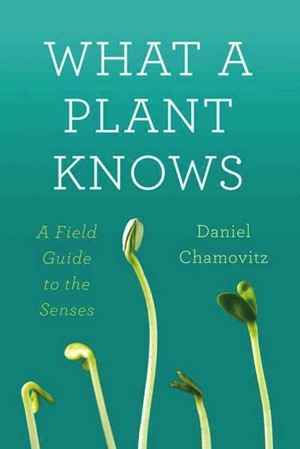
What I’m Reading…: What a Plant Knows: A Field Guide to the Senses by Daniel Chamovitz

What a plant knows cover


What a Plant Knows: A Field Guide to the Senses

Daniel Chamovitz 

This is certainly on the geekier side of my reading list, but when I am came across this book it intrigued me immediately. The combination of plants, science and, by extension, gardening seemed like an interesting combination. I have not been disappointed either.

The book is divided into sections including what a plant sees, hears, smells and feels, how a plant knows where it is and finally, what a plant remembers. All these sections are quite informative and deeply interesting for anyone with an interest in gardening, plants, and/or science. This might even be a good introductory book for those interested in studying botany in high school or college.

Can plants see, feel, hear and smell like we do? Certainly not, but they can do all those things in their own unique ways. Because of their inability to move from where they are planted, plants must be very sensitive to their environment and react quickly to any changes that might threaten them. If they are being attracted by insect, animals or disease they can output smells that warn other parts of the plant — and even other plants in huge area — to the attack.

Lacking a nervous system, plants sense and respond using chemical indicators for the most part. They can sense light and dark and react to subtle changes in the ration between. They can grow towards the sun or seek out support from structures and other plants to support their vines and leaves.

Plants like the Venus Flytrap and mimosa can react to touch and use it for protection or to supplement their diet with extra nutrients they might not be able to glean from the poor soil where they grow.

What a plant knows just might have you thinking differently about the plants in your garden and might even lead you act a bit differently in your own garden, both for your benefit and that of the plants that grow there.

What a plant knows is an easy read and contains lots of great footnotes linking to further information available on the Internet. That said, the method of providing links to web-based material shows a conflict between the different media (online and offline) and how it might be best used. Instead of short, meaningful link names, the author uses standard (and long) URLs which aren’t really meant to be typed in and offer many opportunities for typos and other mistakes. They would have been better to utilize one of the many link shortening services or even created their own, easier to use, system for providing interactive links on the book.

This minor quibble aside, I would highly recommend this book for anyone who is interested in understanding their plants just a little bit better. 

Listen to an interview with author, Daniel Chamovtiz on Minnesota Public Radio

Paperback | Kindle


Audio: Douglas is Interviewed for The Wisconsin Vegetable Gardener Podcast

An Interview with Joey and Holly Baird of The Wisconsin Vegetable Gardener podcast.

Wiveggardener

Here is my interview (from a longer episode) of The Wisconsin Vegetable Gardener podcast. The entire show is 90 minutes, so I excerpted my 30 minute interview to share with you.

We talk about my gardening origins, the oddities of gardening in Los Angeles, container gardens and more.

I hope you enjoy it!

Listen to the show