Vintage Botanical Print – 81 in a series – Aquilegia Canadensis from The Floral world and garden guide (1878)

Floralworldgarde1318edhi_0046 blog.

Click for larger image

THIS elegant but hardy perennial is, as its name implies, a native of Canada, where it usually grows about nine inches high ; but in this country, however, it generally attains the same size as the common Columbine, which it greatly resembles in the appearance of its leaves, though it differs in having its flowers of a different form and colour. It may be easily propagated by dividing the roots either in the autumn or the spring ; or it may be raised from seed, which it ripens in great abundance. In the latter case, however, the seeds should be sown as soon as they are ripe, as otherwise they will be a long time before they germinate. The very graceful, nodding, scarlet and orange flowers, which appear in April and. May, are nearly two inches in length, and on each pedicel there are two bracts, so near the flower as to have almost the appearance of a distinct green calyx.

Purchase copies of this print

Fp,840x830,black,off_white,box20,s,f8f8f8 pad,1000x1000,f8f8f8.

Gbra,5x7,900x900 1.

Mug,standard,x1000,right pad,1000x1000,f8f8f8.


Garden View, Adelaide Botanic Garden, Adelaide, Australia [Photography]

Adelaide botanic garden 1.

Find more of my photos on PixelFed


Explore Hundreds of Exquisite Botanical Collages Created by an 18th-Century Septuagenarian Artist via Colossal [Shared]

Explore Hundreds of Exquisite Botanical Collages Created by an 18th-Century Septuagenarian Artist via Colossal

The image depicts a botanical illustration of a flowering plant with a dark background. The plant is identified as Panaverium Marilinum, commonly known as the Sea Daffodil. The illustration features a cluster of white, elongated petals with a delicate, curving structure, resembling a spiders web. The petals are arranged in a spiral pattern, with some extending outward and others curling inward. The stamens, visible at the tips of the petals, are yellow with pinkish-red anthers. The plant has broad, green leaves with a slightly glossy texture, positioned at the base of the flower. The illustration is detailed, with shading and highlights that give depth to the petals and leaves. The name of the plant is written in cursive script at the bottom right corner, with the scientific name above it. The overall composition is centered, with the plant occupying the majority of the space, creating a striking visual impact against the black background.</p></p>

<p><p>Provided by @altbot, generated privately and locally using Ovis2-8B

At age 72, Mary Delany (1700-1788) devoted herself to her art practice, taking up a form of decoupage to create an exquisite collection of botanical collages from dyed and cut paper. She interpreted many of the delicate specimens she encountered in Buckinghamshire while staying with her friend, the Duchess of Portland, through layered pieces on black backdrops. From the wispy clover-like leaves of an oxalis plant to the wildly splayed petals of the daffodil, the realistic works are both stunning for their beauty and faithfulness to the original lifeforms.

Read and View This Entire Article – Explore Hundreds of Exquisite Botanical Collages Created by an 18th-Century Septuagenarian Artist via Colossal 

Azalea Mural, Larimer Street, Denver, Colorado [Photography]

Azalea Mural, Larimer Street, Denver, Colorado

Find more of my photos on Instagram | Flickr | PixelFed

More from my Instagram Feed

Exquisite Instructional Book From 1896 Illustrates How Flowers Become Art Nouveau Designs via My Modern Met

Exquisite Instructional Book From 1896 Illustrates How Flowers Become Art Nouveau Designs via My Modern Met

The Art Nouveau movement was known for the beautiful way in which it depicted natural forms. Now, you can gain more insight into the aesthetic that swept Europe from 1890 through 1910 with the book La Plante et Ses Applications Ornementales (The Plant and Its Ornamental Applications). Published in 1896 by Swiss graphic designer and art instructor Eugène Grasset, the elaborately illustrated book was influential in defining the movement’s style. His design students created the content for the book, and together they transformed realistic sketches of 24 plants into elaborate Art Nouveau motifs for use in painting or carving.

The two dozen plants chosen by Grasset include the dandelion, iris, and wild geranium. Every bloom is represented in three ways. The first picture shows the natural rendering of each plant from multiple angles. The other two images give examples of stylized designs incorporating the flower. This three-part method of presenting illustrations demonstrates Grasset’s philosophy of drawing. “The art of drawing is not the art of observing forms and objects alone, it is not mere mimicry of these objects; it is the art of knowing how far and wherein, and with what just limitations, those forms and objects can be reproduced in a picture, or in a decorative work,” he wrote.

Read Exquisite Instructional Book From 1896 Illustrates How Flowers Become Art Nouveau Designs via My Modern Met

Read and Download the entire book at the Internet Archive


* A portion of each sale from Amazon.com directly supports our blogs
** Many of these books may be available from your local library. Check it out!
† Available from the LA Public Library

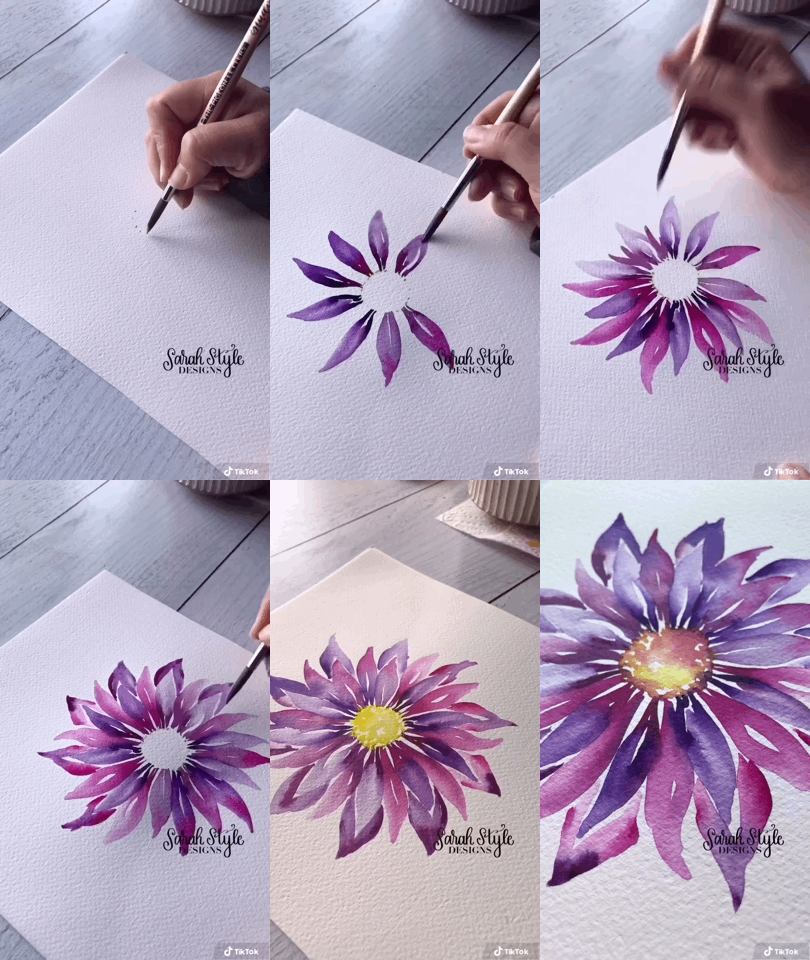
Dazzling Dahlias – 65 in a series – Dahlia painting 🌸 via Sarah Style Designs on TikTok [Video]

@sarahstyledesigns

Dahlia painting 🌸 #sarahstyledesigns #tiktokpartner #fyp #foryou #dahlia #dahliapainting

♬ ROXANNE – Arizona Zervas

Dahlia painting 🌸 via Sarah Style Designs on TikTok [Video]


Dahlias: Beautiful Varieties for Home & Garden


An interesting link found among my daily reading

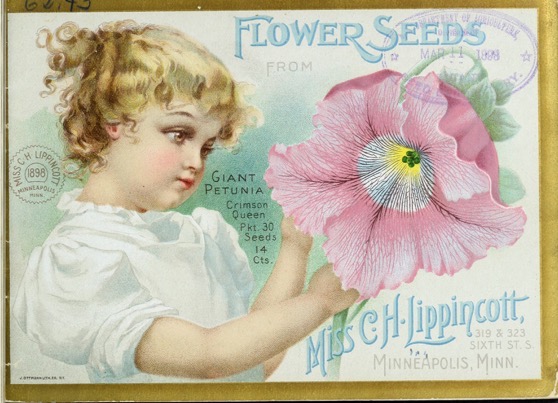
Historical Seed Catalogs: Flower seeds from Miss C.H. Lippincott (1898) – 50 in a series

Historical Seed Catalogs: Flower seeds from Miss C.H. Lippincott (1898) – 50 in a series

Historical Seed Catalogs: Flower seeds from Miss C.H. Lippincott (1898) - 50 in a series

Historical Seed Catalogs: Flower seeds from Miss C.H. Lippincott (1898) - 50 in a series

Historical Seed Catalogs: Flower seeds from Miss C.H. Lippincott (1898) - 50 in a series

Download in Text, PDF, Single Page JPG, TORRENT from Archive.org

From the archives: Look More Closely – October 17, 1999

Look More Closely

Gardens are a curious thing. Sometimes I am looking at my garden as a whole, trying to develop overall themes and designs. Sometimes I am focused on one plant as I move it from one area to another or try and nurture it back to health. Sometimes, though, I can go for weeks or months without ever really “seeing” my garden. I have several ways of re-connecting with my garden and one involves the combination of gardening with another of my hobbies, art.

Sketch of Oak TreesDrawing is seeing

An ancient artist once said that you never really see anything unless you draw or paint it. The attention required in developing a representation of something requires us to regard it as never before. We alternately jump from the concrete to the abstract as we draw petal and leaf, root and branch. These mental leaps can lead us to a deeper understanding of whatever we are drawing.

I know what you are thinking. “I can’t draw. I can’t paint! He must be crazy!” While I am a little daft in some ways, I have learned that anyone can draw and anyone can paint. More importantly, the level of your skill really doesn’t matter at all. Just as a writer’s journal is something private, your sketches can be for your eyes only. Even more, the act of drawing itself is more important than the results. The goal of sketching in the garden is to see things more clearly not necessarily make a perfect reproduction of them on paper.

Paint out

If you are looking for an interesting garden party idea take a hint from an art coach friend of mine and schedule a “paint out.” You can host a paint out in your own garden, a friend’s garden or some public place. It is very simple to organize. Merely get a bunch of your friends together with pad and pencil and start to draw. You can each draw something different in the garden or you can all draw the same tree or plant. It is amazing how we can each see something different in the same rose, the same daisy, the same tree. Remember, the process is more important than the results. Notice how you approach the drawing. Are you drawing the plant or merely how you think the plant should be drawn? Look closely at whatever you are drawing but forget what it is . Instead of a petal it is a combination of pink and white light. Instead of a leaf, it is a construction of veins and edges.

Sketch of flower vaseSketch, don’t shoot

Sketching can be especially useful when you are visiting gardens. Instead of taking photographs, make a sketch instead. You will be surprised at how much more you remember about the garden later. The act of sketching, like taking notes in class, helps to lock the memory tighter in our mind. It also helps to distill the scene into its more important parts. When sketching, we unconsciously and consciously leave out the lesser parts to concentrate on that which most interests us.

You don’t need to go to the lengths of Monet, who created his own garden as a source for his artwork. Sketching and painting in your garden can open up a whole new world of possibilities for you, both in gardening and art.