From my Instagram Feed
Part of a series from A Gardener’s Notebook
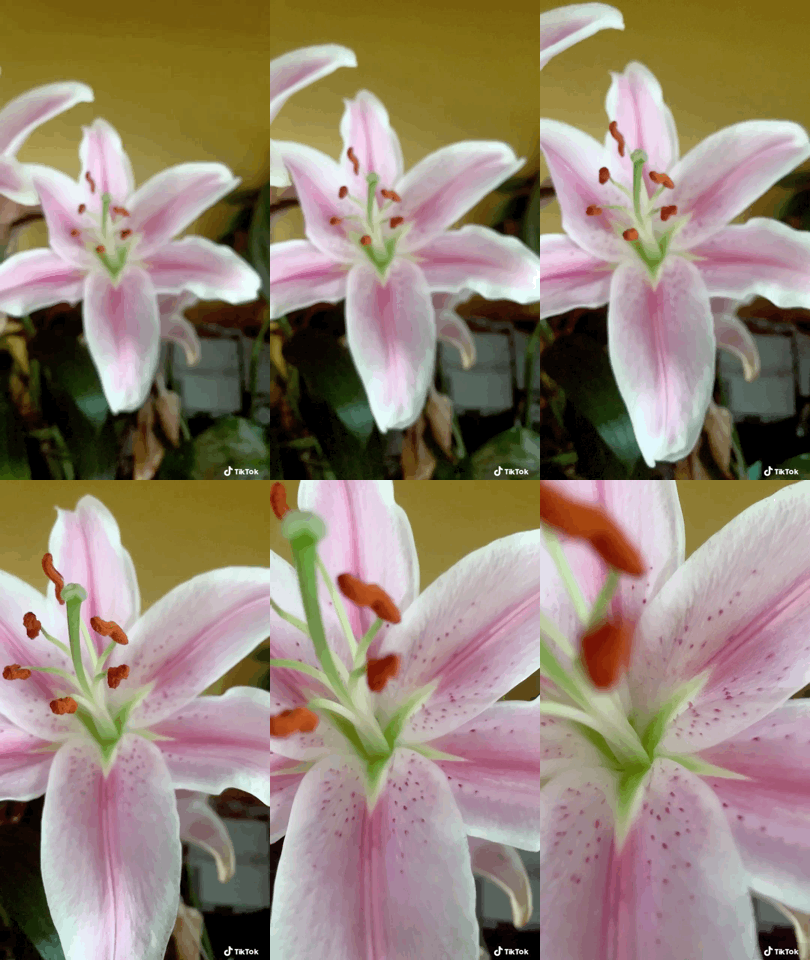
@douglaswelch Pink Daylily Fantasy ##daylily ##flowers ##slomo ##garden ##gardening ##plants ##closeup
* A portion of each sale from Amazon.com directly supports our blogs
** Many of these books may be available from your local library. Check it out!
† Available from the LA Public Library
Help Support A Gardener’s Notebook!
Podcast: Play in new window | Download
Subscribe: RSS
Dazzling Dahlias – 33 in a series – Yellow Dahlia via Kristen Fletcher on Flickr
Photo: Kristen Fletcher on Flickr
An interesting link found among my daily reading
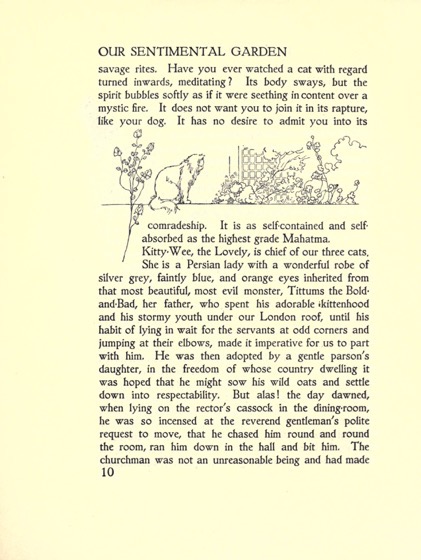
From the book, Our sentimental garden by Agnes Castle and Egerton Castle (1914). Works Illustrated By Charles Robinson . There are many lovely pieces of art in this book and I will be sharing them over the next several weeks. You can download the entire book from the Internet Archive.
Read/Download Our sentimental garden by Agnes Castle and Egerton Castle (1914)
Products from Douglas E. Welch Design and Photography Using Artwork From Our Sentimental Garden
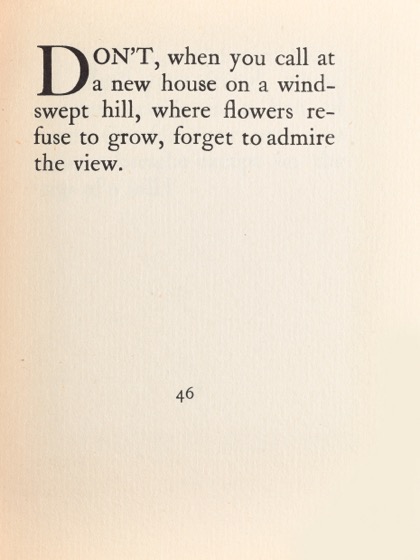
DON’T, when you call at
a new house on a wind-
swept hill, where flowers re-
fuse to grow, forget to admire
the view.

Read and Download the entire book from Archive.org
* A portion of each sale from Amazon.com directly supports our blogs
** Many of these books may be available from your local library. Check it out!
Historical Garden Books – 85 in a series – The florist and pomologist (1879)
Download in Text, PDF, Single Page JPG, TORRENT from Archive.org
Find more books on Bookshop and Help Indie Book Stores!
* A portion of each sale from Amazon.com directly supports our blogs
** Many of these books may be available from your local library. Check it out!
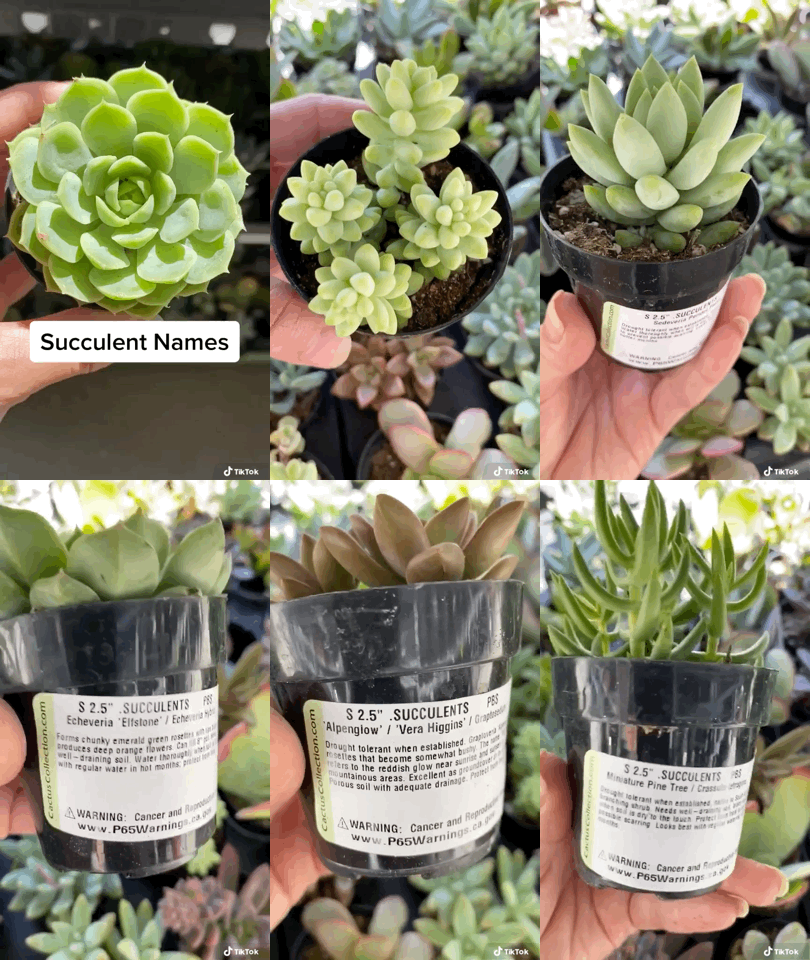
@thehappyplant ##succulents ##plantlover ##gardening101 ##planttips ##succulentwall ##backyardvibes ##foryou ##plantparents ##thehappyplant
Follow @agardenersnotebook on Instagram
Like A Gardener’s Notebook on Facebook

Find more books on Bookshop and Help Indie Book Stores!
* A portion of each sale from Amazon.com directly supports our blogs
** Many of these books may be available from your local library. Check it out!
By PATRICIA SIMPSON
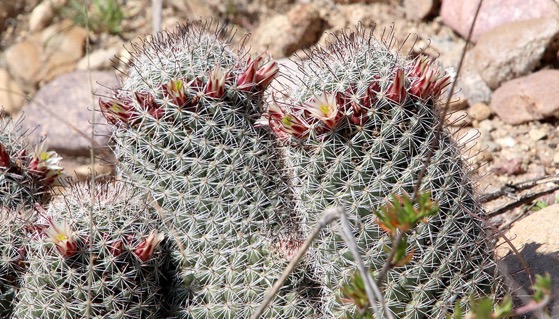
Cute and cuddly! Not really what one thinks of when meeting a cactus. But our observation of the month by christybeck (visit bit.ly/3g6bwFu) isn’t just any prickly plant, it’s the Fish-Hook Cactus (Mammilliaria dioica). Cute for its small size and tight cluster. Cuddly for its softer-than-most appearance. But let’s not fool ourselves, it’s never a good idea to cuddle with a cactus, especially one that bears the name “fish-hook,” a tool meant to capture and not let go of its prey.
Have you ever noticed that a cactus has clusters of spines all around? These are called areoles. In the Fish Hook Cactus, straight short spines shoot out of the areole in a circle formation, except for one long spine at the very center which grows quite a bit longer than the others and is curved at the end, like (you guessed it) a fish hook!
Follow @agardenersnotebook on Instagram
Like A Gardener’s Notebook on Facebook

Find more books on Bookshop and Help Indie Book Stores!
* A portion of each sale from Amazon.com directly supports our blogs
** Many of these books may be available from your local library. Check it out!
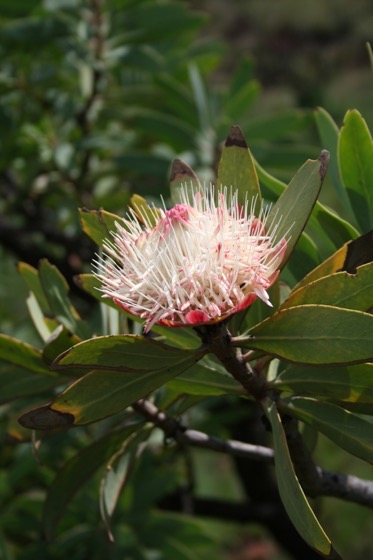
Interesting Plant: Protea
By Marco Schmidt [1] – Own work, CC BY-SA 2.5, Link
Discovered this via the article 13 unique and interesting plants to grow in your garden on the Greener Living Blog. There are quite a few plants I will highlight here in future posts. — Douglas
Protea /ˈproʊtiːə/[1] is both the botanical name and the English common name of a genus of South African flowering plants, sometimes also called sugarbushes (Afrikaans: suikerbos). In local tradition, the protea flower represents change and hope.
The genus Protea was named in 1735 by Carl Linnaeus after the Greek god Proteus, who could change his form at will, because they have such a wide variety of forms. Linnaeus’s genus was formed by merging a number of genera previously published by Herman Boerhaave, although precisely which of Boerhaave’s genera were included in Linnaeus’s Protea varied with each of Linnaeus’s publications.— Wikipedia

Photo by Nadia Valko on Unsplash

Photo by David Clode on Unsplash
What are your thoughts on this Interesting Plant? Drop a note in the comments!
More information:
View all past “Interesting Plant” posts
Interesting Plant is a series from A Gardener’s Notebook blog and podcast that highlights the most interesting plants I find in my Internet and real-world travels — Douglas