Vintage Botanical Print – 81 in a series – Aquilegia Canadensis from The Floral world and garden guide (1878)

Floralworldgarde1318edhi_0046 blog.

Click for larger image

THIS elegant but hardy perennial is, as its name implies, a native of Canada, where it usually grows about nine inches high ; but in this country, however, it generally attains the same size as the common Columbine, which it greatly resembles in the appearance of its leaves, though it differs in having its flowers of a different form and colour. It may be easily propagated by dividing the roots either in the autumn or the spring ; or it may be raised from seed, which it ripens in great abundance. In the latter case, however, the seeds should be sown as soon as they are ripe, as otherwise they will be a long time before they germinate. The very graceful, nodding, scarlet and orange flowers, which appear in April and. May, are nearly two inches in length, and on each pedicel there are two bracts, so near the flower as to have almost the appearance of a distinct green calyx.

Purchase copies of this print

Fp,840x830,black,off_white,box20,s,f8f8f8 pad,1000x1000,f8f8f8.

Gbra,5x7,900x900 1.

Mug,standard,x1000,right pad,1000x1000,f8f8f8.


Explore Hundreds of Exquisite Botanical Collages Created by an 18th-Century Septuagenarian Artist via Colossal [Shared]

Explore Hundreds of Exquisite Botanical Collages Created by an 18th-Century Septuagenarian Artist via Colossal

The image depicts a botanical illustration of a flowering plant with a dark background. The plant is identified as Panaverium Marilinum, commonly known as the Sea Daffodil. The illustration features a cluster of white, elongated petals with a delicate, curving structure, resembling a spiders web. The petals are arranged in a spiral pattern, with some extending outward and others curling inward. The stamens, visible at the tips of the petals, are yellow with pinkish-red anthers. The plant has broad, green leaves with a slightly glossy texture, positioned at the base of the flower. The illustration is detailed, with shading and highlights that give depth to the petals and leaves. The name of the plant is written in cursive script at the bottom right corner, with the scientific name above it. The overall composition is centered, with the plant occupying the majority of the space, creating a striking visual impact against the black background.</p></p>

<p><p>Provided by @altbot, generated privately and locally using Ovis2-8B

At age 72, Mary Delany (1700-1788) devoted herself to her art practice, taking up a form of decoupage to create an exquisite collection of botanical collages from dyed and cut paper. She interpreted many of the delicate specimens she encountered in Buckinghamshire while staying with her friend, the Duchess of Portland, through layered pieces on black backdrops. From the wispy clover-like leaves of an oxalis plant to the wildly splayed petals of the daffodil, the realistic works are both stunning for their beauty and faithfulness to the original lifeforms.

Read and View This Entire Article – Explore Hundreds of Exquisite Botanical Collages Created by an 18th-Century Septuagenarian Artist via Colossal 

A Botanical Mystery Solved, After 146 Years via Atlas Obscura [Shared]

Yet another example of how archives can continue to educate even a century after their contents were created. – Douglas

A Botanical Mystery Solved, After 146 Years – Atlas Obscura

A Botanical Mystery Solved, After 146 Years via Atlas Obscura [Shared]

Something about the painting made Tianyi Yu pause. The artwork, depicting tropical plants crowded together in a riot of color, had been painted in 1876 by prolific botanical illustrator Marianne North. The wealthy Victorian woman had traveled the world, usually on her own, documenting in bold oils the plants and landscapes she saw.

During a trip to Borneo, North had filled this canvas with plants from a particular spot in the forests of the island’s northwest corner. The viewer’s eye might be drawn to oblong yellow fruits from one plant, or pink buds from another, or the rounded leaves cascading down one side of the painting, one of them apparently nibbled by an insect. But Yu, a botanical illustrator who was working at London’s Kew Gardens while pursuing a masters degree, was drawn to clusters of berries, some green and unripe but others black or a bold blue. These berries would solve a botanical cold case more than a century in the making, and connect both illustrators forever.

Read A Botanical Mystery Solved, After 146 Years – Atlas Obscura

Root System Drawings – Wageningen University & Research – Image Collections [Shared]

Root System Drawings – Wageningen University & Research – Image Collections

Root System Drawings - Wageningen University & Research - Image Collections [Shared]

This collection holds 1,180 drawings, the outcome of 40 years of root system excavations in Europe, mainly in Austria. The drawings, their analysis and description were done by Univ. Prof. Dr. Erwin Lichtenegger (1928-2004) and Univ. Prof. Dr. Lore Kutschera (1917-2008), leader of Pflanzensoziologisches Institut, Klagenfurt, (now in Bad Goisern, Austria).

Read Root System Drawings – Wageningen University & Research – Image Collections

‘Cyborg soil’ reveals the secret microbial metropolis beneath our feet via The Conversation [Shared]

‘Cyborg soil’ reveals the secret microbial metropolis beneath our feet

'Cyborg soil' reveals the secret microbial metropolis beneath our feet

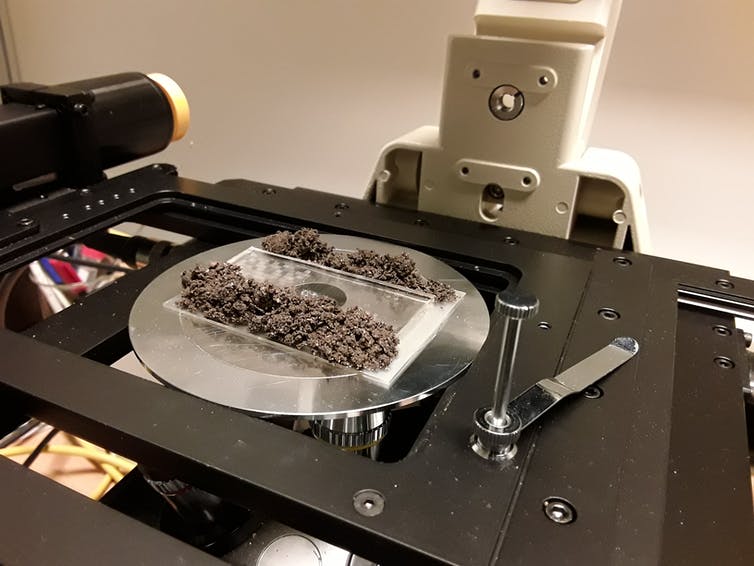
Dig a teaspoon into your nearest clump of soil, and what you’ll emerge with will contain more microorganisms than there are people on Earth. We know this from lab studies that analyse samples of earth scooped from the microbial wild to determine which forms of microscopic life exist in the world beneath our feet.

The problem is, such studies can’t actually tell us how this subterranean kingdom of fungi, flagellates and amoebae operates in the ground. Because they entail the removal of soil from its environment, these studies destroy the delicate structures of mud, water and air in which the soil microbes reside.

This prompted my lab to develop a way to spy on these underground workers, who are indispensable in their role as organic matter recycling agents, without disturbing their micro-habitats.

Our study revealed the dark, dank cities in which soil microbes reside. We found labyrinths of tiny highways, skyscrapers, bridges and rivers which are navigated by microorganisms to find food, or to avoid becoming someone’s next meal. This new window into what’s happening underground could help us better appreciate and preserve Earth’s increasingly damaged soils.

Read ‘Cyborg soil’ reveals the secret microbial metropolis beneath our feet

From bean to pod in 42 days 🌱 via BoxLapse on Tikitok [Video]

@boxlapse

From bean to pod in 42 days 🌱 ##bean ##themaincharacter ##timelapse ##fyp ##plantsoftiktok

♬ Harry Potter – The Intermezzo Orchestra

Boxlapse 01

Meet the monkeyflower, a weed that may hold the key to zebra stripes and other biological mysteries via Science | AAAS

Yaowu Yuan’s passion for monkeyflowers began in 2004 with a slideshow. Then a budding plant taxonomist at the University of Washington in Seattle and an avid hiker, he was amazed at the variety of wildflowers he saw on his outings in the Cascade mountains. Like Charles Darwin, he was vexed by what Darwin called an abominable mystery: How did nature generate such a diversity of flower colors and forms? During a campus seminar, Yuan encountered a plant that he thought might yield answers. University of Washington plant molecular biologist H. D. “Toby” Bradshaw and his graduate student showed slides documenting as much floral diversity within a single monkeyflower species as Yuan had seen in the meadows and streambanks of the Cascades—all generated by mutating the genome of this one Mimulus species.