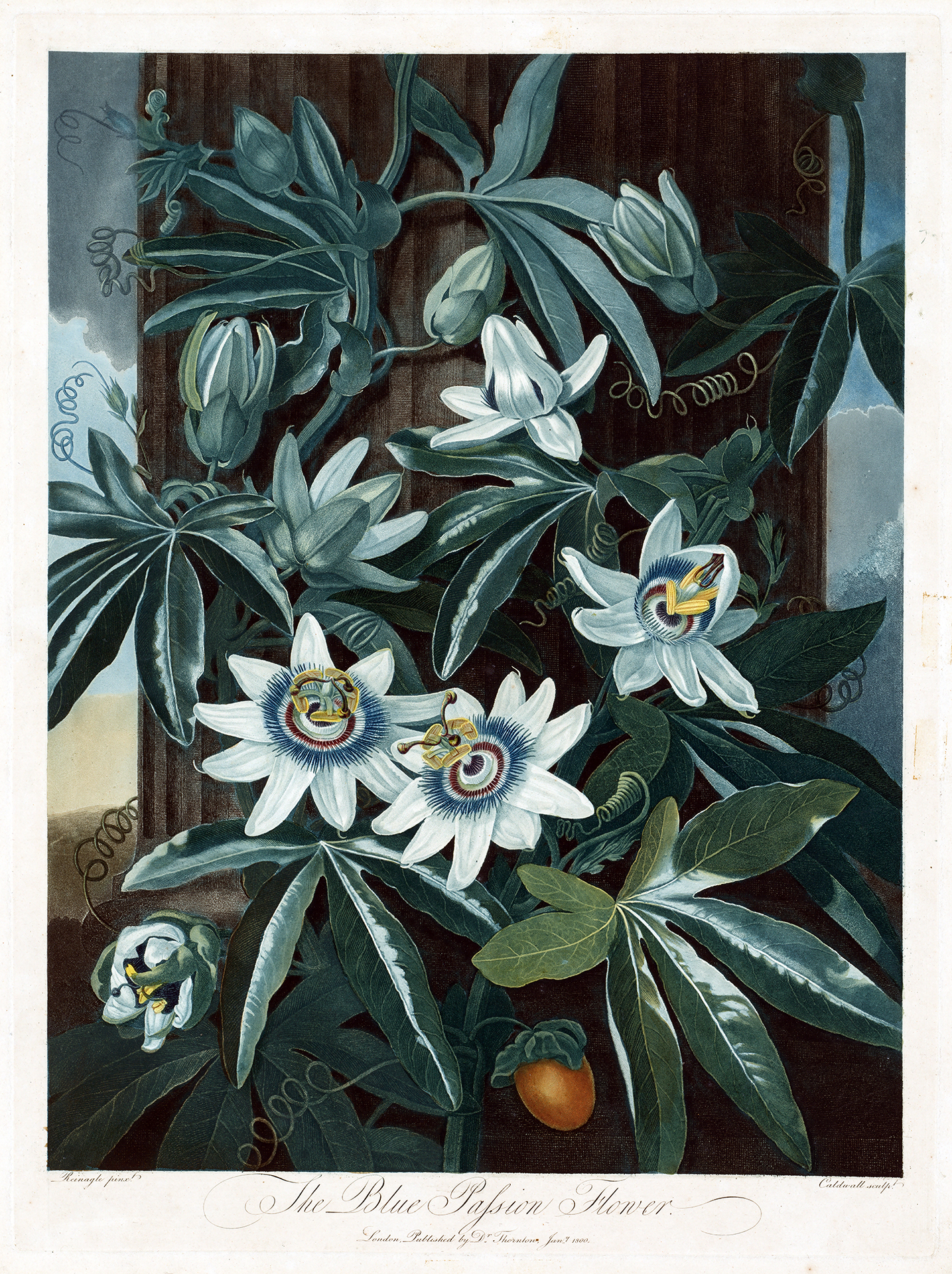
Recently Purchased: “Vintage Blue Passion-flower Print, 1799-1807” Zipper Pouch and More

ORDER TODAY

5793674946 copy-small.

Capture the intricate beauty of the natural world with this exquisite botanical illustration, “The Blue Passion Flower.” Originally published in 1800 by Dr. Thornton, this vintage print features a lush, climbing vine of passion flowers in various stages of bloom.

The artwork highlights the unique, complex anatomy of the blossoms—star-shaped white petals surrounding a dramatic, fringed corona of deep blue and purple. Set against a moody, dark background with detailed green foliage and delicate curling tendrils, this piece brings a touch of classic Enlightenment-era science and timeless elegance to any product. It is a perfect choice for lovers of vintage art, botany enthusiasts, or anyone who appreciates the intersection of science and fine art.

Also available on throw blankets, pillows, tops, tees, iPhone cases, and much more!

*Redbubble has discounts when purchasing multiple items and also gives 10%-20% discounts on a regular basis. Check back often!


See More Products On These Sites

DouglasEWelch.com/shop/follow | PixelFed | Bluesky | Mastodon | Threads

See my entire catalog

DouglasEWelch.com/shop/

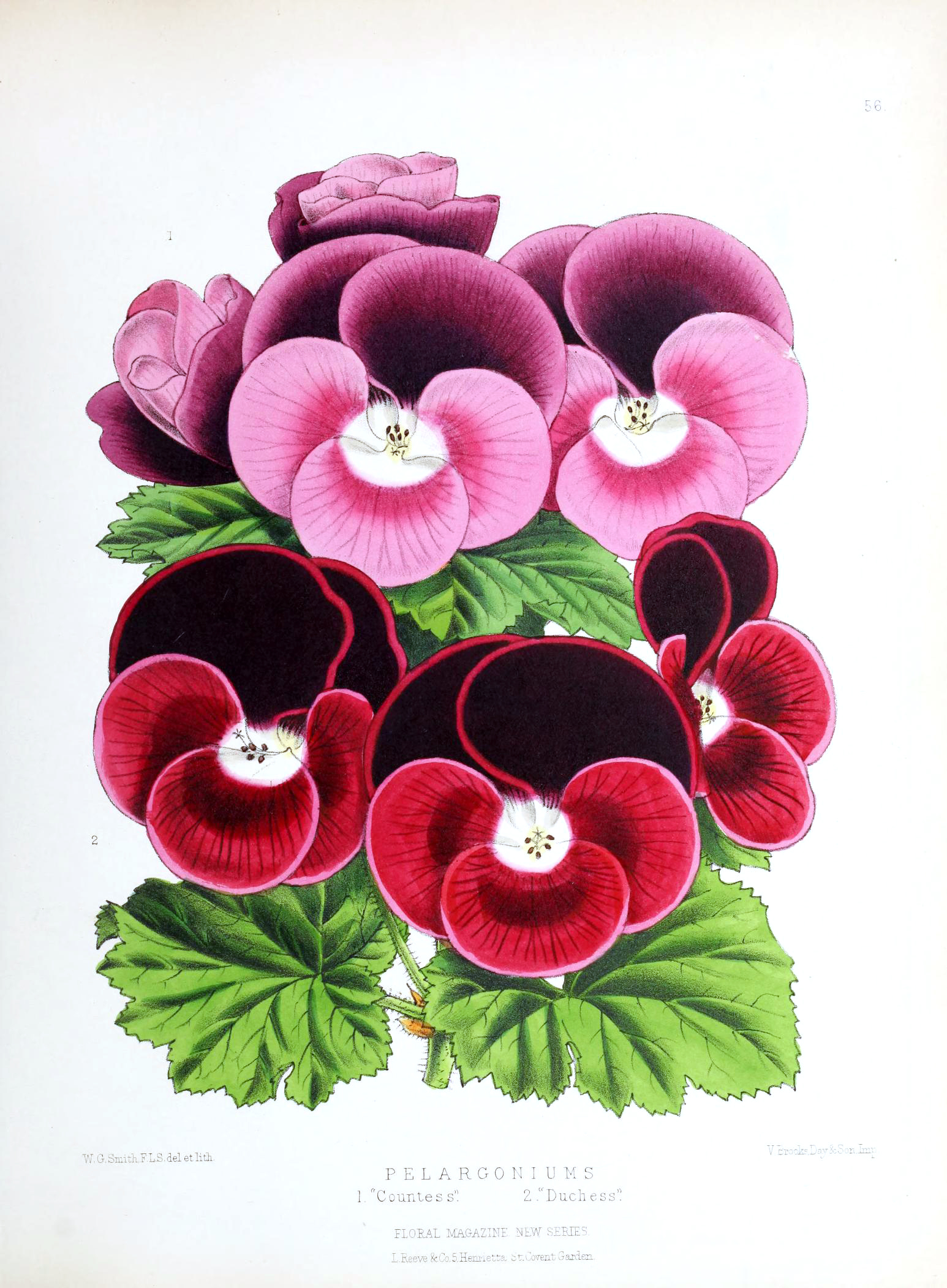
Vintage Botanical Prints – 53 in a series – Pelargoniums from The Biodiversity Heritage Library (1861)

 The image is a detailed botanical illustration of pelargonium flowers, specifically labeled as "Countess" and "Duchess." The illustration features a cluster of flowers with large, rounded petals in shades of pink and red, with darker centers and white centers with yellow stamens. The flowers are depicted with a high level of detail, showcasing the texture and veins of the petals. The leaves are green with serrated edges, adding to the naturalistic representation. The background is plain white, which highlights the vibrant colors of the flowers. At the bottom of the image, there is text that reads "PELARGONIUMS," followed by the names "Countess" and "Duchess," and additional text indicating the source as "FLORAL MAGAZINE NEW SERIES" and "L. Harvey & Sons, St. Helens, Surrey." The illustration is numbered "2" in the bottom left corner, and there is a small number "56" in the top right corner, suggesting it is part of a larger series.

Click for larger image

Plate 56.

SHOW PELARGONIUMS— COUNTESS AND DUCHESS.

If we may judge from the number of certificates which have been awarded to varieties of the Show Pelargonium during the past season, it must have been an exceptionally good one, for we find that no fewer than thirty were so honoured ; and although the name of Mr. Hoyle no longer appears as a raiser, it is evident that the improvement which has taken place in Mr. Foster’s strain will quite compensate for the loss sustained through Mr. Hoyle’s death, for all the varieties which have been awarded certificates came from Clewer Manor.

Of those now figured. Countess (fig. 1), is somewhat distinct in colour ; the pale pink of the lower petals being unusual ; the top is maroon, shaded off to deep orange rose, the edge pale lilac, and with a clear white eye, the whole appearance of the flower is remarkably bold. Duchess (fig. 2), affords a good contrast to the preceding, being a rich dark flower, lower petals crimson veined with a darker shade, the top petals intense deep maroon, almost black, with a narrow edge of bright crimson and clear white eye. Both have been awarded first-class certificates.

Mr. Turner of Slough has as usual the distribution of the Clewer seedlings ; and besides those figured there are. Brilliant, Blue Bell, Chieftain, Conquest, Druid, Emperor William, Flora, Great Mogul, Hero, Highland Lassie, Jubilee, King Charles, Lord Byron, Mabel, Monarch, Othello, Purple Gem, Prince of Wales, Prince Arthur, Buth, Bobin Hood, Superb, Syren, Scottish Chieftain, Victory, Charles Dickens, and Prince Bismarck, and certainly never in any one season has so promising a set been offered to the cultivator

Pelargoniums from The Biodiversity Heritage Library (1861)


Decorate Your Home and Office With This Print

Vintage Botanical Prints – 52 in a series – Tropæolaceæ: The Indian Cress, Or Nasturtium Tribe (1868) via Illustrations Of The Natural Orders Of Plants

The image is a detailed botanical illustration of a plant, likely a member of the genus Nasturtium. The illustration features a variety of flowers in different colors, including vibrant orange, yellow, and purple blooms, with green leaves and tendrils. The flowers are depicted in various stages of bloom, with some fully open and others still in bud form. The leaves are large and heart-shaped, with prominent veins, and the tendrils are shown winding around the plant.

At the bottom of the image, there are smaller illustrations labeled with letters and numbers, providing a detailed view of the plant's parts, such as the flower structure, seed, and leaf. The illustration is highly detailed, with fine lines and shading that give a realistic appearance to the plant's features. The background is plain white, which helps to highlight the intricate details of the plant.

Provided by @altbot, generated privately and locally using Ovis2-8B

Click for larger image

Key characteristics

Smooth herbaceous plants, of tender succulent nature, trailing or twining, have an acrid taste. The leaves are alternate, without stipules, stalked, sometimes shield-shaped. The flower-stalks grow from the base of the leaf-stalks, and bear each one flower; the prevailing colour is orange. The sepals of the calyx are from three to five, the upper one having a long spur, distinct or connected at the base, sometimes coloured, in the bud they are usually closed in a valvular form, or are very slightly folded over. The petals are from one to five, of equal or unequal size, convolute in the bud, sometimes partially undeveloped, as in Tropæolum umbellatum (3); the stamens are from six to ten, inserted into the calyx, distinct, the anthers are two-celled. The ovary is simple, three cornered, composed of three or five carpels. The style is simple, the stigmas three or five, acute; the three parts of the fruit separate from the common axis, sometimes they are winged; the seeds are large, filling the whole carpel, without albumen.

This Order has affinity with the Mallow tribe, and is connected by many resemblances with Geraniaceæ, but the spur of Pelargonium is united to the flower-stalk.

Tropæolaceæ: The Indian Cress, Or Nasturtium Tribe (1868) via Illustrations Of The Natural Orders Of Plants


Decorate Your Home And Office With This Print

Vintage Botanical Prints – 51 in a series – Seven plants, including three orchids and a gesneria: flowering stems and floral segments.(c. 1837)

Vintage Botanical Prints - 51 in a series -  Seven plants, including three orchids and a gesneria: flowering stems and floral segments.(c. 1837)

Click for larger image

Seven plants, including three orchids and a gesneria: flowering stems and floral segments.(c. 1837), Wellcome Collection

Publication/Creation [London], 1837.Physical description 1 print : etching, with watercolour
Lettering Botanical magazine 1837 novembre …Lettering note Lettering continues with latin names of the plants depicted
Reference Wellcome Library no. 27537iType/Technique
Language English Latin


Vintage Botanical Prints – 50 in a series – Late Tulips / Bybloemen or Violets, Cooper Hewitt Museum

CHSDM 099EF03769FA2 000001

Click for larger image

Late Tulips / Bybloemen or Violets, Cooper Hewitt Museum


Decorate you home and office with this print

Vintage Botanical Prints – 49 in a series – The Blue Passion-flower, 1799-1807, Robert John Thornton

Vintage Botanical Prints - 49 in a series -  The Blue Passion-flower, 1799-1807. Robert John Thornton

Click for larger image

The Blue Passion-flower, 1799-1807. Robert John Thornton (British, 1768-1837). Aquatint, stipple, line engraving, etching and roulette; The Cleveland Museum of Art, Gift of The Print Club of Cleveland, for the Donald Gray Memorial Collection 1939.293


Decorate your home and office with this print

Vintage Botanical Prints – 12 in a series – Passiflora kermesina print from The floral cabinet and magazine of exotic botany (1837)

Vintage Botanical Prints – 12 in a series – Passiflora kermesina print from The floral cabinet and magazine of exotic botany (1837)

Buy this print

FloralcabinetmaIKnow 0040

Click for larger Image

from The floral cabinet and magazine of exotic botany (1837) via The Internet Archive

A slender climbing shrub, with a smooth round dark-green stem. The leaves are shining, of a dark-green colour on their upper surface, and a pale purplish- red beneath, the lobes serrulated at the base, and the serratures furnished with shortly stipitate glands ; the petioles round, with two small stipitate glands near the middle ; the stipules foliaceous, semi-cordate, somewhat tendrilled at the apex, and occasionally toothed towards the base. The peduncles are slender, axillary,’ and, like the rest of the genus, have an evident articulation beneath the flower. The calyx is crimson, the divisions of which are linear-oblong, obtuse. The petals in form and colour resemble the sepals, but are somewhat larger. The corona consists of a series of filamentous rays, the exterior of which are tipped with white. These elegant appendages of the flower are somewhat ambiguous in their nature : they have been considered by some as abortive stamens ; while Dr. Lindley is disposed to regard them as a peculiar modification of petals.

FloralcabinetmaIKnow 0011


Buy copies of this print and more!

Gbra 5x7 900x900 2Ur coaster pack 4 flatlay square 1000x1000 2 2Icr iphone 11 tough back a x1000 pad 1000x1000 f8f8f8 3Ssrco classic tee two models fafafa ca443f4786 front square three quarter 1000x1000 6

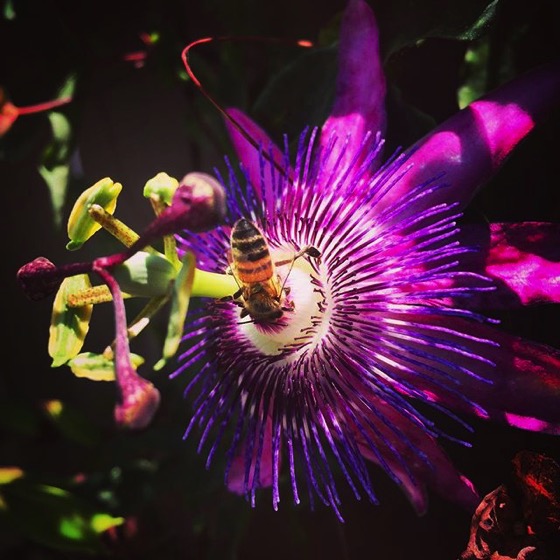
Bee on Passionflower (Passiflora) via My Instagram

Bee on Passionflower (Passiflora) via My Instagram

Bee on Passionflower (Passiflora)

Spotted on a walk through the neighborhood. 

Join the Gardener’s Notebook Mailing List

Instagram and Follow

Learn more about passionflowers with this book

* A portion of each sale from Amazon.com directly supports our blogs
** Many of these books may be available from your local library. Check it out!
† Available from the LA Public Library