Tag Archives: opuntia

Prickley Pear (Opuntia) Fruit Beginning to Ripen in the Garden This Week

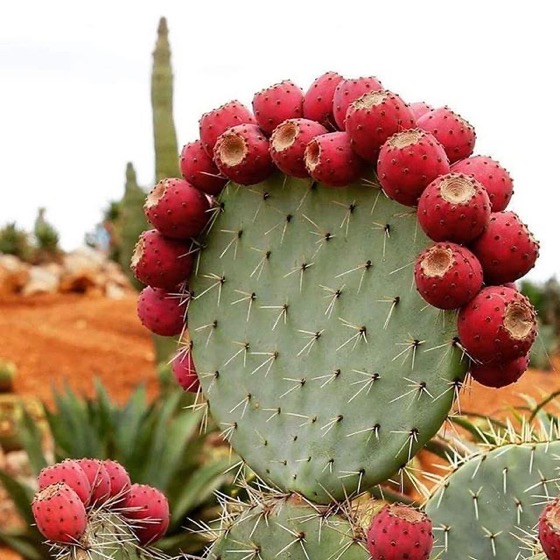
As summer winds down, the prickly pear cactus (Opuntia) is starting to ripen its fruit. I have 5 large cacti in the front and back garden and they have reached maturity, so our harvest of fruit has been growing each year. Today, I spotted over 40 fruits at various stages of ripening. I am guessing they will all be ready for harvest once I return from a 2 week trip to Australia in September. 

Prickley Pear (Opuntia) Fruit Beginning to RIpen in the Garden This Week

Prickly pear fruit currently ripening

Last year, I turned the fruit into prickly pear syrup for my pancakes and more. This year, with a larger harvest, I am thinking of making freezer jam. I really don’t have the wherewithal to go the full route of canning the jam, but figured this might be a good option to preserve the fruit and provide us a tasty treat for the next year.

Preparing the fruit looks like it might be fraught with many cactus spines and such, but I found my leather gardening gloves provided enough protection as I skinned each fruit. Once skinned, I processed them through a makeshift food mill (i.e., a sieve) and captured the results. This was fairly slow and a lot of work, so I think I am going to borrow a friend’s food mill this year to make it go faster. The large seeds in the fruit make it necessary to process them into something more palatable. Once that is done, it is a small bit of cooking on the stove to thicken the resulting fruit into jam.

Prickly pear harvest 2.

Prepping last year’s fruit

Prickly pear harvest 1.

Last year’s harvest

I had never thought about eating prickly pear, even though I saw a lot of it here in the San Fernando Valley. Then, on a summer visit to family in Sicily, I attended a conference on cherries and prickly pear (figo d’India, in Italian), two major agricultural products of the island.  There I tasted the fruit, including the seeds, juice, and even a prickly pear granita. That immediately made me think about harvesting my own fruit. 

I had originally planted the cactus, started from a few harvested paddles from a neighbor, to add some vertical elements ot the garden, so the fruit is just an added benefit.

Prickly pear 2.

Transplanted prickly pear after I rooted it in a pot for about a year.

Prickly pear 2025 01.

The same plant today (and this had been pruned at least once)

In the garden: Prickly Pear (Opuntia) Harvest

Optunia flowers.

I have waited several years for my opuntia or prickly pear to bear fruit. They need to be of a certain age and size to do so and it looks like this season was that time. We didn’t get many – and some were purloined by a neighbor, I think – but these 9 made for a nice collection.

Prickly pear harvest 1.

You must be careful when gathering and skinning the “pears” as they are covered with spines and almost invisible glochids or tiny, almost hair-like, spines that hurt like the dickens if you get them in your skin.

Prickly pear harvest 2.

Thankfully I didn’t have any issues with this. I wore a garden glove to protect one hand and then sliced off the root end. One slice along the fruit then allowed the skin to roll off the fruit.

We have tasted prickly pear fruit when visiting family in Sicily, so I had a basic idea of what it would taste like. In Sicily, fico d’India is a protected agricultural product and you see fields of it all over the east side of the island. 

“Some varieties are recognized as “excellencies of the territory” by the Sicilian Region and two of them – the San Cono and the Etna variety – are actually enlisted as PDO (Protected Designation of Origin) products.” – Putia 

My fruits were quite fruity and tasty , and I sampled a few right out of the skin. Prickly pear tends to be quite seedy, though, so most are processed through a food mill and turned into a sauce or syrup. When done, mine was probably more sauce-like, as I left in a lot of the pulp after straining for seeds. I added only a bit of sugar as I reduced the juice as it was plenty sweet already. 

Prickly pear sauce.

While I plan on using the sauce over pancakes and, perhaps, ice cream, I also made a prickly pear cocktail.

Prickly Pear Spritzer

Mix together…

1 oz vodka
1 oz prickly pear sauce/syrup

Splash of soda water to add some fizz

You could change the quantity of either ingredient depending on it you wanted a stronger or sweeter cocktail.

The taste of the prickly pear has a slight herbal quality which makes it very refreshing. I could see sipping this cocktail on a summer evening.

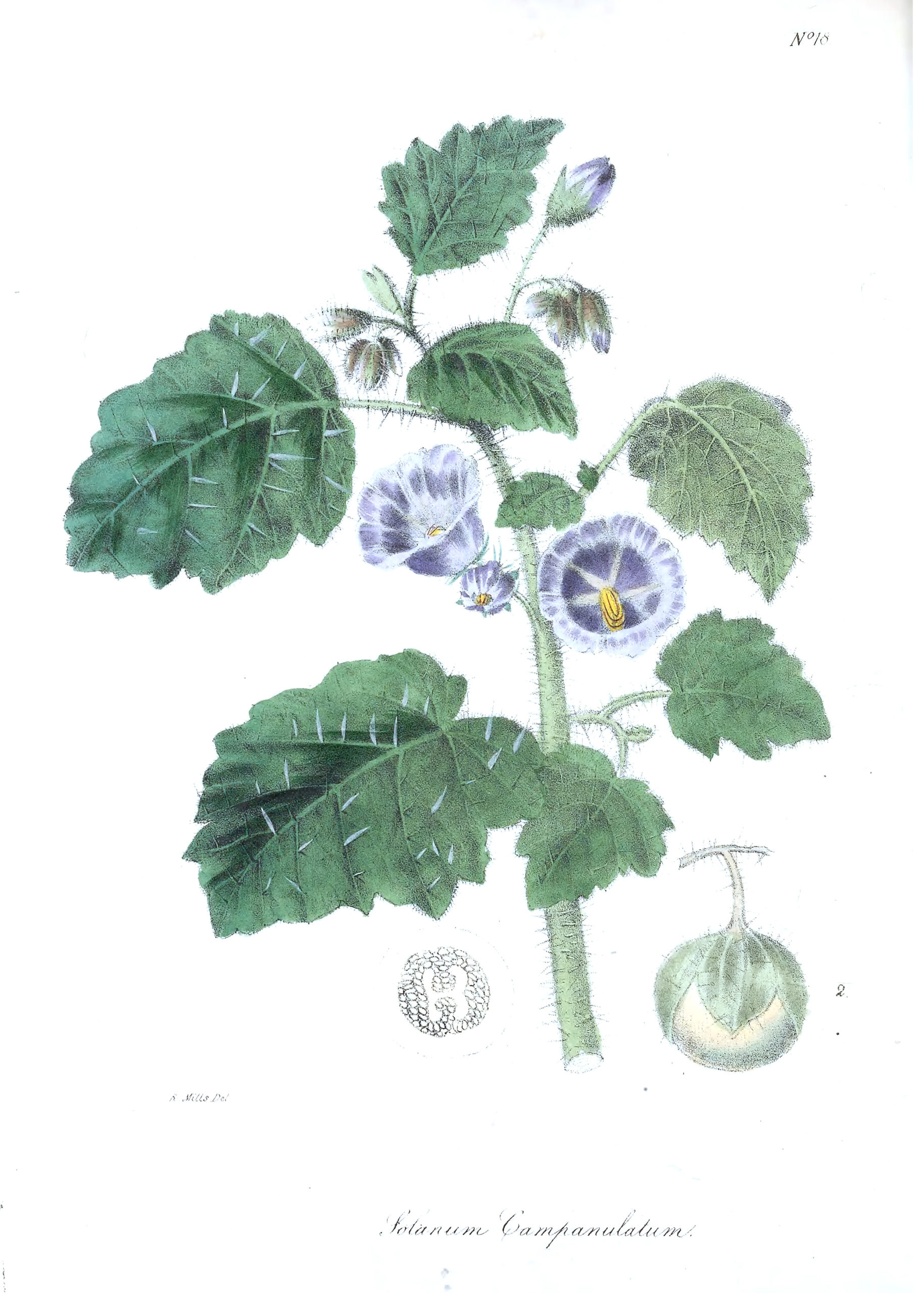
Vintage Botanical Print – 80 in a series – Solanum campanulatum from The floral cabinet and magazine of exotic botany (1837)

Vintage Botanical Print - 80 in a series - Solanum campanulatum from The floral cabinet and magazine of exotic botany (1837)

Click for larger image


This very distinct and showy species of Solanum, with a bell-shaped corolla (an unusual form for a Solanum), will doubtless form an interesting addition to those at present in cultivation. It grows about 2^ feet high (such at least was the height of the plant from which our drawing was taken), and is covered on all sides with sharp setaceous prickles, the greater portion of which are confined to the stem and the calyx. We are doubtful whether this plant be the same which Dr. Brown has described in his Prodromus, and on that account we have not altered the specific name ” campanulatum;”” we should however rather expect it to be different, as he has described the stem of his plant ” caule herbaceo,” and states it to be an annual, whilst ours is certainly suffruticose.

Purchase copies of this prints

Fp 840x830 black off white box20 s f8f8f8 pad 1000x1000 f8f8f8 2 Ssrco classic tee two models fafafa ca443f4786 front square three quarter 1000x1000 Gbra 5x7 900x900


Vintage Botanical Print – 79 in a series – Opuntia vulgaris from Familie Der Cacteen (1893-1905)

The image depicts a botanical illustration of a cactus plant, specifically an Opuntia vulgaris, also known as the common prickly pear. The illustration is detailed and realistic, showcasing the plants green, flat, paddle-shaped pads, which are covered with small red spots and tiny spines. Two bright yellow flowers with multiple petals are prominently displayed, adding a vibrant contrast to the green pads. The cactus is potted in a simple, brown container, and the background is a plain, off-white color, emphasizing the plant. The illustration includes text at the bottom left corner, reading Cactaceae, and at the bottom right, Opuntia vulgaris. Basel. Botan. Garten, 6. Juli 1895, indicating the plants family, species, and the date and location of the illustration.

Provided by @altbot, generated privately and locally using Ovis2-8B

Click for larger image

Purchase copies of these prints