Find more of my photos on Instagram | Flickr | PixelFed
More from my Instagram Feed
How to Make a Mason Bee House for Your Garden
Gardeners know that having bees around is a big help in the garden. Some gardeners even turn to urban beekeeping to attract some industrious pollinators to the yard (and reap the reward: honey). If you’re not quite ready for full-on beekeeping, you can still get in on the game by attracting solitary bees with a mason bee house, which gives mason bees a place to reproduce. These species are usually indigenous, as they aren’t cultivated for their honey production and can still be industrious pollinators.
Why Native Plants Gardening is The Best – Guide to The Next Big Gardening Trend
Planting a tree and seeing it grow and thrive is one of the most long-lasting and fulfilling gardening experiences. I feel that way about the gingko in our front yard, but when it comes to wildlife value, a gingko is almost like having a plastic tree in your yard—it has zero value to the little critters that make nature work. A gingko attracts no caterpillars at all (which are essential for birds to raise their young), but a native oak, on the other hand, supports more than 550 species of caterpillars. According to Doug Tallamy, a professor of entomology and wildlife ecology at the University of Delaware and a leading voice in the movement to plant more natives, a single pair of chickadees needs 6,000 to 9,000 caterpillars to feed one clutch of young.
Read Why Native Plants Gardening is The Best – Guide to The Next Big Gardening Trend
More on Native Plants
CNPS Garden Q&A with Lili Singer, Director of Special Projects and Adult Education at the Theodore Payne Foundation:
What’s your advice for creating year-round color in my California native garden?The California Flora is vast and offers myriad choices, making it fun and easy to establish year-round color. The first step is to asses your site’s climate, soil, sunlight, and space. Next, you can mix and match plants that will thrive in those conditions.
Read Garden Q&A – Year-round color in a California native garden via California Native Plant Society
* A portion of each sale from Amazon.com directly supports our blogs
** Many of these books may be available from your local library. Check it out!
† Available from the LA Public Library
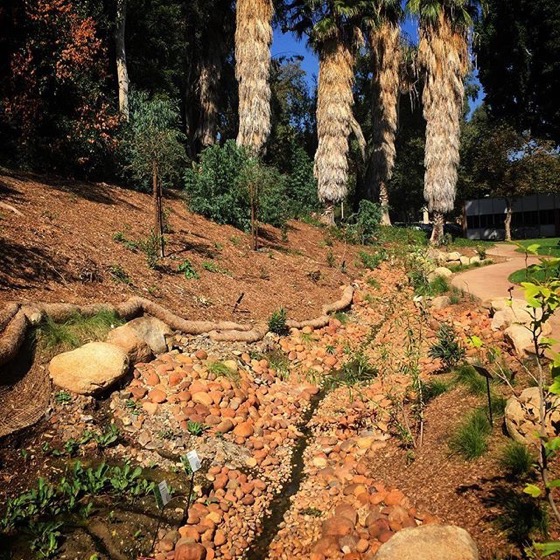
Do you have an existing water feature you can highlight instead of just deal with? See how Cal Poly Pomona addressed their own natural spring! — Douglas
New drought-tolerant native garden with swale at Cal Poly Pomona
A new installation behind the Communications building includes seating and solar powered USB outlets.
For years, most people at Cal Poly Pomona had no idea the campus was home to a natural spring behind Building 1. But California’s record drought in 2011 got biology Professors Tina Hartney and Ed Bobich thinking about a campus water initiative.
“At a time when we were concerned about water, it was no small bit of irony that we had a natural source of water coming out of this spring — water that had sustained people and animals for years that was now going into a drain,” Bobich said.
Find out more about Project Blue creek
Scan this name tag to add me on Instagram
How do I scan a nametag?
To scan a nametag using the Instagram app camera:
To scan a nametag from your profile:
Don’t miss a single post!
Sign up for the Gardener’s Notebook Mailing List
Learn more about drought tolerant gardens with these books
†††
* A portion of each sale from Amazon.com directly supports our blogs
** Many of these books may be available from your local library. Check it out!
† Available from the LA Public Library