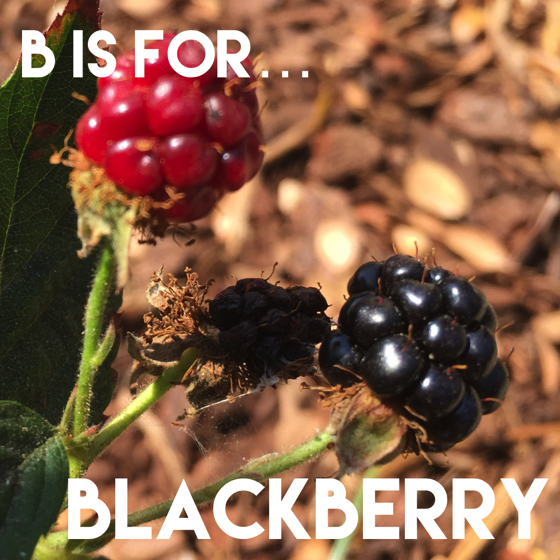
A look at our young blackberry plant which is spinning off a few fruit even in its first year of being planted. This blackberry fruits on each year’s canes, so these canes will be removed and the new growth will fruit next year.
The blackberry is an edible fruit produced by many species in the Rubus genus in the Rosaceae family, hybrids among these species within the Rubus subgenus, and hybrids between the Rubus and Idaeobatus subgenera. The taxonomy of the blackberries has historically been confused because of hybridization and apomixis, so that species have often been grouped together and called species aggregates. For example, the entire subgenus Rubus has been called the Rubus fruticosus aggregate, although the species R. fruticosus is considered a synonym of R. plicatus.[1]
What distinguishes the blackberry from its raspberry relatives is whether or not the torus (receptacle or stem) “picks with” (i.e., stays with) the fruit. When one picks a blackberry fruit, the torus does stay with the fruit. With a raspberry, the torus remains on the plant, leaving a hollow core in the raspberry fruit.
The term bramble, a word meaning any impenetrable thicket, has traditionally been applied specifically to the blackberry or its products,[2] though in the United States it applies to all members of the Rubus genus. In the western US, the term caneberry is used to refer to blackberries and raspberries as a group rather than the term bramble.
The usually black fruit is not a berry in the botanical sense of the word. Botanically it is termed an aggregate fruit, composed of small drupelets. It is a widespread and well-known group of over 375 species, many of which are closely related apomictic microspecies native throughout Europe, northwestern Africa, temperate western and central Asia and North and South America.[3]
Monrovia Black Satin Blackberry in my garden today.
The blackberry is an edible fruit produced by many species in the Rubus genus in the Rosaceae family, hybrids among these species within the Rubus subgenus, and hybrids between the Rubus and Idaeobatus subgenera. The taxonomy of the blackberries has historically been confused because of hybridization and apomixis, so that species have often been grouped together and called species aggregates. For example, the entire subgenus Rubus has been called the Rubus fruticosus aggregate, although the species R. fruticosus is considered a synonym of R. plicatus.[1]
What distinguishes the blackberry from its raspberry relatives is whether or not the torus (receptacle or stem) “picks with” (i.e., stays with) the fruit. When one picks a blackberry fruit, the torus does stay with the fruit. With a raspberry, the torus remains on the plant, leaving a hollow core in the raspberry fruit.
The term bramble, a word meaning any impenetrable thicket, has traditionally been applied specifically to the blackberry or its products,[2] though in the United States it applies to all members of the Rubus genus. In the western US, the term caneberry is used to refer to blackberries and raspberries as a group rather than the term bramble.
The usually black fruit is not a berry in the botanical sense of the word. Botanically it is termed an aggregate fruit, composed of small drupelets. It is a widespread and well-known group of over 375 species, many of which are closely related apomictic microspecies native throughout Europe, northwestern Africa, temperate western and central Asia and North and South America.[3]
* Selected design printed on both sides * 1 inch wide super strong cotton shoulder strap (14 inch length) * Soft yet hard wearing 100% spun Polyester Poplin fabric * Dry or Spot Clean Only
I see so many bad hedging choices made here in Los Angeles, so when our new neighbors wanted to plant a hedge, I found this article on non-traditions and perhaps better choices. — Douglas
Ficus Nitida and Ficus Benjamina are not the solution.
Whenever a client asks about installing a hedge they’re usually thinking of planting a row using Ficus Nitida (Retusa) or Benjamina. They have been Southern California’s “go to” trees for privacy hedges for decades, but there are a number of reasons to pass them by. They can be very invasive and their roots grow close to the surface, damaging sidewalks. While they grow fast, they need frequent trimming and are not drought-toelerant. They require a substantial amount of water to establish and a moderate amount once established.
What follows is information on seven excellent hedges provided by the North Park Nursery. If you’re thinking about adding a hedge and are concerned about how it will behave and how much water it will consume, here is valuable information about the best plant material for the job.